A DOT roadside inspection is a check of a commercial truck and its driver by a certified officer, at a weigh station or on the roadside. In Maryland, most are done by the Maryland State Police Commercial Vehicle Enforcement Division, and two out of three are Level II walk-around inspections.
Key takeaways
- Maryland logged 73,090 inspections from November 2025 through October 2026, by our count of FMCSA data.
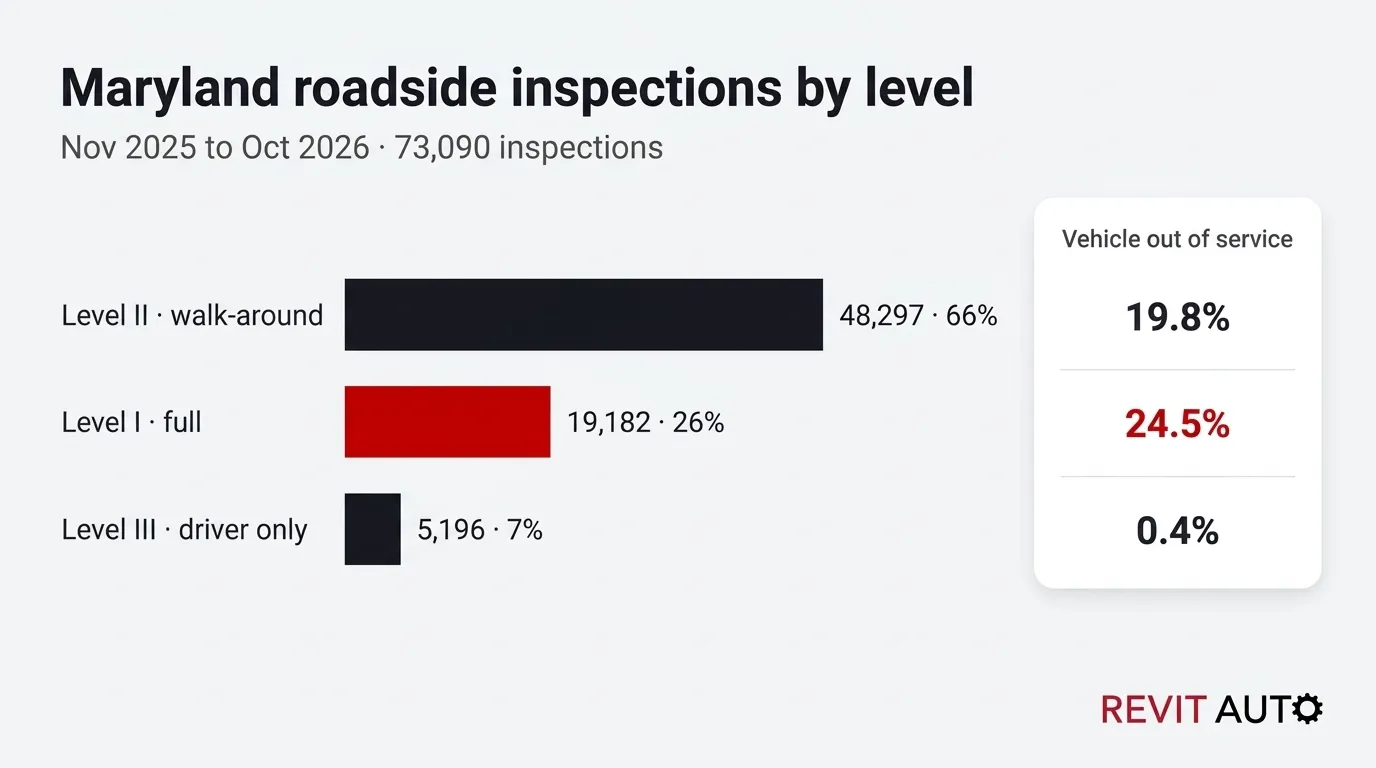
- 66% were Level II walk-arounds, 26% were full Level I inspections and 7% were Level III driver-only checks.
- About 1 in 4 trucks given a Level I inspection was put out of service for a vehicle problem.
- Almost half of all inspections, 47%, found no violations at all.
- A typical Level I took about 33 minutes, and a walk-around about 25.
- Only a Level I or Level V inspection with no critical violations earns a CVSA decal.
Picture a box truck heading north on I-270 toward the Hyattstown scale, not far from our shop in Damascus. The scale sign is lit, the driver pulls in, and an officer waves the truck to the inspection bay.
What happens next depends on the level of inspection, and on what the truck looked like before it left the yard. A lot of what an officer finds, a driver could have caught that morning.
What happens at a DOT roadside inspection?
An officer picks a truck at random, from a screening system, or because something stands out. Think a light out or a load that looks off. The driver hands over their license, medical card and logs, and the officer checks the truck.
What gets checked depends on the level, and so does the time. In Maryland, a typical Level I took about 33 minutes. A Level II took about 25 and a Level III about 22, based on officers’ recorded times. The officer then gives the driver a report. It lists any violations and says whether the driver or the truck is out of service.
Every inspection, clean or not, goes to the carrier’s FMCSA record. Clean ones count too. They help balance out the bad ones in your CSA scores.
The CVSA inspection levels
Roadside inspections in Maryland follow the Commercial Vehicle Safety Alliance (CVSA) North American Standard. There are eight levels. Fleets mostly see the first three.
| Level | What it is | What gets checked |
|---|---|---|
| I | Full inspection | The driver’s paperwork and the whole truck, including underneath: brakes, steering, suspension, frame and more |
| II | Walk-around | The driver’s paperwork, plus everything on the truck that can be checked without going underneath |
| III | Driver only | License, medical card, hours of service and other driver records |
| IV | Special | A one-time check of one item, usually for a study |
| V | Vehicle only | A Level I check of the truck without the driver there, often at the carrier’s yard |
| VI | Radioactive loads | An enhanced Level I for certain radioactive shipments |
| VII | State-required | A check set by the state, outside the standard levels |
| VIII | Electronic | Data sent from the truck wirelessly, without an officer stopping it |
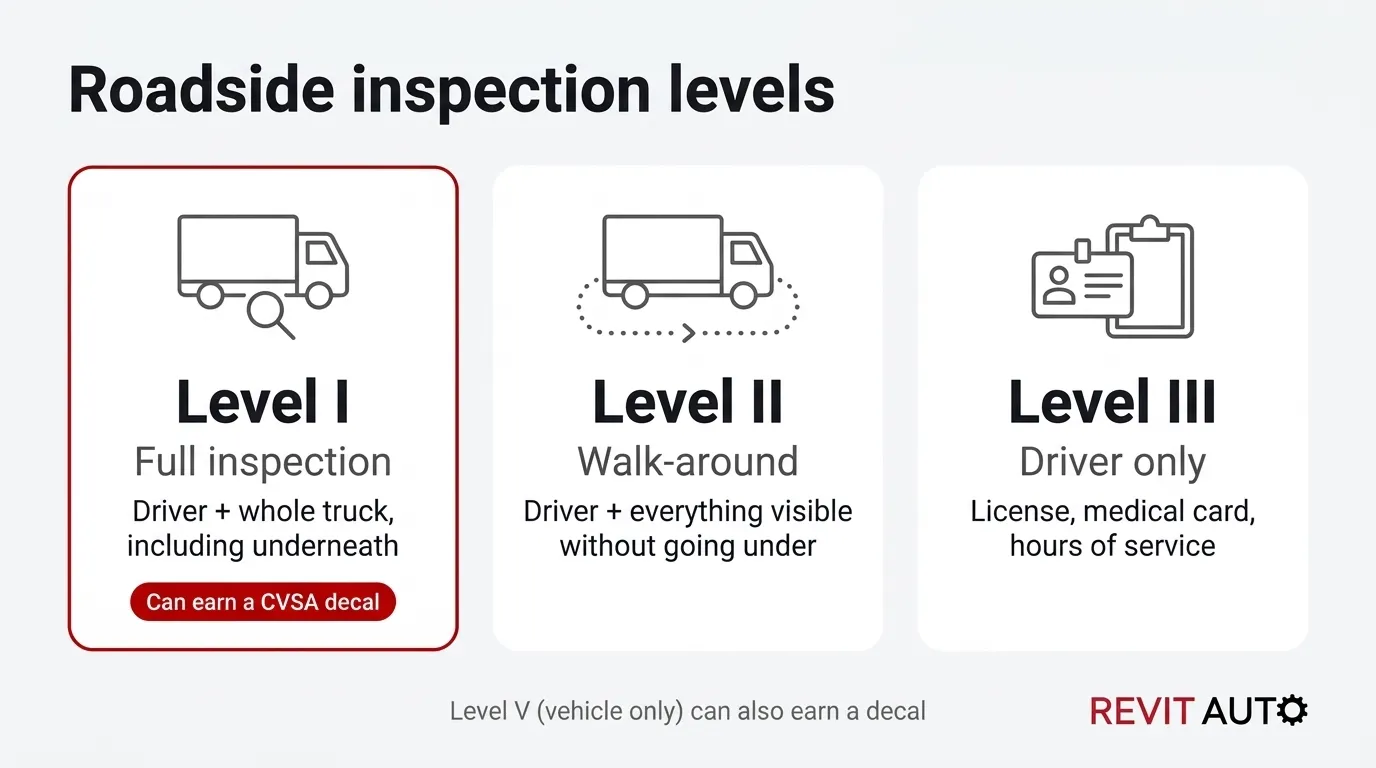
A truck that passes a Level I or Level V inspection with no critical violations can get a CVSA decal. It’s good for up to 3 months. A valid decal shows officers the truck passed a full inspection recently.
What the Maryland numbers show
We pulled every Maryland roadside inspection in the FMCSA inspection data from November 2025 through October 2026. There were 73,090 as of November 3, 2026, and recent weeks may still be filling in.
| Level | Inspections | Share | Vehicle out of service | Driver out of service |
|---|---|---|---|---|
| I, full | 19,182 | 26% | 24.5% | 7.9% |
| II, walk-around | 48,297 | 66% | 19.8% | 9.3% |
| III, driver only | 5,196 | 7% | 0.4% | 6.8% |
Here’s what I take from the numbers:
- Level II is the normal stop. Two out of three Maryland inspections were walk-arounds. Lights, tires, air leaks and anything loose or leaking get seen in a walk-around.
- A full inspection finds more. Almost 1 in 4 trucks given a Level I was put out of service for a vehicle problem. That’s what an officer finds when they go underneath.
- Clean inspections are common. 34,192 inspections, about 47%, found no violations at all.
Nationally, brakes are the usual problem. In CVSA’s 2026 International Roadcheck, brake systems were again the top reason trucks were put out of service.
Where Maryland inspects trucks
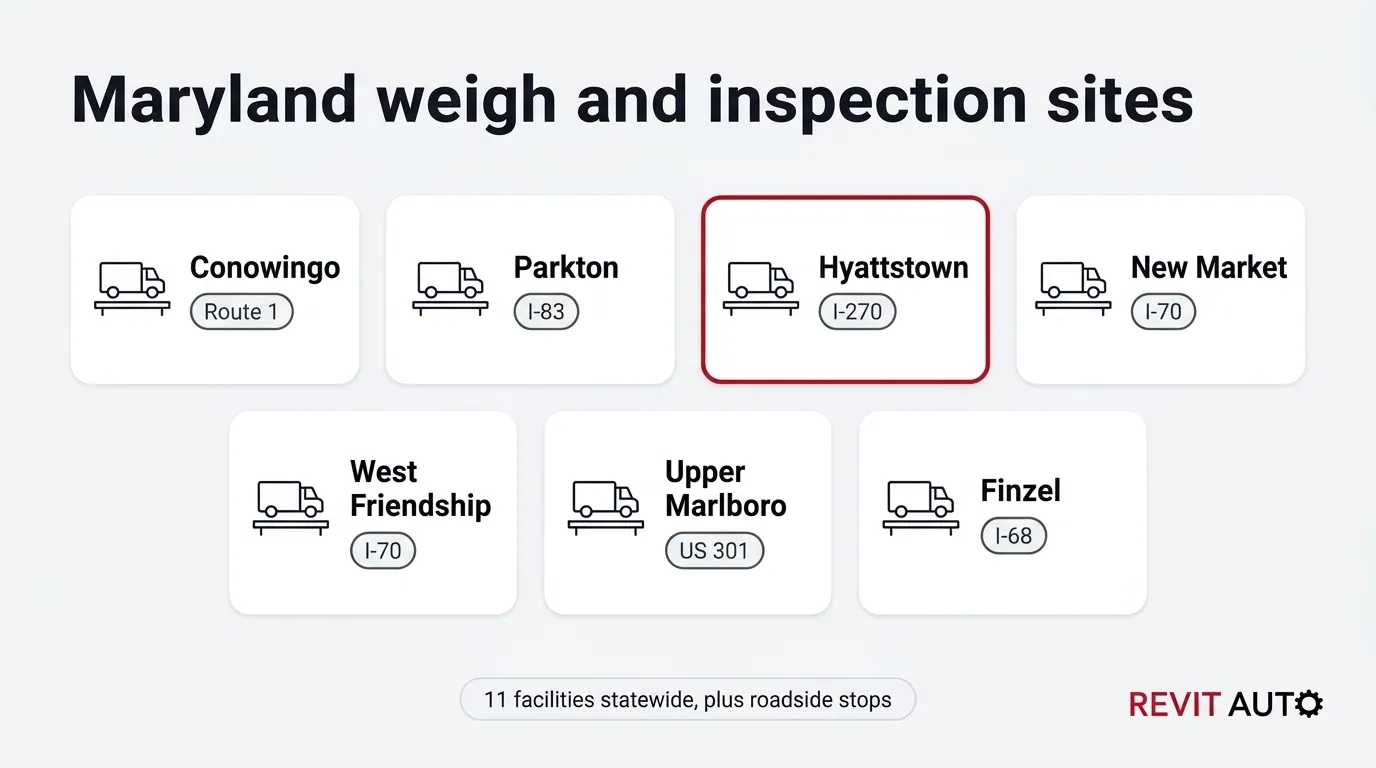
The Maryland State Police Commercial Vehicle Enforcement Division runs the state’s weigh and inspection program. It says it operates 11 weigh and inspection facilities, including:
- Conowingo on Route 1
- Parkton on I-83
- Hyattstown on I-270
- New Market and West Friendship on I-70
- Upper Marlboro on US 301
- Finzel on I-68
Inspections also happen away from the scales. Officers can pull a truck over on the roadside.
Maryland takes part in Drivewyze PreClear. A truck with a good safety record may get a signal to bypass an open station. A bad record means more trips into the bay.
If your truck is put out of service
An out-of-service order means the truck or driver can’t move until the problem is fixed. Under the CVSA out-of-service criteria, that covers things like brakes out of adjustment, flat or badly worn tires, and serious air leaks.
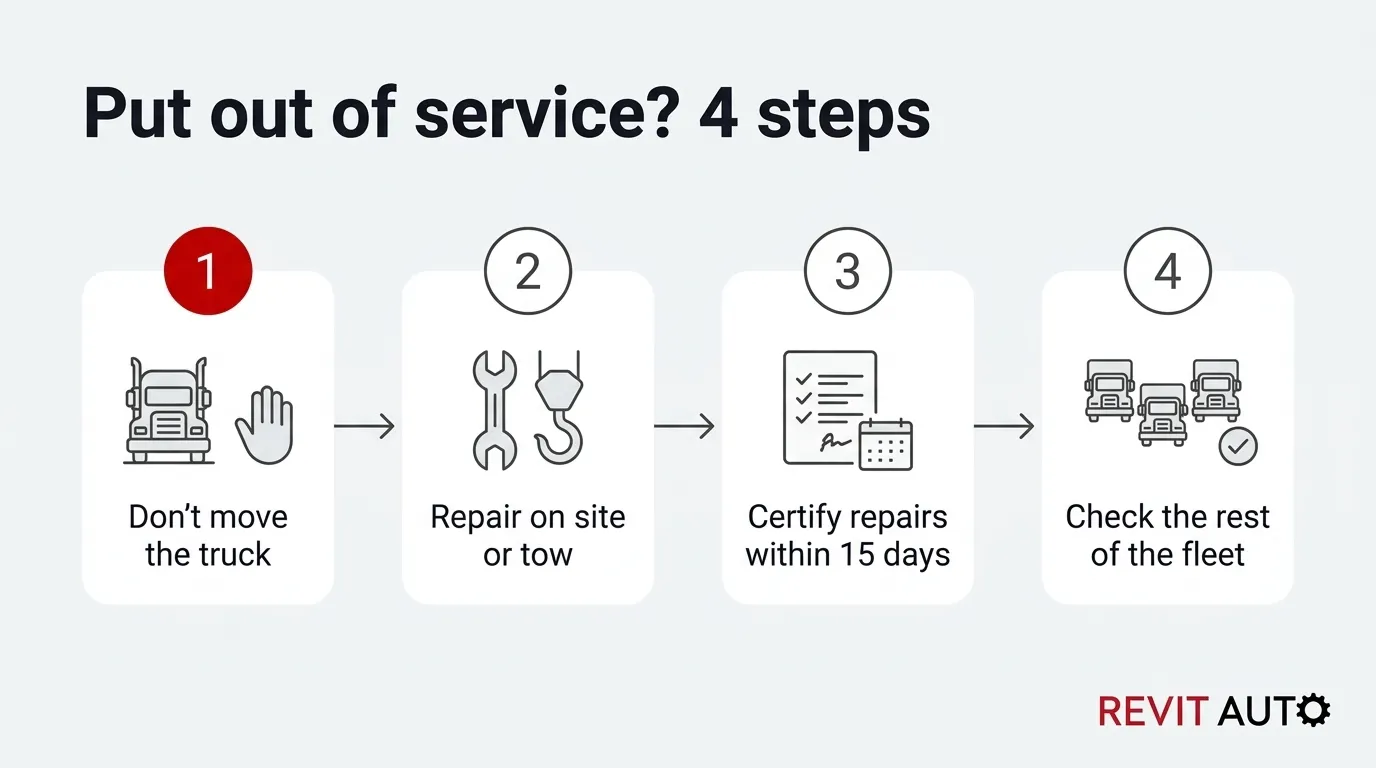
Here’s what to do:
- Don’t move the truck. Driving on an out-of-service order is its own violation.
- Fix it where it sits, or tow it. Some repairs can be done at the station. Others need a mechanic to come out.
- Sign and return the report. The carrier has to certify that the violations were fixed, under 49 CFR 396.9, within 15 days.
- Fix the cause, not just the part. If a brake was out of adjustment, check the rest of the fleet.
Out-of-service orders also hit your scores. They feed into the FMCSA’s CSA system, which we cover in our CSA Vehicle Maintenance BASIC guide.
How to get your trucks ready
Most of what gets a truck written up can be found in your own yard first.
- Run real pre-trips. A daily DVIR catches lights, tires and air leaks before they leave the yard.
- Check brakes at every PM. Brake problems were the top out-of-service reason in CVSA’s 2026 Roadcheck, and adjustment is easy to check.
- Keep paperwork in the cab. License, medical card, registration, the last annual inspection and, for Maryland trucks, proof of the last PM inspection under COMAR 11.22.01.05.
- Keep logs clean. Hours of service violations put drivers out of service even when the truck is fine. Our Hours of Service and ELD guide covers the rules.
- Do a Level I yourself. Our annual DOT inspection checklist covers the same parts an officer checks.
On our quarterly inspections, I drain both air tanks and check for water. Water in the tanks means the air dryer needs service before it turns into a brake problem.
I also check that the slack adjusters are greased and moving, look for cracked leaf springs, and make sure the brake chambers have their covers. Those are the same parts an officer checks on a Level I.
Free download: DOT inspection checklist
A printable checklist of what a Level I inspection covers, with what passing looks like for each item.
What fleet managers say
Getting a truck fixed and back on the road fast matters most after a bad inspection. One customer put it this way:
“Extremely good customer service, you are kept updated on every step. Also very easy to work with and the owner, Blair is very knowledgeable and goes above and beyond to make sure that you trucks are fixed and back on the road as soon as possible. Highly recommend.”
Heron Bailey · ★★★★★ Read the review on Google
Revit Auto is rated 5.0 from 120 reviews on Google, as of November 2026.
Pass your next roadside inspection
We do onsite DOT inspections and mobile fleet maintenance at your yard across Maryland, DC and Northern Virginia.
We check every truck the way an officer would, fix what we find, and leave you the records.
Free Maryland fleet compliance resources
| Resource | What it helps you do |
|---|---|
| DOT inspection checklist (download) | Check a truck the way an officer will |
| DVIR form template (download) | Give drivers a daily report to fill in |
| Annual DOT inspection checklist (guide) | See the federal pass/fail specs |
| Maryland PM Program (guide) | Keep Maryland trucks on their PM interval |
Frequently asked questions
What is a DOT roadside inspection?
It’s a check of a commercial truck and its driver by a certified officer, at a weigh station or on the roadside. In Maryland, most are done by the State Police Commercial Vehicle Enforcement Division.
How long does a DOT roadside inspection take?
In Maryland, a typical Level I took about 33 minutes from November 2025 through October 2026. A Level II took about 25 and a Level III about 22. Those are medians from the start and end times in FMCSA data. A truck with problems takes longer.
What is the most common inspection level in Maryland?
Level II, the walk-around. It made up 66% of Maryland roadside inspections from November 2025 through October 2026, by our count of FMCSA data.
What is a Level 1 DOT inspection?
The full North American Standard inspection. The officer checks the driver’s paperwork and the whole truck, including underneath. In Maryland, about 1 in 4 trucks given one was put out of service.
Do I get a sticker for passing?
Only for a Level I or Level V inspection with no critical violations. The CVSA decal is good for up to 3 months.
What happens if my truck is put out of service?
It can’t move until the problem is fixed, either on the spot or by tow. The carrier then certifies the repairs on the report within 15 days.
Do clean inspections help my record?
Yes. Every inspection goes on the carrier’s FMCSA record, and clean ones help offset violations.
Can Revit Auto inspect my trucks before the state does?
Yes. We do DOT inspections at your yard across Maryland, DC and Northern Virginia, and fix what we find on the spot when we can.
Explore more compliance guides
This guide explains Maryland and federal rules for general information. It isn’t legal advice. Confirm current requirements with FMCSA, MDOT MVA or the Maryland State Police before acting on them.
Sources
- FMCSA vehicle inspection file, Maryland, Nov 2025 to Oct 2026 (U.S. DOT open data, our analysis)
- CVSA inspection levels (CVSA)
- CVSA inspection decals (CVSA)
- CVSA out-of-service criteria (CVSA)
- CVSA 2026 International Roadcheck results (CVSA)
- Maryland State Police Commercial Vehicle Enforcement Division (MSP)
- 49 CFR 396.9, inspection of motor vehicles in operation (Cornell LII)