
The Maryland PM Program is the state’s preventive maintenance rule for commercial vehicles registered in Maryland. Most covered trucks must be inspected every 12 months or 25,000 miles, whichever comes first. Newer tractors, zero-emission trucks and older dump trucks run on different intervals.
Key takeaways
- Maryland ties inspections to miles as well as months, so a busy truck can come due long before its 12-month date.
- Most covered vehicles are due every 25,000 miles or 12 months, whichever comes first.
- Tractors 5 years old or newer get 35,000 miles, and zero-emission or fuel-cell trucks 5 years old or newer get 50,000 miles.
- Dump service trucks 18 years old or more are due every 12,500 miles or 6 months.
- You must keep 2 years of PM records where the truck is based, and carry proof of the last inspection on the vehicle.
Picture a 26,000 lb Maryland box truck on local routes. It passed its inspection in March, so the owner figures it’s good until next March.
By September it has rolled 25,000 miles since that inspection. On paper it looks fine, but under Maryland law it’s already due.
A Maryland fleet deals with three kinds of inspection. There’s emissions testing for gas vehicles with an OBD2 port, the Maryland State Inspection when you first buy the vehicle, and the annual DOT inspection.
The PM Program sits on top of those. It’s the only one that runs on miles.
When I start a PM inspection, I check the paperwork first: plate and registration, the VIN and every sticker on the truck. Then I record the mileage and when the oil was last changed. In Maryland, that mileage decides when the next one is due.
Who does the Maryland PM Program cover?
The program covers commercial vehicles registered in Maryland, under COMAR 11.22.01.02. That includes:
- Trucks (Class E) with a registered gross weight over 10,000 lb, or over 10,000 lb combined when pulling a trailer
- Truck tractors (Class F)
- Freight trailers and semitrailers (Class G) on a flat registration fee
- Buses and passenger vehicles seating 16 or more, including the driver
- State and local government trucks, tractors, trailers and larger buses
If your trucks are Maryland-plated and over 10,000 lb, assume you’re in. Trucks plated in other states follow their home state’s rules, plus the federal annual inspection if they run interstate.
Maryland PM Program intervals by vehicle class
The interval depends on the vehicle, and it’s set by Maryland Transportation Article § 23-302. Each one is “whichever comes first.”
| Vehicle | Miles | Or months |
|---|---|---|
| Most covered vehicles | 25,000 | 12 |
| Truck tractors (Class F), 5 years old or newer | 35,000 | 12 |
| Zero-emission or fuel-cell trucks, 5 years old or newer | 50,000 | 12 |
| Dump service trucks, 18 years old or more | 12,500 | 6 |
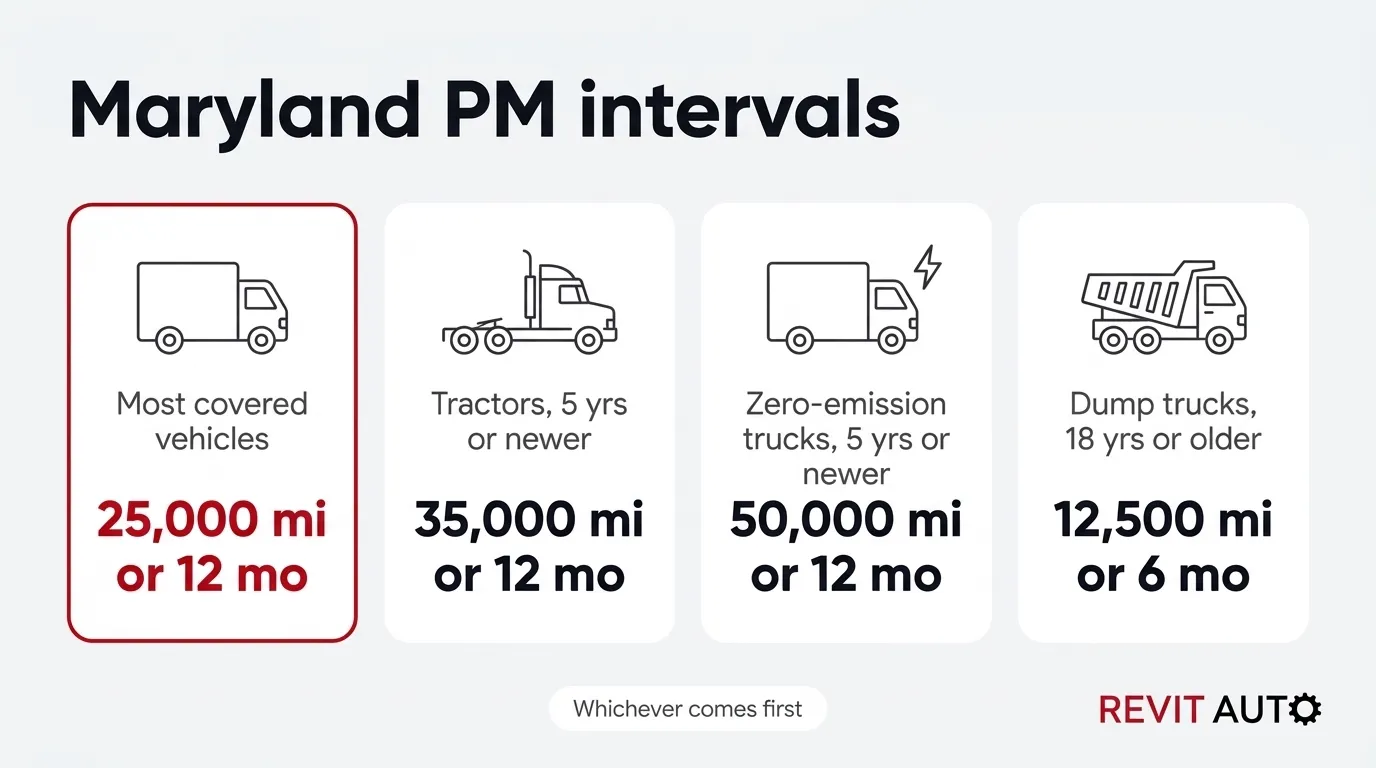
COMAR hasn’t been updated to include the 35,000 and 50,000-mile limits. For the dump truck rule, age counts from the later of the model year or first registration date.
The state regulation, COMAR 11.22.01.03, still shows only the 25,000-mile rule and the dump truck rule. Where they differ, go by the law in § 23-302.
How the "whichever comes first" math works
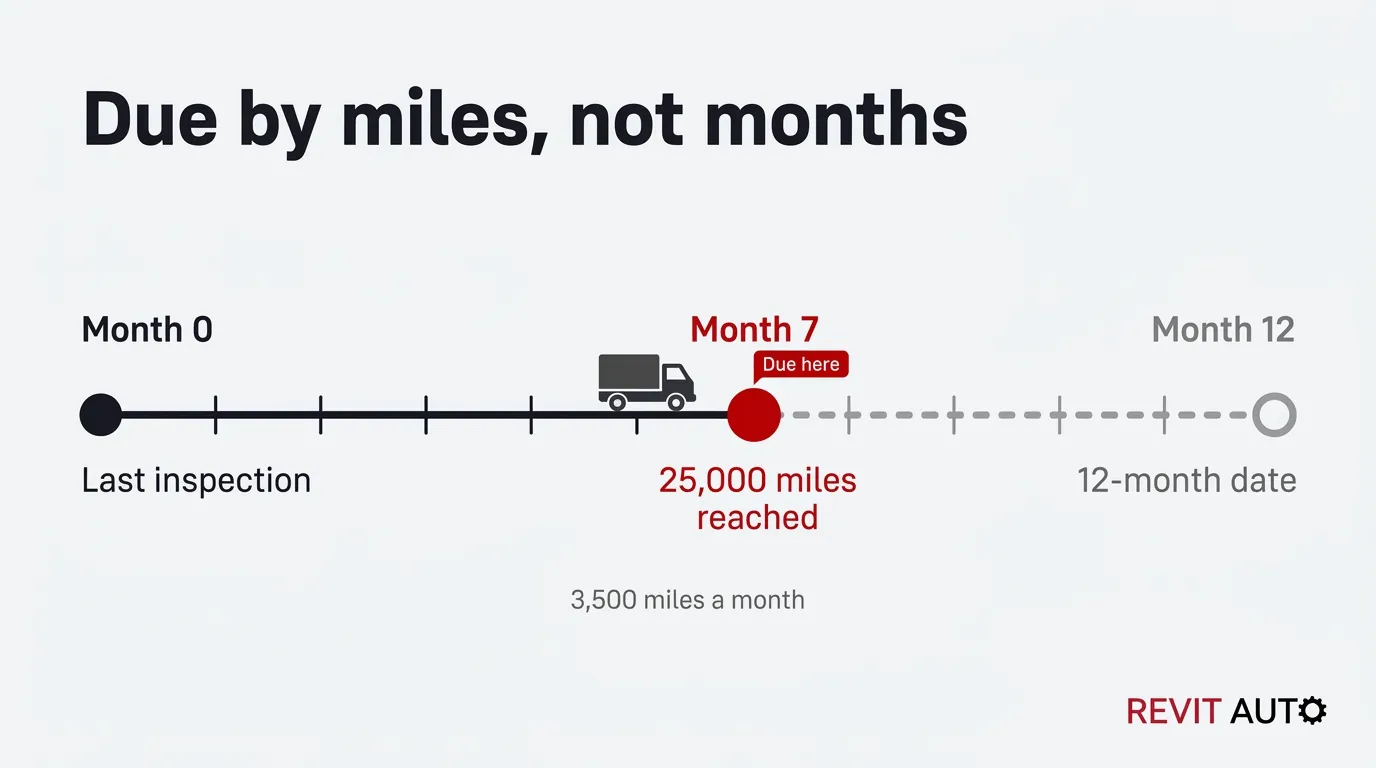
Say a straight truck runs about 3,500 miles a month. It reaches 25,000 miles in about 7 months, so it’s due in month 7, not month 12.
A truck that runs 1,000 miles a month hits 12 months first.
Does the federal annual inspection count?
Federal rules require a periodic inspection at least once every 12 months, under 49 CFR 396.17. There’s no mileage trigger in the federal rule.
In 2008, FMCSA listed Maryland’s program as equivalent to the federal one. So a passing Maryland PM inspection can also count as your federal annual inspection.
It doesn’t work the other way around. A federal annual inspection done in March doesn’t cover a Maryland truck that hits its mileage limit in September.
What a PM inspection covers
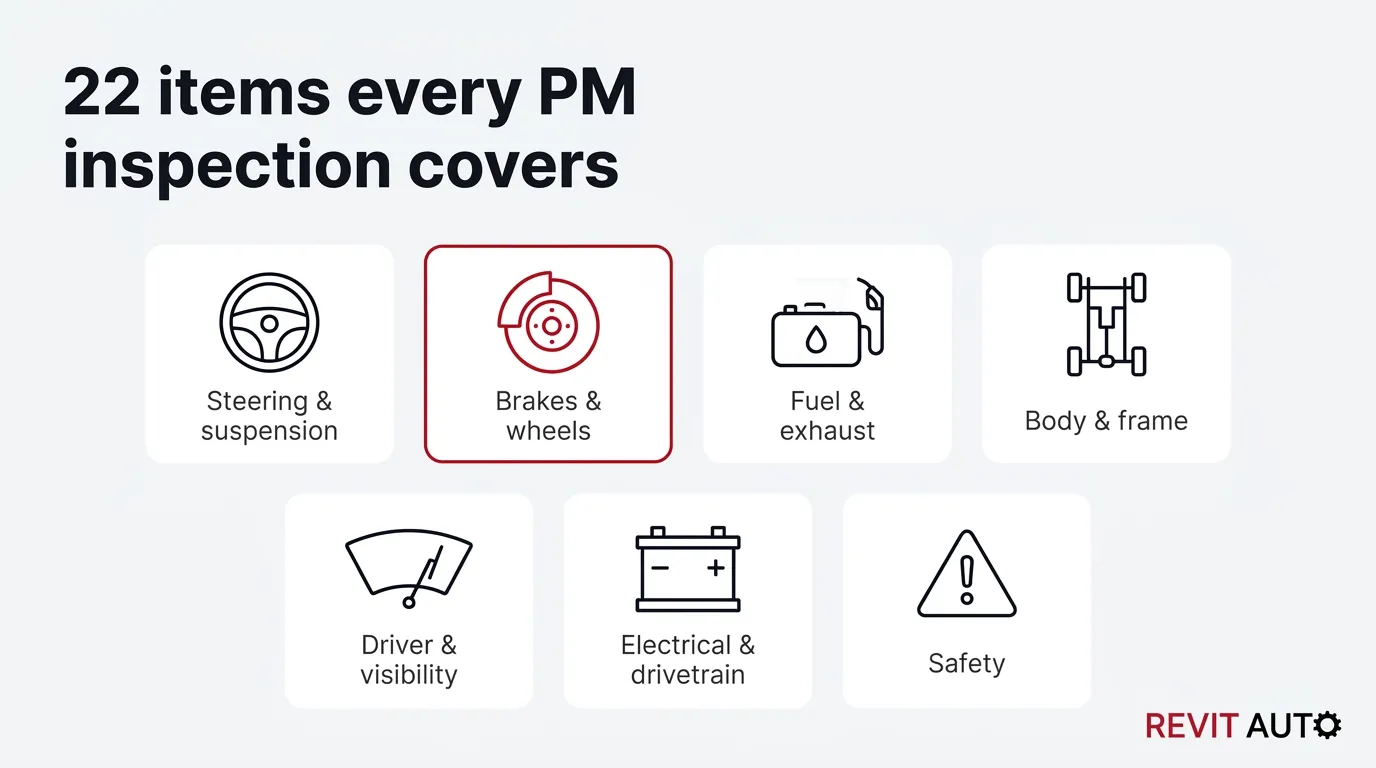
COMAR 11.22.01.03 lists the minimum equipment a PM inspection has to cover. Here it is, grouped by system:
| System | Items |
|---|---|
| Steering and suspension | Alignment, suspension, steering |
| Brakes and wheels | Brake systems, tires, wheels, rims, studs and nuts, clutch and brake pedal pads |
| Fuel and exhaust | Fuel storage and delivery, exhaust system, tanks and pressure vessels |
| Body and frame | Frame, body and sheet metal, hitches and coupling devices |
| Driver and visibility | Seats and seat belts, sun visor, mirrors, glazing, wipers and defroster, horn |
| Electrical and drivetrain | Electrical system, certain power train parts, speedometer and odometer |
| Safety | Emergency equipment |
Every item has to be inspected and brought up to the state’s standards. The detailed standards for trucks and tractors are in COMAR 11.22.02.
If you want to see what the federal side checks, our annual DOT inspection checklist lists the pass/fail specs.
How we run one
I like to be very systematic. On a quarterly inspection, I start with the paperwork, then check the fluids with the engine off and the transmission fluid with it running.
After that come the steering, brakes and suspension underneath, then a walk-around for damage. Going through the truck in the same order every time is how nothing gets missed.
Everything we find goes into a digital inspection report with photos, even small stuff like a leaking hood shock. We document it anyway, so you can make the call.
The records you must keep
Maryland is specific about paperwork, under COMAR 11.22.01.04:
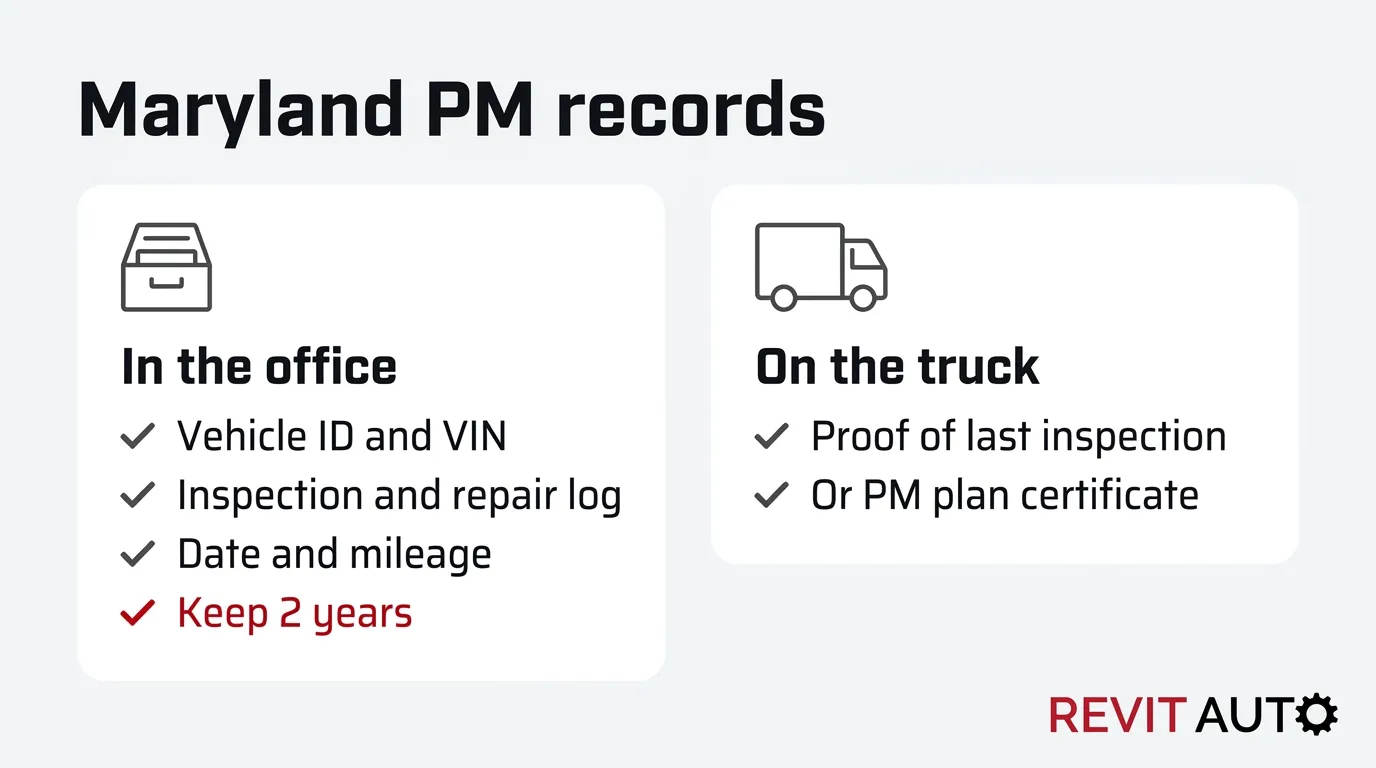
- For each vehicle: year, make, model, title number and VIN. The VIN has to be read off the vehicle, not copied from documents.
- A log of every inspection, repair and maintenance job, with the date and the mileage.
- Where: at the location where the truck is garaged, assigned or maintained.
- How long: 2 years. After you sell or scrap a truck, keep its records 6 more months.
- Out-of-state records: produced within 5 working days if the state asks.
The truck also has to carry proof. Under COMAR 11.22.01.05, it needs either a record of its most recent inspection or a written certification that it’s under a PM plan. The person driving is responsible for having it on board, so put it in the cab when the service is done.
Free tool: Maryland DOT compliance calendar
Enter each truck’s class, last inspection date and mileage, and see when it’s due next.
Common mistakes with the PM Program
- Tracking only the calendar. The mileage trigger is the one that surprises high-use trucks.
- One interval for a mixed fleet. A new tractor, an older dump truck and a straight truck can each run on a different clock.
- Assuming the federal inspection covers it. It doesn’t stop the Maryland mileage clock.
- Waiting until the due date to book. A failed item then means a second visit and a parked truck.
- Loose records. If the date, mileage or VIN is missing, the log doesn’t do its job.
What fleet managers say
The fleets that stay ahead of Maryland’s rules schedule PM by miles as well as dates. One customer wrote this when they hired us to set theirs up:
“Extraordinary service. Wonderful attitude. Truly helpful. We will work with Revit to implement a new company wide vehicle Preventative Maintenance program for our entire fleet. Thank you to Blair and his team. So glad we found you.”
David M · ★★★★★ Read the review on Google
Revit Auto is rated 5.0 from 120 reviews on Google, as of November 2026.
Keep every truck on its PM clock
We do mobile fleet maintenance and onsite DOT inspections at your yard across Maryland, DC and Northern Virginia.
We track each truck’s interval and leave the records with you.
Free Maryland fleet compliance resources
| Resource | What it helps you do |
|---|---|
| Maryland DOT compliance calendar (tool) | See when each truck is due next |
| PM schedule template (download) | Plan PM by miles and months |
| Annual DOT inspection checklist (guide) | Check the federal pass/fail specs |
| DVIR guide (guide) | Set up daily driver reports |
Frequently asked questions
What is the Maryland PM Program?
It’s Maryland’s preventive maintenance rule for commercial vehicles registered in the state. Most covered trucks must be inspected every 12 months or 25,000 miles, whichever comes first.
Is the interval 25,000 or 35,000 miles?
It depends on the vehicle. Most covered vehicles are due at 25,000 miles. Truck tractors 5 years old or newer are due at 35,000, under § 23-302.
Which vehicles get 50,000 miles?
Zero-emission electric or fuel-cell trucks that are 5 years old or newer. Everything else follows the 25,000 or 35,000-mile rule, or the dump truck rule.
Does the federal annual inspection cover the Maryland PM requirement?
Not by itself. The federal rule has no mileage trigger, so a Maryland truck can still come due by miles. A passing Maryland PM inspection can count as the federal one, though.
How long do I keep PM records?
2 years, at the location where the truck is garaged, assigned or maintained. After you sell or scrap a truck, keep its records for 6 months.
What has to be carried on the truck?
A record of the most recent inspection, or a written certification that the truck is under a PM plan. The person driving is responsible for having it on board.
Can Revit Auto keep my fleet on schedule?
Yes. We do PM and inspections at your yard across Maryland, DC and Northern Virginia, track each truck’s interval, and leave you the records.
Explore more compliance guides
This guide explains Maryland and federal rules for general information. It isn’t legal advice. Confirm current requirements with the Maryland MVA and FMCSA before acting on them.
Sources
- Maryland Transportation Article § 23-302, preventive maintenance intervals (Maryland General Assembly)
- COMAR 11.22.01.02, vehicles covered (Cornell LII)
- COMAR 11.22.01.03, inspection intervals and items (Cornell LII)
- COMAR 11.22.01.04, records (Cornell LII)
- COMAR 11.22.01.05, certification carried on the vehicle (Cornell LII)
- COMAR 11.22.02, standards for trucks and truck tractors (Cornell LII)
- 49 CFR 396.17, periodic inspection (Cornell LII)
- FMCSA list of equivalent state inspection programs, 73 FR 63040 (2008) (Federal Register)
- Maryland Transportation Article § 13-919, dump service registration (Maryland General Assembly)