
The hours of service rules are federal limits on how long a commercial driver can drive and work. People call them HOS for short. A property-carrying driver can drive up to 11 hours inside a 14-hour window, after 10 hours off duty. The weekly cap is 60 hours in 7 days or 70 in 8.
Key takeaways
- Three clocks run at once: 11 hours of driving, a 14-hour window and a 60 or 70-hour week.
- The 14-hour window doesn’t stop for lunch, fuel, loading or a breakdown.
- A 30-minute break is required after 8 hours of driving, and a 34-hour restart resets the week.
- Short-haul drivers within 150 air-miles who are released within 14 hours don’t need logs or an ELD.
- Short-haul still has limits. It drops the logbook and the 30-minute break, not the driving caps.
How many hours can a truck driver legally drive in a day? The answer depends on three different clocks, and mixing them up is where fleets get into trouble.
All three run at the same time. Miss any one of them and a driver can end up parked at a scale house.
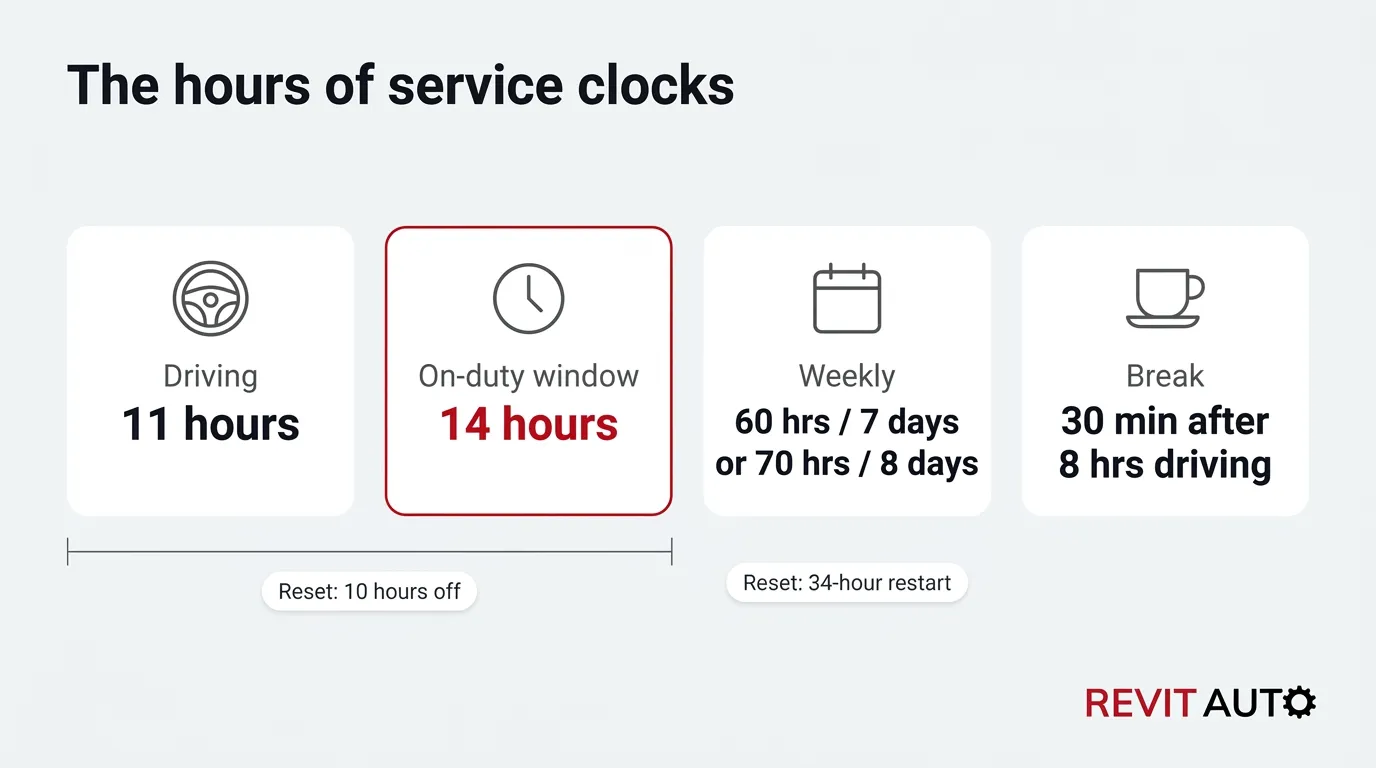
The three hours of service clocks
Under 49 CFR 395.3, a property-carrying driver manages three limits at once.
| Clock | Limit | Resets after |
|---|---|---|
| Driving | 11 hours | 10 hours off duty in a row |
| On-duty window | No driving after the 14th hour since coming on duty | 10 hours off duty in a row |
| Weekly | 60 hours in 7 days, or 70 hours in 8 days | A 34-hour restart, or older hours rolling off |
| Break rule (not a clock) | 30 minutes after 8 hours of driving | The break itself |
The 11-hour driving limit
After 10 hours off duty in a row, a driver can drive up to 11 hours. The driving clock resets after another full 10 hours off, or a qualifying sleeper berth split.
The 14-hour window
A driver can’t drive after the 14th hour since coming on duty. This is the one that catches people.
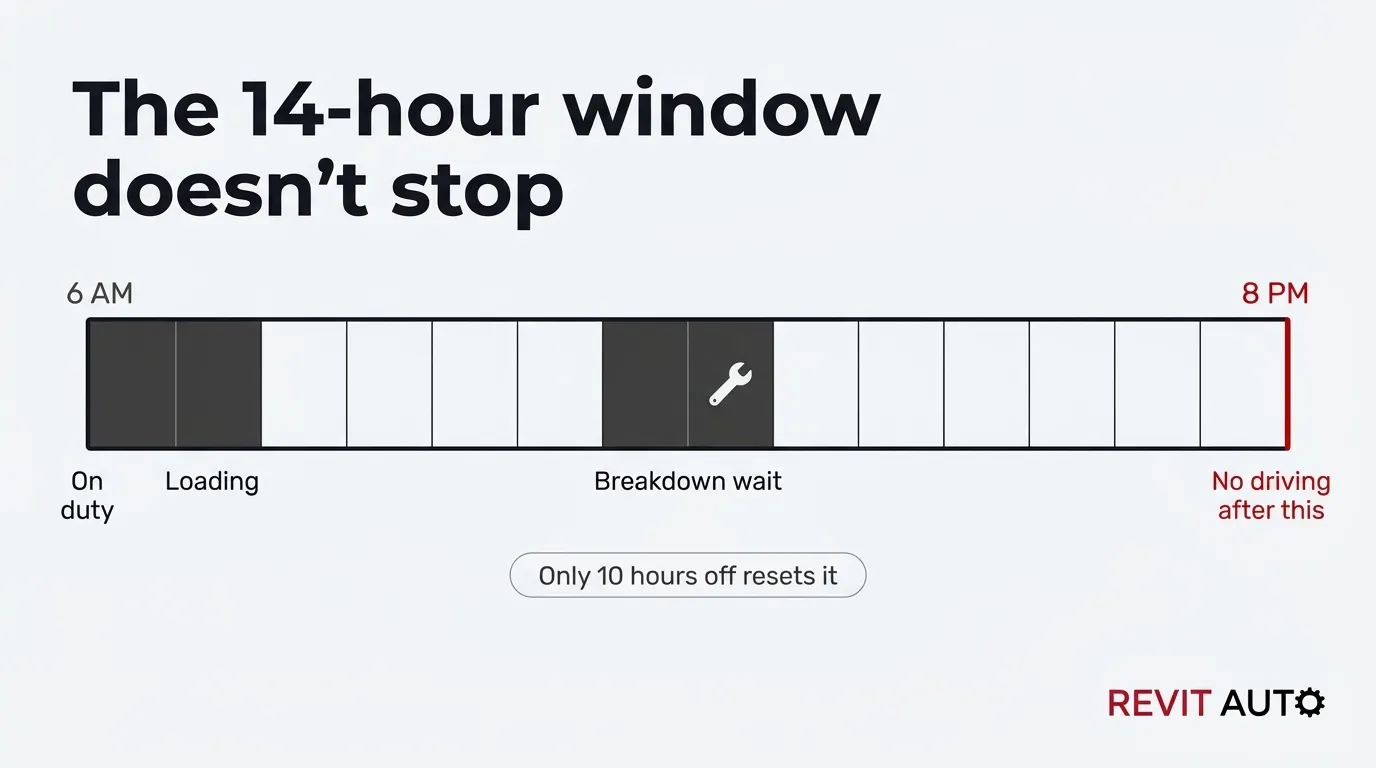
The window keeps running through lunch, fuel stops and waiting at a dock. Only 10 hours off resets it, though a qualifying sleeper berth split can pause it.
Here’s how it plays out. A driver comes on duty at 6:00 AM, so they can’t drive after 8:00 PM, even if they’ve only driven 7 hours.
The 60 or 70-hour week
A driver can’t drive after 60 on-duty hours in 7 days, or 70 in 8 days, depending on the carrier’s cycle. It’s a rolling total, so the oldest day’s hours drop off as each new day starts.
The break, the restart and the exceptions
A few more rules sit on top of the three clocks:
- 30-minute break. Required after 8 hours of driving without a 30-minute interruption. It doesn’t have to be off duty, just time not driving.
- 34-hour restart. 34 hours off duty in a row resets the 60 or 70-hour week to zero.
- Sleeper berth split. A driver can split the 10 hours off into two periods. One must be at least 7 hours in the sleeper berth, and the other at least 2 hours, under 49 CFR 395.1(g).
- Bad weather or traffic. When a driver runs into adverse driving conditions they didn’t know about at the start, they can drive up to 2 more hours, under 49 CFR 395.1(b).
Used well, the 34-hour restart gives a driver a fresh week. Take it while the driver still has plenty of hours left, and you lose working days you didn’t need to.
The ELD rule and who is exempt
Most drivers who have to keep a logbook must use an electronic logging device (ELD), under 49 CFR 395.8. An ELD connects to the engine and records driving time, engine hours, miles and location automatically.
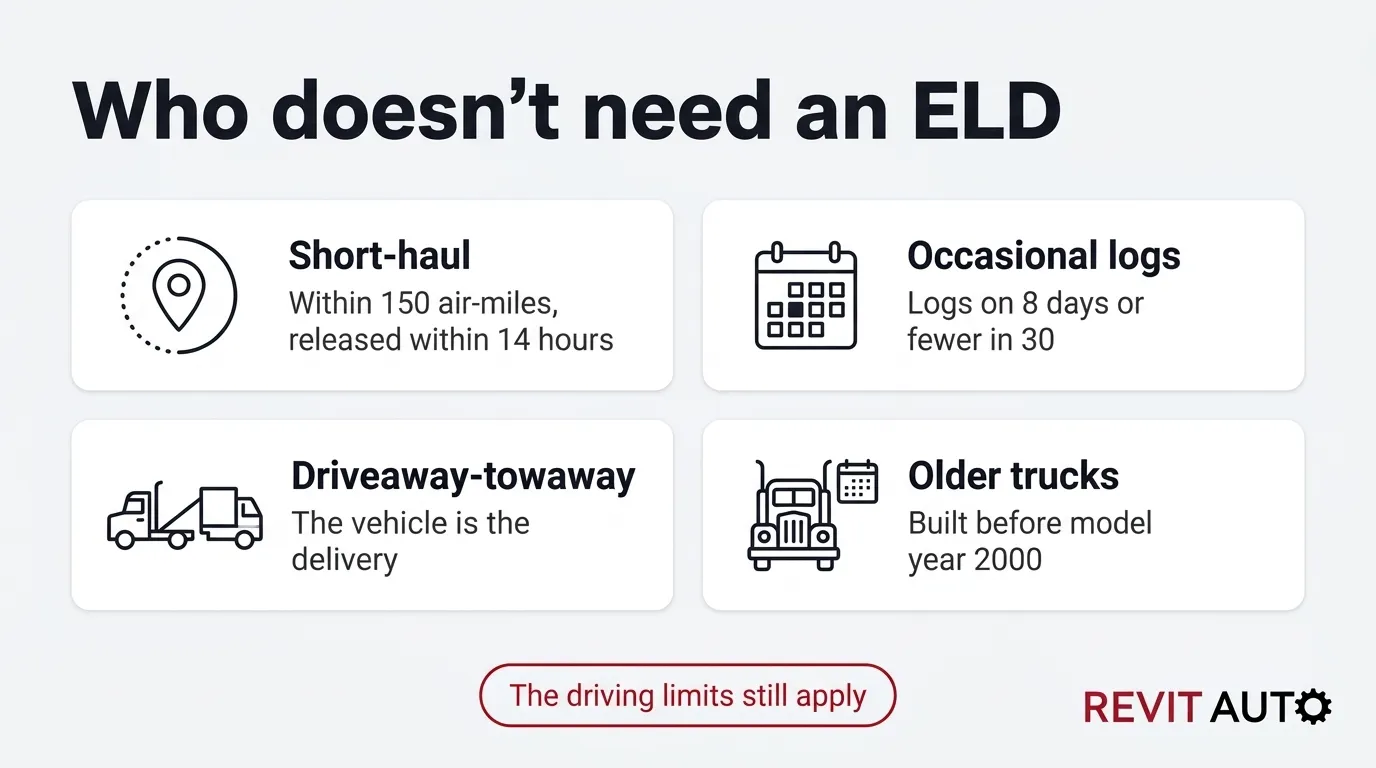
These drivers don’t need an ELD:
- Short-haul drivers who stay within 150 air-miles of their reporting location and are released within 14 hours. They don’t need a logbook either, and they skip the 30-minute break, under 49 CFR 395.1(e).
- Drivers who keep logs on 8 days or fewer in any 30-day period.
- Driveaway-towaway operations, where the vehicle being driven is the delivery.
- Older trucks, built before model year 2000 as shown by the VIN.
Short-haul drivers still have to stay inside the 11-hour driving limit. The carrier keeps time records showing when each driver came on and went off duty.
Make sure your device is on the FMCSA registered ELD list. FMCSA removes devices from the list from time to time, and a removed device has to be replaced.
What happens if a driver breaks the rules?
HOS violations are easy to prove, because the ELD records everything.
- Out of service on the spot. A driver found over a limit at a roadside inspection is put out of service until they’ve had enough time off to be legal again. For an 11 or 14-hour violation, that means 10 hours off with a loaded truck sitting still.
- Fines. FMCSA can fine the carrier for each violation. The amounts go up with inflation every year.
- CSA scores. HOS violations count against the carrier in the FMCSA’s Hours-of-Service Compliance category.
In Maryland, 6.8% of the driver-only Level III inspections from November 2025 to October 2026 put the driver out of service. That counts any driver violation, not only hours, by our count of FMCSA data. Our guide to Maryland roadside inspections has the full numbers.
Where maintenance comes in
I’m a mechanic, so the hours problem I see most is the breakdown. A truck that goes down on the road takes the driver’s hours with it.
The 14-hour window keeps running while a driver waits on the shoulder for a tow or a repair. A 3-hour wait is 3 hours the driver can’t get back that day.
That’s why we push PM and daily inspections so hard. A DVIR that catches a leaking air line at 6:00 AM costs a few minutes in the yard. The same air line failing on I-95 can cost the day.
On our quarterly inspections, I drain both air tanks to check for water. Water in there means the air dryer needs service, and it’s a lot cheaper to find it in the yard.
When a truck does go down, knowing where it is matters. Downtime Terminator is the fleet app Revit Auto makes. Its GPS tracking shows where every vehicle is.
Common hours of service mistakes
- Treating the 14-hour window like a pause button. Loading delays and breakdowns eat the driving day.
- Miscounting the rolling week. Hours drop off day by day, and drivers lose track.
- Taking the 34-hour restart too early. It costs working days the driver didn’t need to lose.
- Assuming short-haul means no rules. It drops the logbook and the 30-minute break, not the 11-hour limit.
- Running a device that’s off the registered list. Check it, and replace it if it’s been removed.
What fleet managers say
Here’s how one customer describes working with us:
“Blair and his Revit Auto team keep our trucks rolling and safe year round. The mobility of his techs saves us time and money on a weekly basis.”
James Ketterer · ★★★★★ Read the review on Google
Revit Auto is rated 5.0 from 120 reviews on Google, as of November 2026.
Keep your trucks moving and your drivers legal
We do mobile fleet maintenance and onsite DOT inspections at your yard across Maryland, DC and Northern Virginia.
Fewer breakdowns on the road means fewer hours lost on the shoulder.
Free Maryland fleet compliance resources
| Resource | What it helps you do |
|---|---|
| DVIR form template (download) | Give drivers a daily report to fill in |
| Maryland roadside inspections (guide) | Know what to expect at a weigh station |
| DVIR guide (guide) | Set up daily driver reports |
| Downtime Terminator app (app, made by Revit Auto) | See where every vehicle is |
Frequently asked questions
How many hours can a truck driver drive in a day?
Up to 11 hours, inside a 14-hour window that starts when the driver comes on duty. The driver then needs 10 hours off in a row before driving again.
What is the 14-hour rule?
A property-carrying driver can’t drive after the 14th hour since coming on duty. Breaks, fuel stops and loading all count. Only 10 hours off in a row resets it, though a sleeper berth split can pause it.
What is the 34-hour restart?
34 hours off duty in a row resets the 60 or 70-hour weekly clock to zero, so the driver starts a fresh week.
When is the 30-minute break required?
After 8 hours of driving without a 30-minute interruption. The break can be off duty or on duty, as long as the driver isn’t driving.
Who is exempt from the ELD rule?
Four groups are exempt: short-haul drivers within 150 air-miles who are released within 14 hours, drivers who keep logs 8 days or fewer in 30, driveaway-towaway operations, and trucks built before model year 2000.
Does the short-haul exemption remove the hours limits?
No. It drops the logbook, the ELD and the 30-minute break. The 11-hour driving limit still applies, and the carrier keeps time records.
Does a breakdown stop the 14-hour clock?
No. The 14-hour window keeps running while a driver waits for a tow or repair. That’s one reason to fix problems in the yard before the truck goes out.
Explore more compliance guides
This guide explains federal rules for general information. It isn’t legal advice. Confirm current requirements with FMCSA before acting on them.
Sources
- 49 CFR 395.3, maximum driving time for property-carrying vehicles (Cornell LII)
- 49 CFR 395.1, scope, short-haul, adverse conditions and sleeper berth (Cornell LII)
- 49 CFR 395.8, records of duty status and ELD exceptions (Cornell LII)
- FMCSA registered ELD list (FMCSA)
- FMCSA vehicle inspection file, Maryland, Nov 2025 to Oct 2026 (U.S. DOT open data, our analysis)