Your CSA score for vehicle maintenance is the FMCSA’s percentile ranking of your fleet’s maintenance violations found at roadside inspections, compared with similar carriers. It’s called the Vehicle Maintenance BASIC, and a property carrier at or above the 80th percentile can be flagged for FMCSA action.
Key takeaways
- The Vehicle Maintenance BASIC is built from roadside inspection violations over the last 24 months.
- Serious and recent violations count more, and out-of-service violations count the most.
- The threshold is the 80th percentile for property carriers, 75th for hazmat and 65th for passenger carriers.
- Clean inspections help, because the score is spread across all your relevant inspections.
- In Maryland, 43% of vehicle inspections from November 2025 to October 2026 found at least one vehicle violation.
CSA scores get talked about a lot. Fewer people know where the maintenance score comes from.
It comes from the roadside. Every light out, every brake out of adjustment and every bald tire an officer writes up ends up in that number.
What is a CSA score?
CSA (Compliance, Safety, Accountability) is the FMCSA’s program for finding carriers with safety problems. Its Safety Measurement System (SMS) sorts inspection and crash data into seven categories called BASICs:
- Unsafe Driving
- Crash Indicator
- Hours-of-Service Compliance
- Vehicle Maintenance
- Controlled Substances and Alcohol
- Hazardous Materials Compliance
- Driver Fitness
Each BASIC gets a percentile from 0 to 100, where a higher number is worse. The SMS updates monthly.
The Vehicle Maintenance BASIC is the one a mechanic can move. Most of the others depend on drivers. This one depends on the trucks.
How the Vehicle Maintenance BASIC works
The score starts with every violation of the vehicle maintenance rules found at roadside inspections in the past 24 months. That covers brakes, lights, tires, wheels, steering, suspension, frame, cargo securement and more, under 49 CFR Parts 393 and 396.
Three things decide how much each one counts:
| Factor | What it means |
|---|---|
| Severity | Each violation has a weight from 1 to 10, set by how closely it’s linked to crash risk. |
| Out of service | A violation that puts the truck out of service gets extra weight. |
| Time | Recent violations count more than older ones. After 24 months they drop off. |
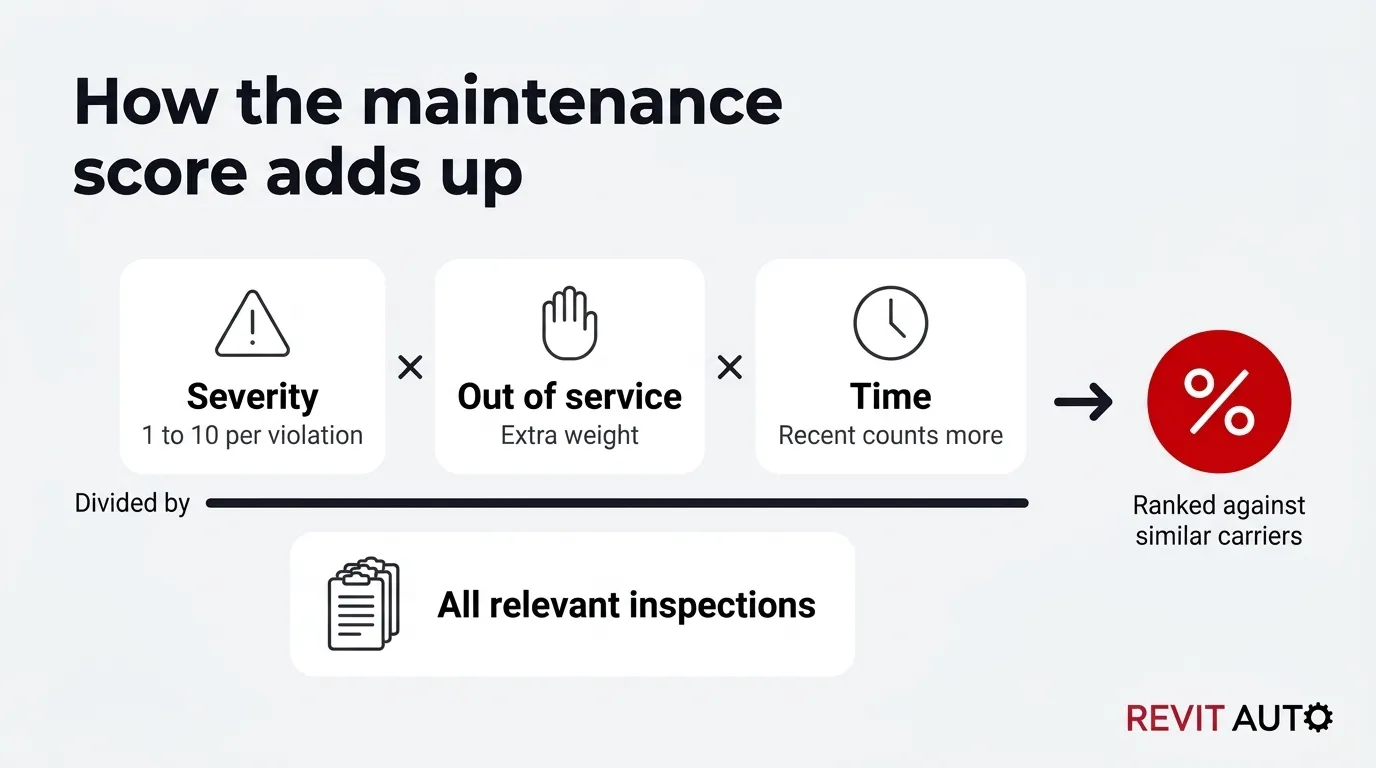
The weighted total is then divided by your relevant inspections, which are also weighted by age. That’s why a clean inspection helps: it adds to the bottom of the fraction without adding to the top.
Finally, the SMS ranks you against carriers with a similar number of inspections. You need at least 5 vehicle inspections, plus a recent violation, before FMCSA assigns a Vehicle Maintenance percentile, according to the FMCSA SMS methodology.
The intervention thresholds
If your percentile reaches the threshold for your type of carrier, FMCSA may step in:
| Carrier type | Vehicle Maintenance threshold |
|---|---|
| General (property) | 80% |
| Hazardous materials | 75% |
| Passenger | 65% |
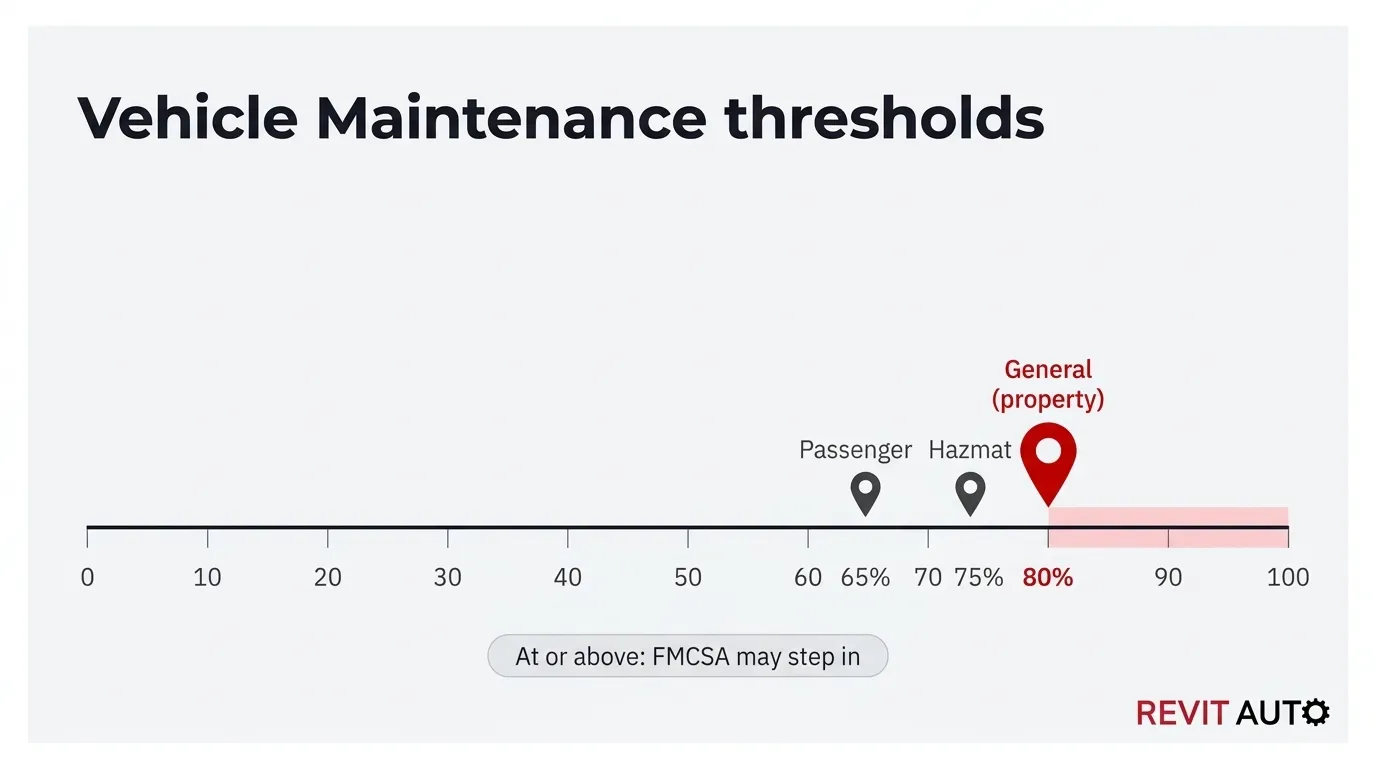
FMCSA action usually starts with a warning letter. It can move to an investigation, either offsite or at your place of business, under the FMCSA’s CSA interventions process.
A high score can also cost you outside FMCSA. Property carriers’ percentiles aren’t public, but shippers, brokers and insurers can still see your inspection and violation history. Roadside screening systems can use it too.
What Maryland inspections show
We pulled every Maryland inspection that checked the vehicle (Levels I, II and V) from the FMCSA inspection data. The window was November 2025 through October 2026.
- 67,881 vehicle inspections
- 43% found at least one vehicle violation
- 21% put the vehicle out of service
- 75% of all violations written were vehicle violations, not driver violations
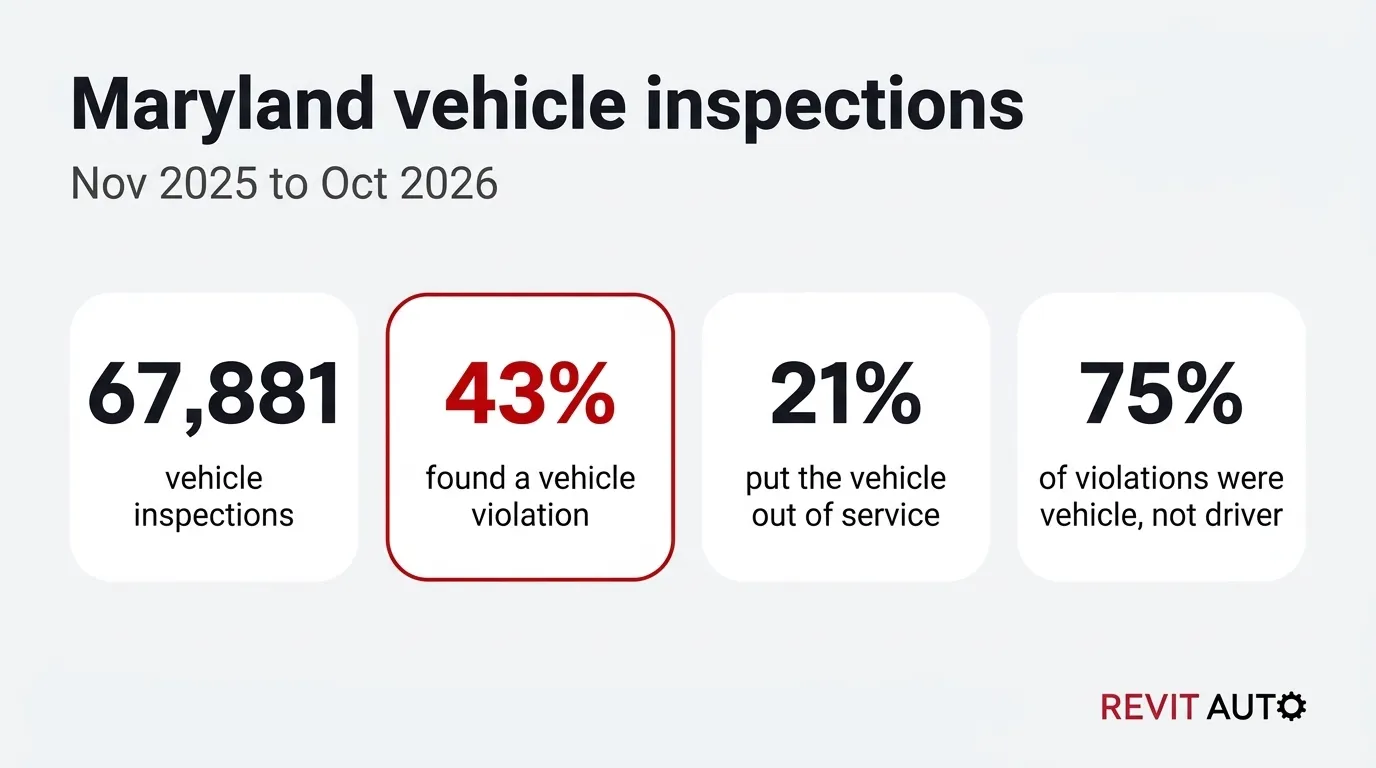
Most of those vehicle violations are maintenance, and that’s the part you can fix before the truck leaves the yard.
How to lower your Vehicle Maintenance score
A fair violation stays on the record for 24 months, so the work is keeping new ones off it.
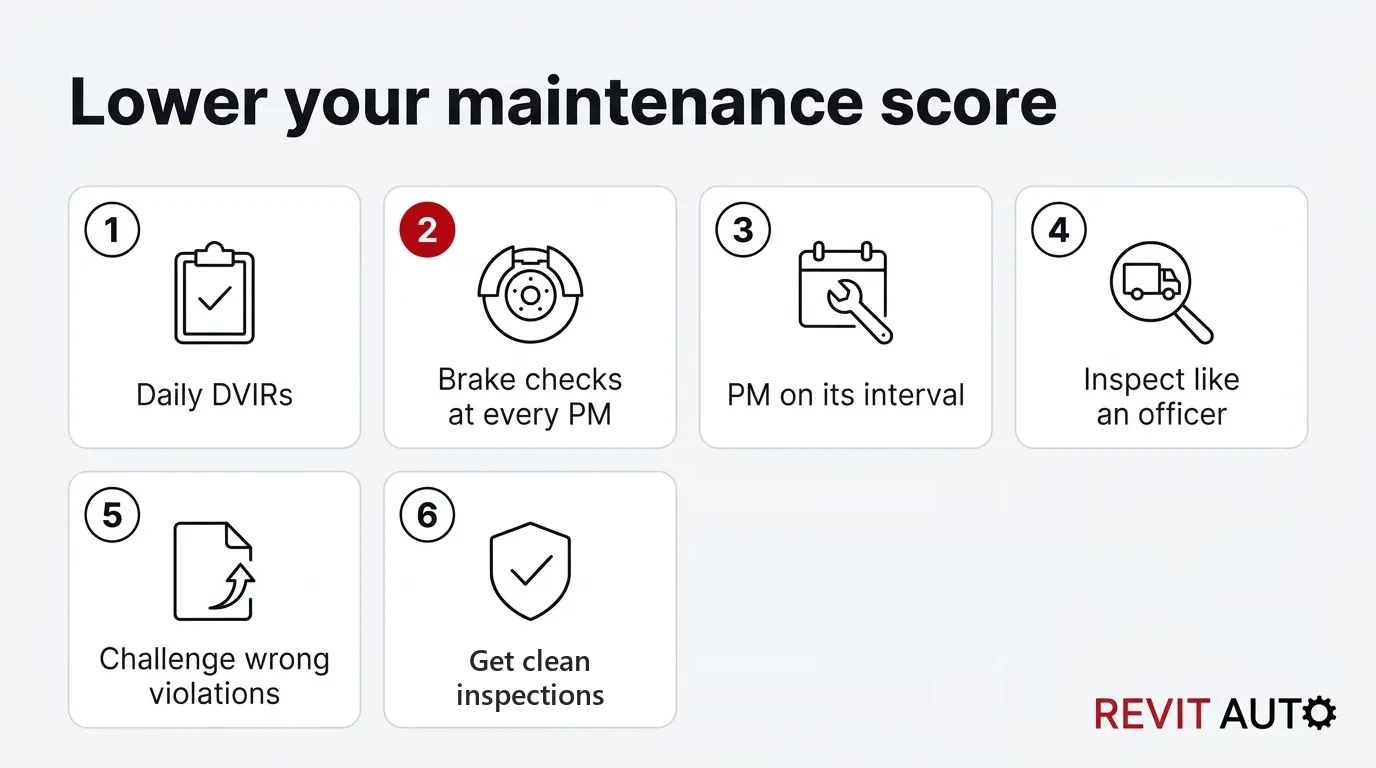
- Run real DVIRs. Lights, tires, air leaks and loose parts are what officers see first in a walk-around. Our DVIR guide covers the daily report.
- Check brakes at every PM. Brake problems were the top out-of-service reason in CVSA’s 2026 International Roadcheck.
- Keep PM on its interval. Trucks covered by the Maryland PM Program have miles-or-months deadlines.
- Inspect like an officer. Our annual DOT inspection checklist covers the same parts.
- Challenge wrong violations. If a violation was written in error, file a request through FMCSA’s DataQs system.
- Get clean inspections on the record. Every clean inspection adds to the denominator.
I go through a truck the same way every time: paperwork, fluids, then steering, brakes and suspension underneath, then a walk-around. I take my time so I don’t miss anything, because the cheap fixes are the ones that cost points.
Small things still go in our digital inspection report with a photo, like rusty transmission cooler lines or an oil seep. We flag what to fix now and what to keep an eye on over the next few oil changes.
Free tool: Maryland DOT compliance calendar
Track each truck’s PM, annual inspection and registration dates in one place.
The changes FMCSA has proposed
In 2023, FMCSA proposed a revised SMS. For maintenance, it would split the category in two:
- Vehicle Maintenance: Driver Observed, for problems a driver could catch on a pre-trip or post-trip inspection
- Vehicle Maintenance, for everything else
The proposal keeps the 65, 75 and 80% thresholds and simplifies severity weights to 1 or 2, with out-of-service violations at 2.
As of November 2026, the SMS still uses the seven BASICs. Check the CSA website for any start date.
What fleet managers say
Here’s what one fleet customer says about on-site PM:
“Blair, Ky and entire team at Revit Auto servicing my fleet of 8 trucks. I really like working with them. They come to my office to do all PM and major repairs. Recently I signed up with them for a yearly membership so all I am expecting is to lower my overall maintenance cost. 100% Recommended and ready to refer Revit Auto to anybody.”
Alexander Yakimovich · ★★★★★ Read the review on Google
Revit Auto is rated 5.0 from 120 reviews on Google, as of November 2026.
Bring your maintenance score down
We do mobile fleet maintenance and onsite DOT inspections at your yard across Maryland, DC and Northern Virginia.
We find what an officer would find, fix it before the truck goes out, and leave you the records.
Free Maryland fleet compliance resources
| Resource | What it helps you do |
|---|---|
| Maryland DOT compliance calendar (tool) | See when each truck is due next |
| DOT inspection checklist (download) | Check a truck the way an officer will |
| Maryland roadside inspections (guide) | Know what to expect at a weigh station |
| How to build a PM schedule (guide) | Plan PM by miles and months |
Frequently asked questions
What is the CSA Vehicle Maintenance BASIC?
It’s the FMCSA’s measure of a carrier’s maintenance violations found at roadside inspections over 24 months. It’s shown as a percentile against similar carriers, where higher is worse.
What is a bad CSA score for vehicle maintenance?
For property carriers, the 80th percentile or higher. The threshold is 75% for hazmat carriers and 65% for passenger carriers.
How long do violations stay on my CSA score?
24 months. Recent violations count more than older ones, so the score improves as violations age.
Do clean inspections help my CSA score?
Yes. The score is spread across all your relevant inspections, so each clean one lowers the average.
How many inspections before I get a Vehicle Maintenance score?
At least 5 vehicle inspections, plus a recent violation, under the FMCSA SMS methodology.
Can I remove a violation from my CSA score?
Only if it was wrong. You can challenge it through FMCSA’s DataQs system with proof, like a repair record or photos.
Is the Vehicle Maintenance BASIC changing?
FMCSA has proposed splitting it into Vehicle Maintenance and Vehicle Maintenance: Driver Observed. As of November 2026, the current seven-BASIC system is still in use.
Explore more compliance guides
This guide explains federal rules for general information. It isn’t legal advice. Confirm current requirements with FMCSA or MDOT MVA before acting on them.
Sources
- FMCSA CSA and the Safety Measurement System (FMCSA)
- FMCSA SMS methodology (FMCSA)
- Revised Carrier Safety Measurement System, February 15, 2023 (Federal Register)
- 49 CFR Part 396, inspection, repair and maintenance (Cornell LII)
- FMCSA vehicle inspection file, Maryland, Nov 2025 to Oct 2026 (U.S. DOT open data, our analysis)
- CVSA 2026 International Roadcheck results (CVSA)
- FMCSA DataQs (FMCSA)