
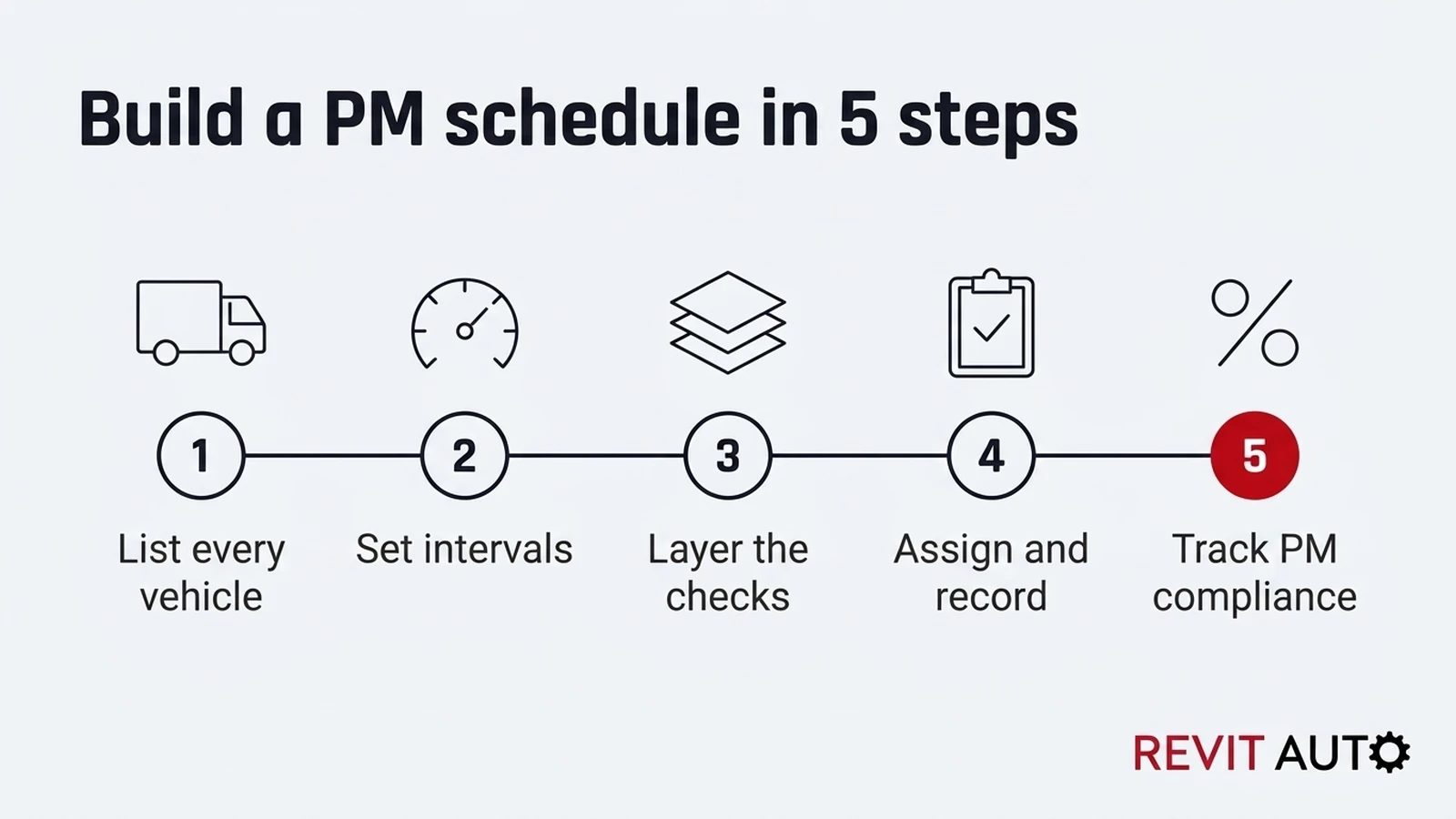
A preventive maintenance schedule is a plan that says which service each vehicle gets, and when, by miles, hours or months. You build one in 5 steps: list the fleet, set intervals, layer the checks, assign and record the work, and track PM compliance.
Key takeaways
- Federal rules require carriers to keep a way to show what each inspection and service is, and when it’s due.
- Set intervals from the manufacturer’s schedule, then tighten them for vehicles that work harder.
- Layer the checks: daily driver reports, service by miles or months, a regular inspection and the annual DOT inspection.
- In Maryland, 3.1% of vehicle inspections cited a truck with no proof of its annual inspection (FMCSA data, Nov 2025 to Oct 2026).
- PM compliance, the share of services done on time, tells you whether the schedule is actually working.
Most fleet managers know they need a PM (preventive maintenance) schedule. Where to start is usually what stops them.
I’ve run Revit Auto for 11 years.
In our Fleet Protection Program, we service and inspect trucks on site on a set schedule. The schedules that work are the simple ones people actually follow.
Is a preventive maintenance schedule required?
Yes, for commercial carriers. Federal rules say every motor carrier must systematically inspect, repair and maintain its vehicles.
The same rule, in paragraph (b)(2), requires “a means to indicate the nature and due date” of each inspection and service. That covers every vehicle you control for 30 days in a row.
In other words, federal law requires a PM schedule.
These rules cover commercial motor vehicles. That includes trucks rated 10,001 lb or more used in interstate commerce.
Maryland adds its own clock for trucks registered here. The Maryland PM Program sets inspection intervals by miles as well as months.
Missed inspections show up at the roadside. Revit Auto analyzed Maryland inspection data from the Federal Motor Carrier Safety Administration (FMCSA).
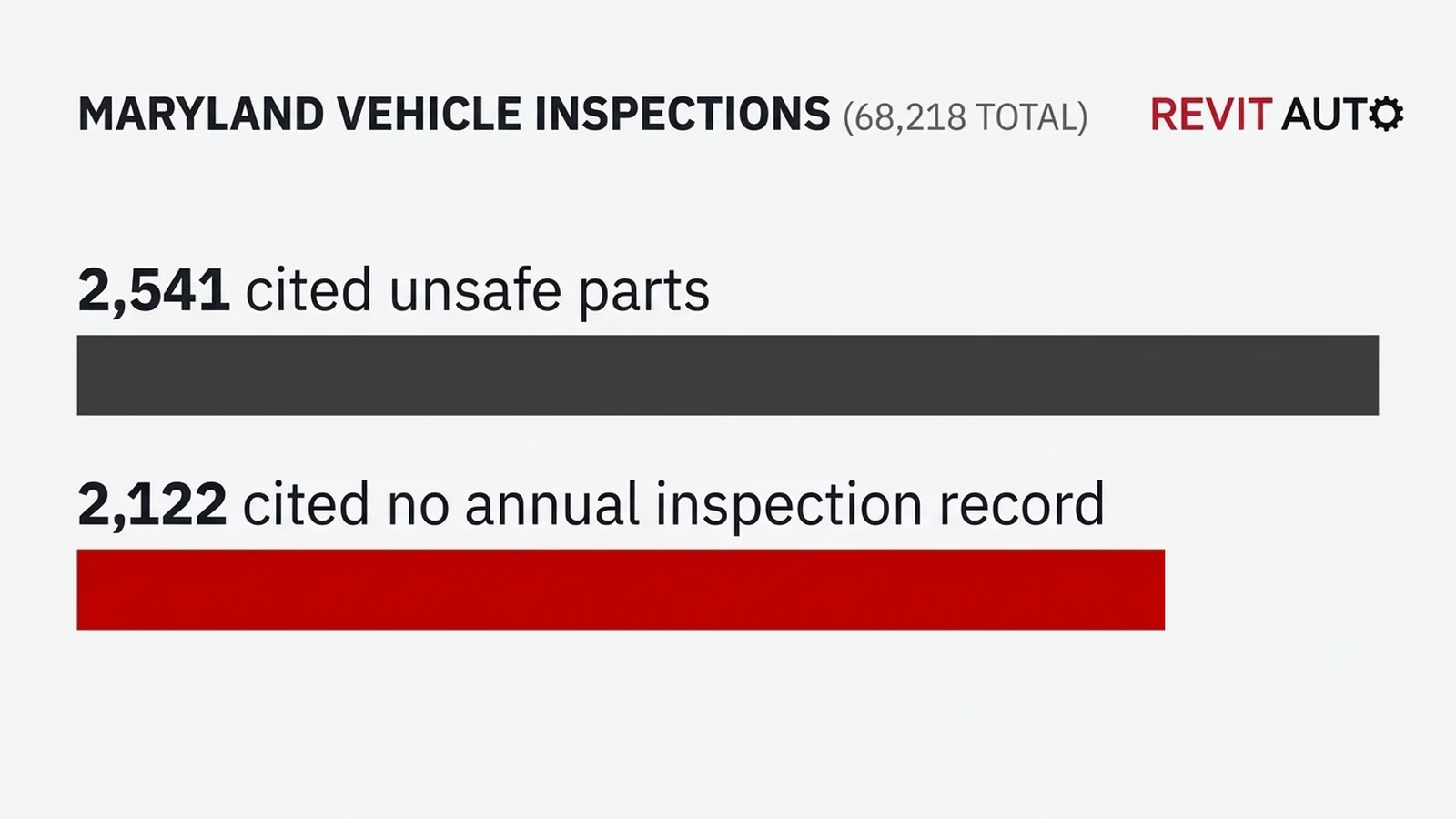
Of 68,218 Maryland inspections that checked the vehicle, 2,122 cited a truck operating without documentation of its annual inspection, which is 3.1%. Federal rules say that proof has to ride on the truck.
Scheduling the annual inspection, and keeping its report or decal on the vehicle, avoids that citation. Another 2,541 inspections (3.7%) cited parts that weren’t in safe working order.
How we counted: FMCSA inspection records for Maryland, Nov 1, 2025 to Oct 31, 2026, Levels I, II and V, matched to their violations. Pulled Nov 14, 2026.
Step 1: List every vehicle
You can’t schedule what you haven’t listed. Start a fleet maintenance schedule with one row per vehicle, and one per trailer.
- Unit number, VIN, make, model and year.
- Current mileage, and engine hours for trucks that idle a lot.
- The kind of work it does, such as stop-and-go deliveries or highway runs.
- Known problems and the date of the last service.
- Who owns it, if you lease. Federal records rules ask for that too.
Federal record rules already ask for the ID part of this list. You’ll need it for your records anyway.
Step 2: Set intervals for each vehicle
Most services get two triggers: a mileage or hour count, and a time limit. Whichever comes first sets the due date.
Start with the manufacturer’s maintenance schedule for each model. Many owner’s manuals list a normal schedule and a severe-service one, which some Ford guides call “Special Operating Conditions.”
Stop-and-go delivery, lots of idling and towing usually count as severe service. For example, a delivery van in city traffic should follow the shorter intervals.
Then layer on the rules. The annual DOT inspection is due every 12 months.
For trucks in the Maryland PM Program, the state sets these intervals, whichever comes first:
| Vehicle | Miles | Or months |
|---|---|---|
| Most covered vehicles | 25,000 | 12 |
| Truck tractors, 5 years old or newer | 35,000 | 12 |
| Zero-emission or fuel-cell trucks, 5 years old or newer | 50,000 | 12 |
| Dump service trucks, 18 years old or more | 12,500 | 6 |
Source: Maryland’s preventive maintenance law.
On diesel trucks, we typically replace our fuel filters earlier. A clogging filter shows in the water separator’s sight glass.
Step 3: Layer the checks
A good schedule stacks smaller checks at different intervals, so each one catches what the last one missed.
| Interval | What happens | Who does it |
|---|---|---|
| Every day | Pre-trip check, plus an end-of-day report of any defects (DVIR) | Driver |
| By miles or months | Oil, filters and fluids, per the manufacturer | Mechanic |
| Every quarter (our practice) | A full inspection, system by system | Mechanic |
| Every 12 months | The annual DOT inspection (Maryland PM trucks: see the Step 2 table) | Qualified inspector |
The daily report is the driver vehicle inspection report, or DVIR, which federal rules require. It’s how a defect gets from the driver to the mechanic the same day.
Our quarterly inspection follows the same order every time. Paperwork first, then mileage and the last oil service, then fluids, steering, brakes, the underside, the air tanks and a walk-around.
I like to be very systematic. I’m taking my time so I don’t miss anything.
Step 4: Assign and record the work
Give each service an owner, a reminder and a record, or the schedule stops getting followed.
- Owner: one person accountable for each service, whether that’s your team or a provider.
- Reminder: an alert before each due date, by miles or by calendar.
- Record: the date and what was done, filed against the vehicle.
At Revit, one person is accountable for each of the 13 to 18 steps of a job, from the phone call to getting paid. If you rely on habits or motivation, you’ll fail.
Records are part of the rule. You keep them for 1 year where the vehicle is based, and 6 months after it leaves your fleet.
Maryland PM Program records are kept for 2 years.
Everything we find goes into a digital report with photos. Clients can check their maintenance records on site from a phone, through Revit’s mobile app.
Downtime Terminator is the fleet app Revit Auto makes. It covers preventive maintenance, service history and work orders, so your PM plan and records live in one place.
Step 5: Track PM compliance
PM compliance is the share of scheduled services that were done on time. It’s the one number that tells you whether the schedule is working.
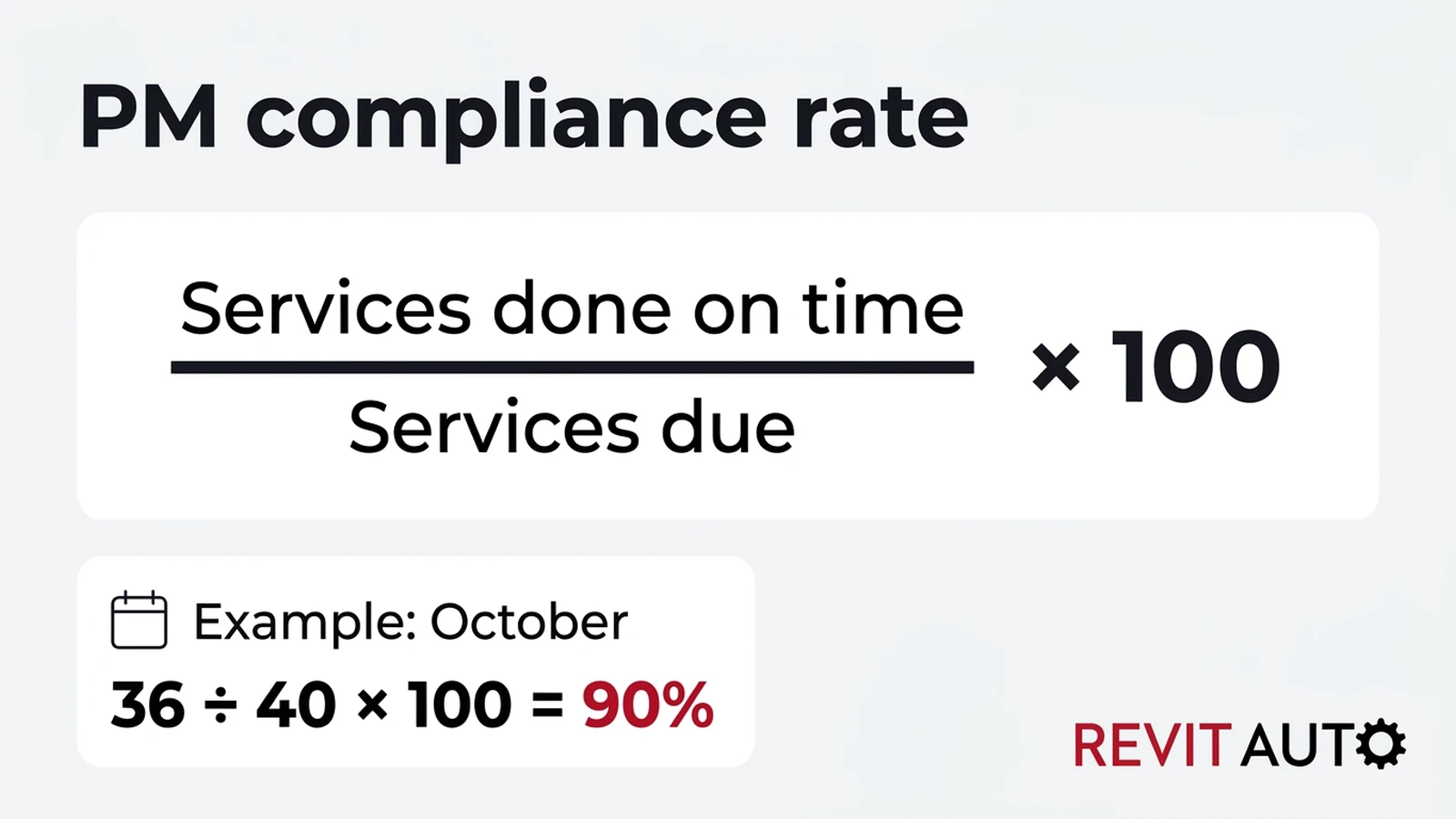
The formula is simple. Take the services done on time in a month, divide by the services that came due, and multiply by 100.
Track it every month, by vehicle group. When it drops, look for the cause before the trucks start telling you.
Read next: Fleet maintenance KPIs to track
When to move a scheduled service
You can move a scheduled service, as long as you know what the vehicle can safely wait for. Legal deadlines don’t move: the annual DOT inspection stays inside 12 months, and Maryland PM limits stay whichever comes first.
On one job, remnants of a hurricane turned the client’s lot into a mud pit. We did the one repair that didn’t need a tech under the truck.
The oil and the transmission fluid still had life left, so we rescheduled the rest for a better day.
Small findings go on the schedule too. When we see a part seeping oil, we write it down as something to watch over the next few oil changes.
Common PM scheduling mistakes
- One schedule for a mixed fleet. A city delivery van and a highway tractor wear differently.
- Forgetting the trailers. Each trailer needs its own row and its own annual inspection.
- Intervals set once and never changed. Good maintenance scheduling follows the work each truck does now.
Free download: PM schedule template
A spreadsheet with every vehicle, its intervals and its next due dates, ready to fill in.
What fleet managers say
One fleet customer described how we handle their schedule:
“First off the Technicians, very informative they’ll explain what repairs will be done for that visit and once they’re done also show you what to keep an eye on. … Both Blair and Ky are awesome at scheduling regular maintenance service and quick to respond to our break downs and emergency calls.”
Ramiro Lopez · ★★★★★ Read the review on Google
Revit Auto is rated 5.0 from 120 reviews on Google, as of November 2026.
Let us build and run your schedule
Through our Fleet Protection Program, we service and inspect your trucks at your yard on a set schedule. That covers mobile fleet maintenance, mobile fleet repairs and onsite DOT inspections.
We work across Maryland, DC and Northern Virginia. Start focusing on growing your business instead of vehicle breakdowns.
Free fleet maintenance resources
| Resource | What it helps you do |
|---|---|
| PM schedule template (download) | Track intervals and next due dates for every vehicle |
| What is fleet maintenance? (guide) | See how a PM schedule fits into a full program |
| Annual DOT inspection checklist (guide) | Know what the yearly inspection checks |
| Downtime Terminator app (app, made by Revit Auto) | Keep PM, service history and work orders in one place |
Frequently asked questions
How do I start a preventive maintenance schedule?
List every vehicle with its mileage and the work it does. Then set intervals from the manufacturer’s schedule, layer daily, mileage, quarterly and annual checks, and give each service an owner.
Is a PM schedule required by law?
For commercial carriers, yes. Federal rules require a way to show what each inspection and service is and when it’s due.
Should a delivery van and a tractor share one schedule?
No. Stop-and-go work, idling and towing usually call for the manufacturer’s severe-service intervals, so each type needs its own.
What is PM compliance?
It’s the share of scheduled services done on time: services done on time, divided by services due, times 100. Track it every month.
Do I need software to run a PM schedule?
Not to start. A spreadsheet and calendar reminders work for a small fleet, and an app helps as the fleet grows.
Where does the annual DOT inspection go in the schedule?
Inside the yearly cycle, as its own line for each vehicle. It’s due every 12 months.
Explore more fleet maintenance guides
- What is fleet maintenance? The types, the program and what it costs
- Preventive vs predictive vs reactive maintenance, compared
- What reactive maintenance really costs
- How to reduce fleet downtime
- The Maryland PM Program: inspection intervals by vehicle class
- What is a DVIR? The driver vehicle inspection report, explained
This guide explains federal and Maryland rules for general information, not legal advice. Confirm current requirements with FMCSA or MDOT MVA before acting on them.
Sources
- Federal rule on inspection, repair and maintenance (Cornell Law)
- Federal rule on driver vehicle inspection reports (Cornell Law)
- Federal rule on the annual inspection (Cornell Law)
- Federal definition of a commercial motor vehicle (Cornell Law)
- Maryland preventive maintenance law (Maryland General Assembly)
- Maryland PM Program record rules (Cornell Law)
- FMCSA vehicle inspection file and violation file, Maryland, Nov 2025 to Oct 2026 (U.S. DOT open data, our analysis)
- Downtime Terminator features (stopdowntime.io)