A driver vehicle inspection report, or DVIR, is the written report a commercial driver files at the end of the workday when they find, or are told about, a defect on the vehicle. Federal rule 49 CFR 396.11 requires it, so every problem has a paper trail from the driver who spotted it to the mechanic who fixed it.
Key takeaways
- A DVIR is the written record of defects found during the daily inspection, not the inspection itself.
- Drivers only have to file one when they find or are told about a defect, for both trucks and passenger vehicles.
- A DVIR with a defect needs three sign-offs: the driver, the carrier or mechanic who certifies the repair, and the next driver.
- You have to keep each DVIR, its repair certification and the next driver’s sign-off for at least three months.
- An FMCSA rule that took effect March 23, 2026 confirms you can create and keep DVIRs electronically.
Ask ten drivers what a DVIR requires and you’ll get ten different answers. A few think it’s the same as a pre-trip, and plenty aren’t sure who signs it.
That confusion is how fleets end up with gaps in their DVIR files. I’ll walk through it the way I explain it to the fleet managers we work with.
What a DVIR is, and what it's for
A DVIR is a defect report. When a driver finds something wrong, they write it up.
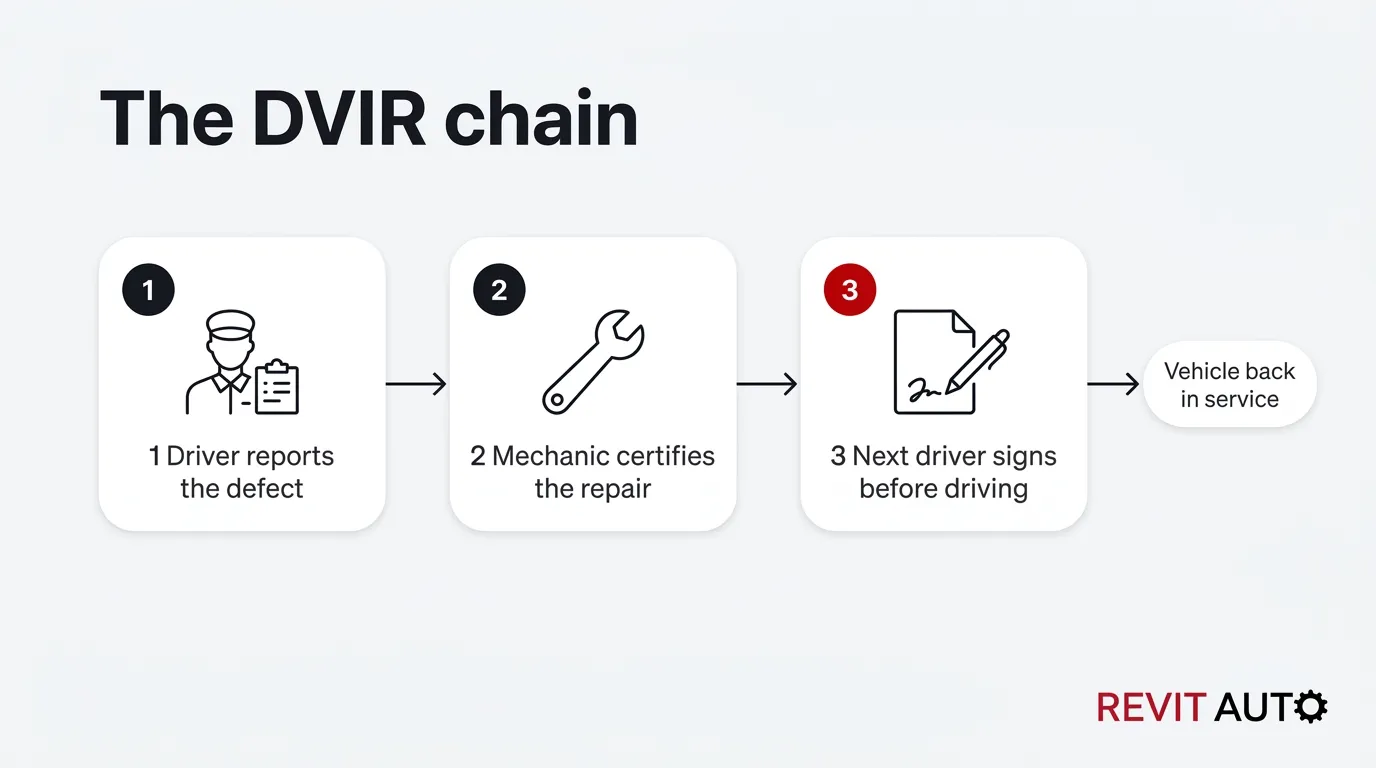
The carrier gets it fixed and certifies the repair. Then the next driver reviews the report and signs it before the vehicle moves again.
It connects three people who might never meet: the driver who found the problem, the mechanic who fixed it, and the driver who takes the wheel next.
The rules live in 49 CFR 396.11 and 49 CFR 396.13.
Which vehicles need a DVIR?
DVIRs apply to commercial motor vehicles. Under the federal definition, that’s a business vehicle that does any one of these:
- Weighs 10,001 lb or more, by weight rating or actual weight
- Carries 9 to 15 people for pay, including the driver
- Carries 16 or more people, paid or not, including the driver
- Hauls hazmat in amounts that need placards
A lot of Sprinters, box trucks and pickups pulling trailers are over that 10,001-lb line.
Staying inside Maryland doesn’t change it. Maryland applies the same federal safety rules to in-state carriers.
Three kinds of operations don’t need DVIRs at all: private motor carriers of passengers (nonbusiness), driveaway-towaway operations, and carriers running only one commercial vehicle. That last one covers most single-truck owner-operators.
DVIR vs. pre-trip inspection: what's the difference?
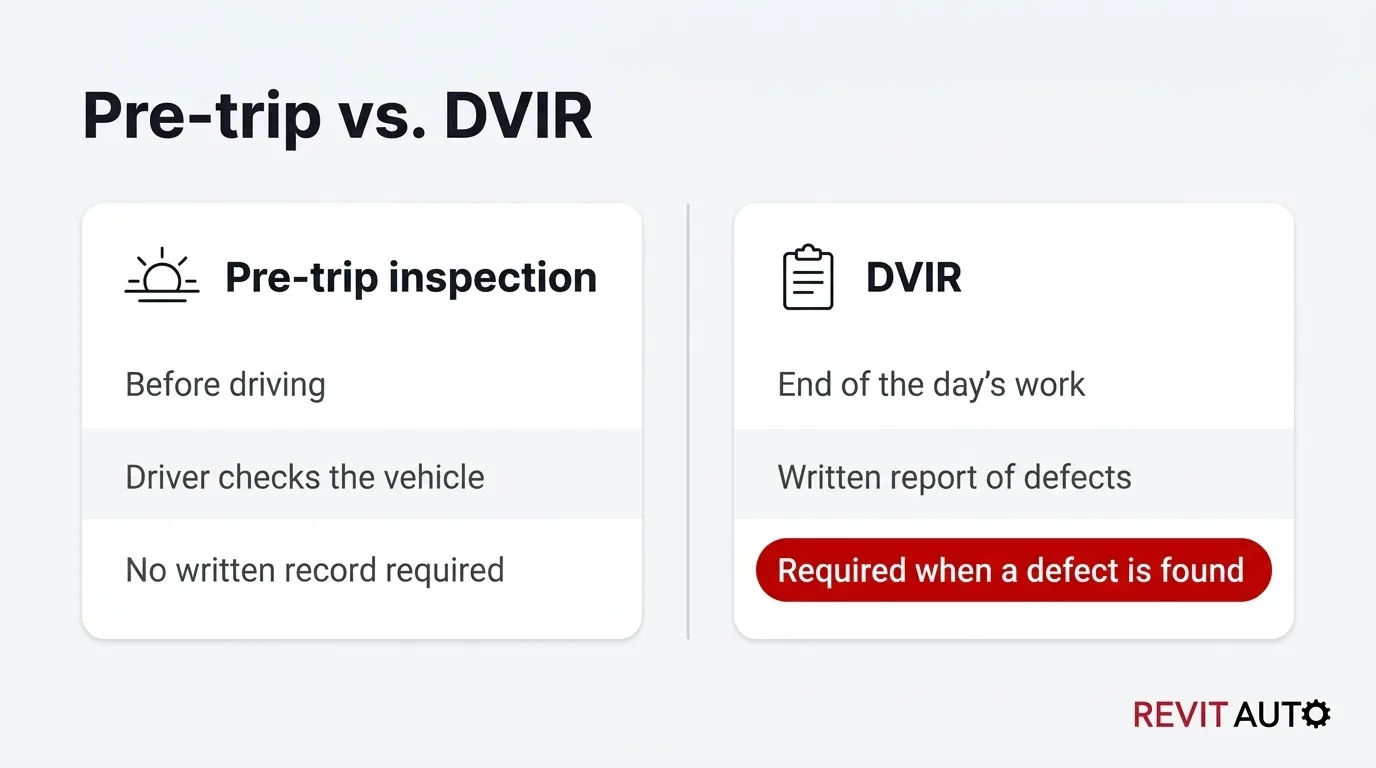
This is where most people get tangled up. A lot of drivers call the DVIR their “post-trip,” and that’s close: it’s the report written at the end of the day. A pre-trip is a different thing.
| Pre-trip inspection | DVIR | |
|---|---|---|
| The rule | 49 CFR 392.7 and 396.13 | 49 CFR 396.11 |
| What it is | The driver checks the vehicle | The written report of defects found |
| When | Before driving | At the end of the day’s work |
| Written record? | Not required by federal law | Required when a defect is found |
| Purpose | Catch problems before the road | Get them documented and fixed |
The two meet the next morning. Before driving, the driver has to be satisfied the vehicle is safe and review the last DVIR, if one was filed.
What must be on a driver vehicle inspection report?
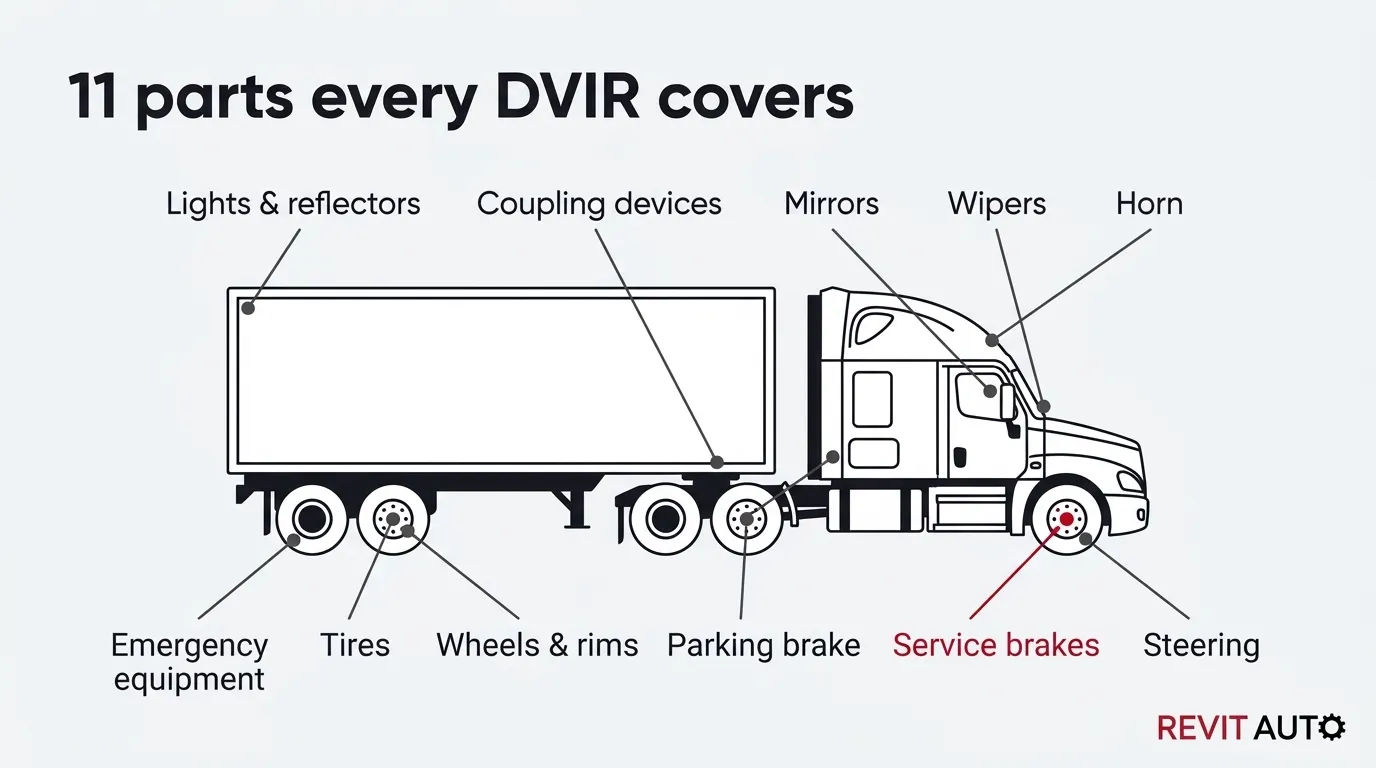
Under 49 CFR 396.11, the report has to cover at least these 11 parts:
- Service brakes, including trailer brake connections
- Parking brake
- Steering mechanism
- Lighting devices and reflectors
- Tires
- Horn
- Windshield wipers
- Rear-vision mirrors
- Coupling devices
- Wheels and rims
- Emergency equipment
They’re the same 11 parts a driver has to be satisfied with before driving under 49 CFR 392.7.
The report has to identify the vehicle and list any defect that would affect safe operation or cause a breakdown. A driver who runs two vehicles in a day fills out one for each.
When I start any job, I check the plate, VIN and mileage first. Put the same details, plus the unit number, on every DVIR. The rule only says to identify the vehicle, but those details tie the report to one truck.
Free download: DVIR form template
A one-page form with all 11 parts, the vehicle details and all three signature lines.
Who signs a DVIR?
A DVIR that lists a defect needs three sign-offs:
- The driver who prepared the report. On a two-driver team, one signature is enough if both agree on the defects.
- The carrier or its mechanic, who certifies on the report that each defect was repaired, or that no repair was needed, before the vehicle runs again.
- The next driver, who reviews the report and signs it before driving, to show they’ve seen it and that the repairs were certified.
The Federal Motor Carrier Safety Administration (FMCSA) treats DVIRs seriously in a compliance review, the in-depth audit of a carrier’s records that FMCSA uses to assign a safety rating. Under its safety rating rules, failing to require drivers to file DVIRs is a “critical” violation.
Failing to fix out-of-service defects a driver reported, before the vehicle runs again, is “acute.” That’s the most serious level. We pulled DOT’s own roadside inspection data to see how often DVIRs get cited on the road. We counted every violation with a code starting 396.11 or 396.13 from October 2023 to October 2026. Officers wrote just 152 DVIR violations, out of more than 13.5 million violation records.
149 of those 152 were the same thing: no signature from the reviewing driver.
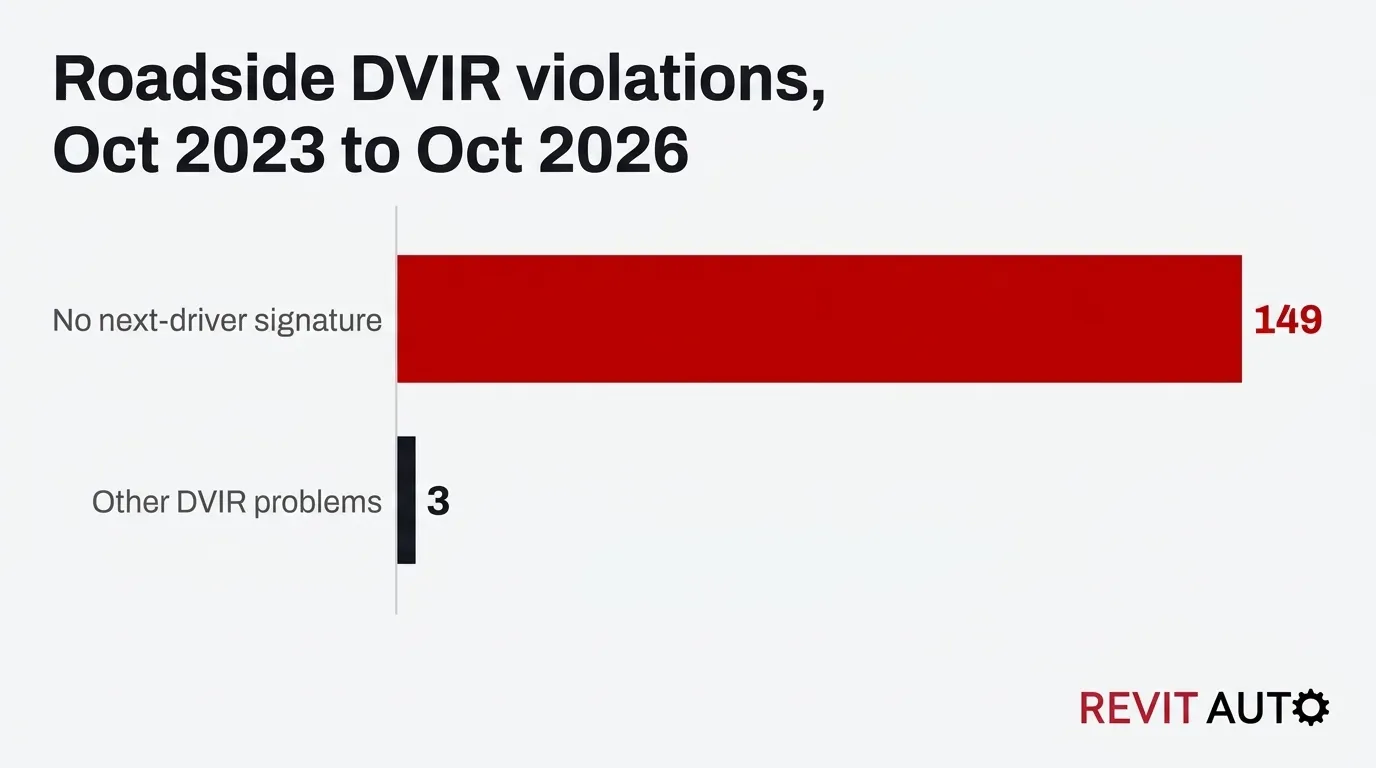
When a DVIR does get cited at roadside, it’s almost always the next driver’s signature. None of those 152 put a truck out of service. The bigger risk is your DVIR file in a compliance review.
DVIR rules by the numbers
| Figure | What it means |
|---|---|
| 11 | Parts a DVIR must cover under 396.11 |
| 3 | Sign-offs on a DVIR with a defect: driver, carrier or mechanic, next driver |
| 3 months | Minimum time to keep the DVIR, the repair certification and the next driver’s sign-off |
| 0 | DVIRs required on days with no defect (since 2014 for trucks and 2020 for passenger vehicles) |
| Mar 23, 2026 | Date the FMCSA electronic DVIR rule took effect |
Sources: 49 CFR 396.11, 49 CFR 396.13, and the FMCSA electronic DVIR final rule, February 2026.
Do you need a DVIR every day?
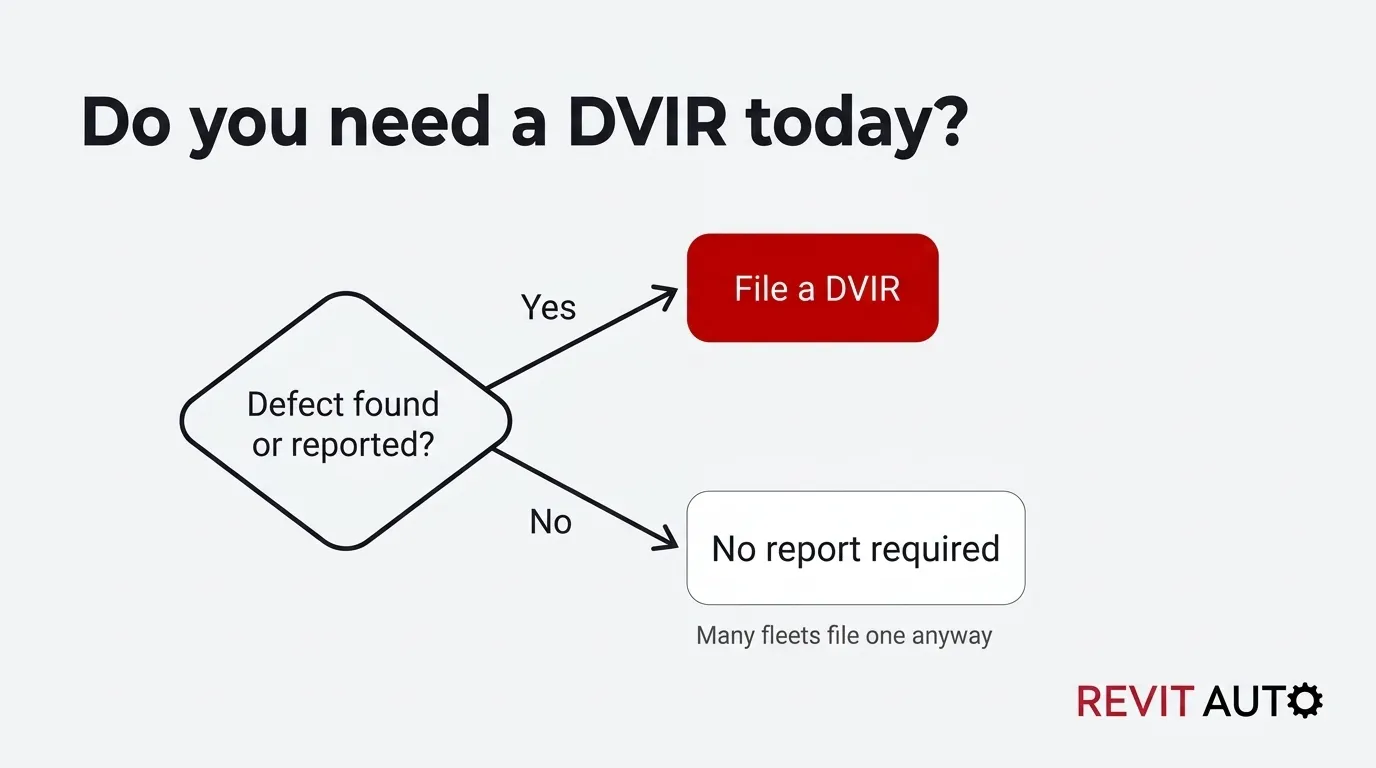
No, and this one trips up a lot of fleets. Under 396.11, drivers don’t have to prepare a report when no defect is found or reported to them.
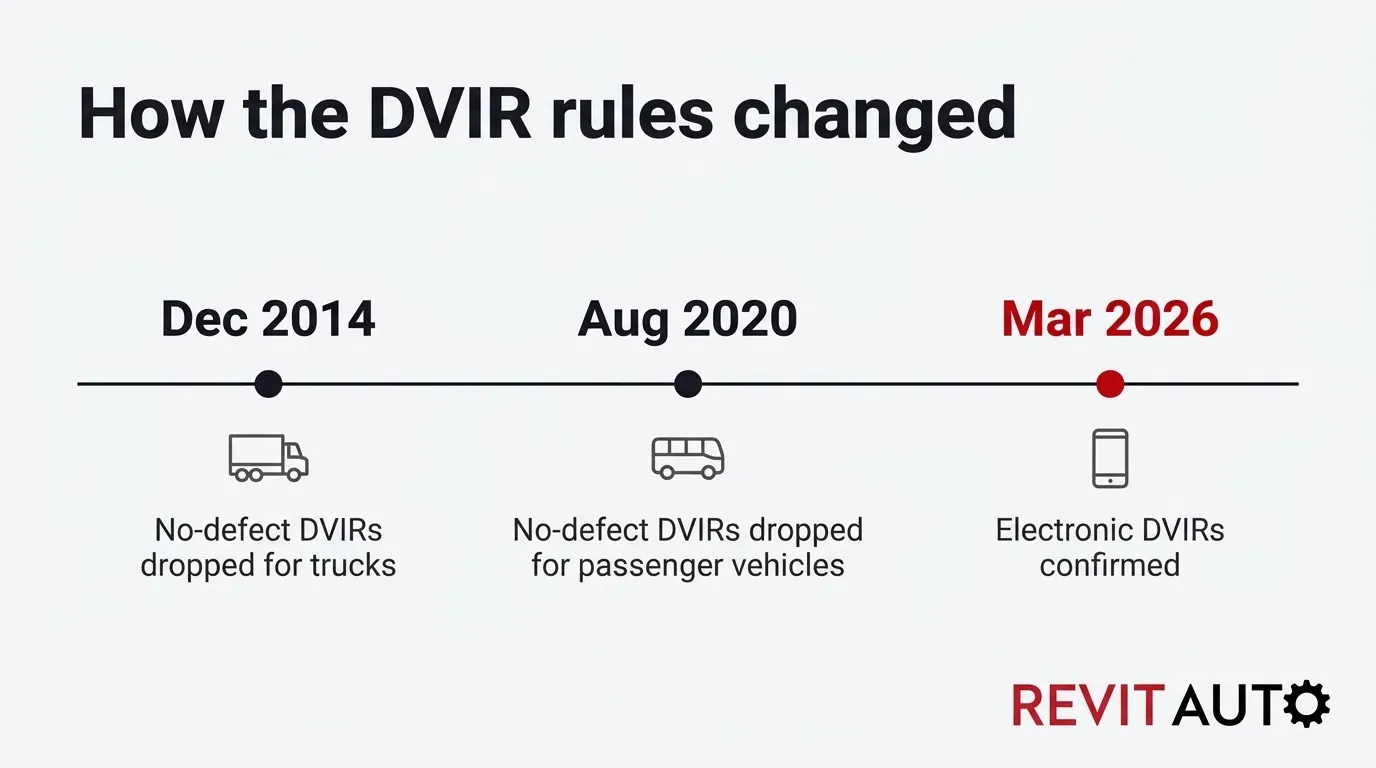
That’s been true for property-carrying trucks since a December 2014 rule. FMCSA extended it to passenger-carrying vehicles in an August 2020 rule.
Plenty of fleets still require a DVIR every day as company policy. It’s a habit, so drivers don’t forget the day it matters, and it gives you a cleaner record.
Are electronic DVIRs allowed?
Yes. An electronic DVIR, or eDVIR, is the same report filled out and signed on a phone, tablet or computer. On February 19, 2026, FMCSA published a final rule on electronic DVIRs (Docket FMCSA-2025-0115). It took effect March 23, 2026.
It added a line to both 396.11 and 396.13: the reports “may be created and maintained in electronic format,” under the federal rule for electronic records, 49 CFR 390.32.
Paper DVIRs are still allowed. FMCSA also turned down a request to bring back no-defect reports for passenger vehicles.
If your drivers are on paper, the weak spot is the form that never makes it back to the office. A digital report can’t get left on a clipboard in the cab.
That’s one reason we built issue reporting into Downtime Terminator, the fleet app Revit Auto makes. Drivers can report a problem from their phone, and it turns into a work order you can track through the repair.
Make it safe for drivers to report
A DVIR only works if drivers write things down.
In my experience, a lot of drivers are afraid to tell you what’s wrong. They think they’ll get in trouble for something they did.
So I make it clear: the report helps me fix the truck faster and get it back on the road. Once drivers believe that, the defects show up on the DVIR instead of at roadside.
When a report does come in, act on it the same day. If drivers see their write-ups get fixed, they keep writing them.
What fleet managers say
“Revit shows up when they say they will, repairs our issues, and if they can’t or don’t have the part the team does the leg work and will figure out what is needed. The whole team communicates and even sends follow up messages to see if we have any issues. This is a proactive company not reactive.”
Shad Lyle · ★★★★★ Read the review on Google
Revit Auto is rated 5.0 from 120 reviews on Google, as of September 2026.
Get your DVIRs right the first time
A driver vehicle inspection report is a simple form, and fleets still get it wrong.
You need a clean form, drivers who feel safe reporting, repairs done before the truck goes back out, and the next driver’s signature every time.
Grab our free DVIR form template to standardize your reports. When a DVIR turns up a defect, we can fix it at your yard with mobile truck repair, and handle your onsite DOT inspections across Maryland, DC and Northern Virginia.
Free Maryland fleet compliance resources
| Resource | What it helps you do |
|---|---|
| DVIR form template (download) | Standardize every driver’s report |
| Annual DOT inspection checklist (download) | Pre-check every truck against the inspector’s list |
| Maryland DOT inspection requirements (guide) | Know who needs the annual inspection and when |
| Maryland PM Program guide (guide) | Understand Maryland’s state inspection program |
| Hours of Service and ELD rules (guide) | Stay legal on driver hours |
Frequently asked questions
What does DVIR stand for?
DVIR stands for driver vehicle inspection report. It’s the written report a commercial driver files listing any defects found on the vehicle, required under 49 CFR 396.11.
Is a DVIR the same as a pre-trip inspection?
No. The pre-trip is the driver checking the vehicle before driving.
The DVIR is the written report of defects, filed at the end of the day’s work when a defect was found.
Do I need to file a DVIR every day?
Only when the driver finds or is told about a defect. That applies to trucks (since 2014) and passenger vehicles (since 2020).
Many fleets still require one every day as company policy.
How long do I have to keep a DVIR?
At least three months from the date the report was written, under 49 CFR 396.11. Keep the repair certification and the next driver’s sign-off with it.
Who has to sign a DVIR?
The driver who wrote it, the carrier or mechanic who certifies the repair, and the next driver, who signs before driving. On a two-driver team, one driver’s signature is enough if both agree on the defects.
Are electronic DVIRs legal?
Yes. An FMCSA final rule that took effect March 23, 2026 says DVIRs may be created and kept electronically under 49 CFR 390.32. Paper is still allowed.
What happens if a fleet doesn't keep up with DVIRs?
In an FMCSA compliance review, failing to require drivers to prepare DVIRs is a “critical” violation. Running a vehicle again without fixing an out-of-service defect a driver reported is “acute.”
Fines can follow under the federal penalty schedule. Recordkeeping violations run up to $1,584 a day, with a $15,846 maximum.
Explore more compliance guides
This guide explains federal rules for general information. It isn’t legal advice. Confirm current requirements with FMCSA before acting on them.
Sources
- Driver vehicle inspection reports, 49 CFR 396.11 (eCFR)
- Driver inspection before driving, 49 CFR 396.13 (eCFR)
- Equipment to inspect before driving, 49 CFR 392.7 (eCFR)
- Electronic documents and signatures, 49 CFR 390.32 (eCFR)
- Definition of a commercial motor vehicle, 49 CFR 390.5 (eCFR)
- FMCSA final rule, Electronic Driver Vehicle Inspection Reports, 91 FR 7893 (Federal Register, February 19, 2026; Docket FMCSA-2025-0115)
- FMCSA final rule removing no-defect DVIRs for property carriers, 79 FR 75437 (December 2014)
- FMCSA final rule, Passenger Carrier No-Defect DVIR, 85 FR 50787 (August 2020)
- Maryland adoption of federal safety rules for in-state carriers, COMAR 11.21.01.03
- Safety fitness rating methodology, acute and critical regulations, Appendix B to Part 385 (Cornell LII)
- Federal civil penalty schedule, Appendix B to Part 386 (Cornell LII)
- DOT Vehicle Inspections and Violations dataset (codes starting 396.11 and 396.13, queried November 1, 2026)