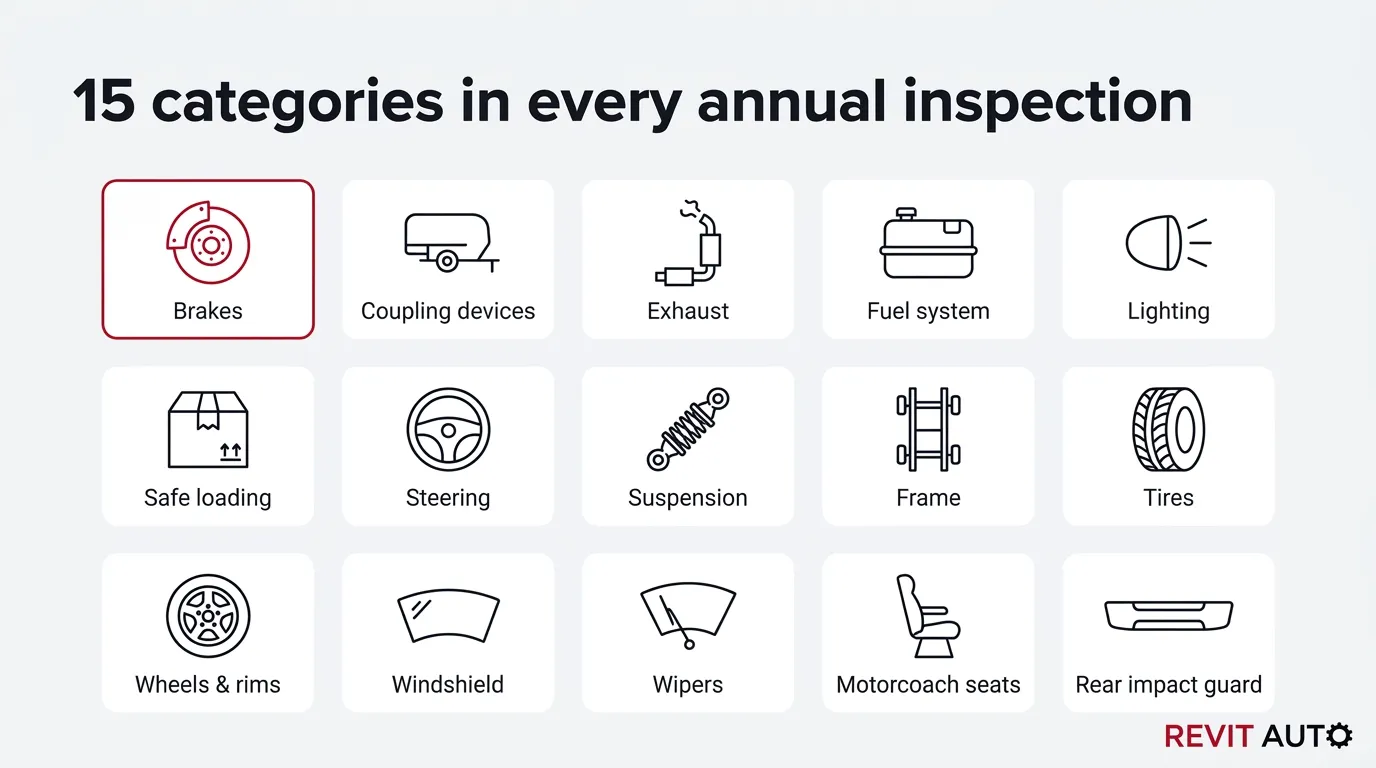
A DOT inspection checklist covers the 15 categories in Appendix A to 49 CFR Part 396, from brakes and steering to tires, lights and coupling devices. Each one has an exact pass or fail spec. A truck has to pass all 15 before it can run, and that inspection is good for 12 months.
Key takeaways
- Missing annual-inspection paperwork was the most common violation tied to this rule at roadside, with 502,508 violations in three years.
- Appendix A has 15 numbered categories, and every vehicle in a combination needs its own inspection.
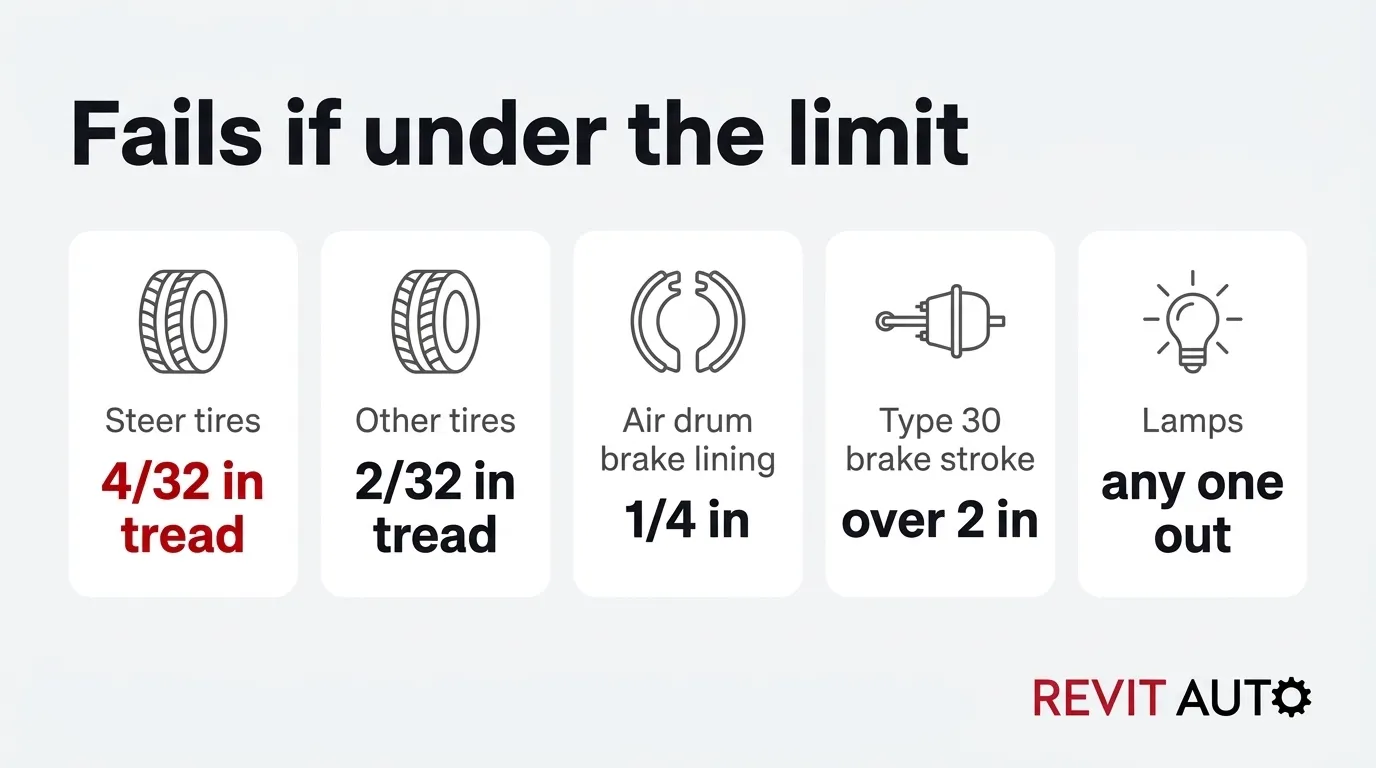
- Steer-axle tires need at least 4/32 inch of tread, and every other axle needs 2/32 inch.
- Air drum brake linings must be at least 1/4 inch thick at the shoe center.
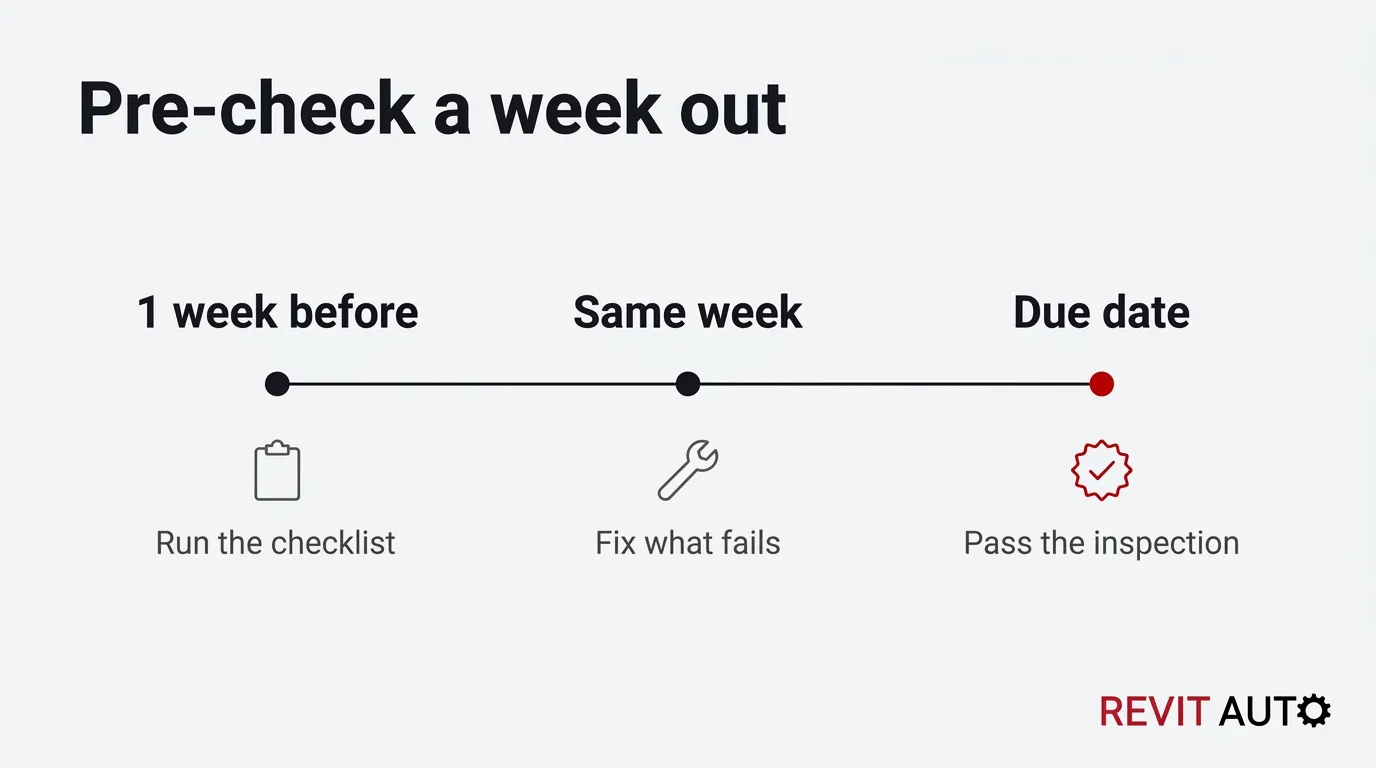
- Run the checklist a week before the due date, so a failed item becomes a repair instead of a second trip.
Appendix A is the federal list of minimum standards every annual inspection has to cover.
The annual inspection is a measured check of brake lining thickness, pushrod stroke and tread depth. A steer tire can look perfect and still sit a fraction under 4/32 inch.
The fleets that pass check against the real specs before inspection day, using a list like the one below.
How the annual inspection works
Under 49 CFR 396.17, every commercial motor vehicle has to pass a periodic inspection at least once every 12 months.
That means any business vehicle rated 10,001 lb or more, plus the other commercial vehicle types. It covers each vehicle in a combination, so a tractor and its trailer are two inspections.
The inspection has to include, at a minimum, every part listed in Appendix A to Part 396. A vehicle doesn’t pass if it has any defect on that list.
Three things make it official:
- A qualified inspector does it. That can be your own trained person, or a garage you hire, under 49 CFR 396.19.
- Proof rides on the vehicle. A copy of the report, or a decal with the inspection date, the name and address of whoever keeps the report, the vehicle ID (if it isn’t marked on the truck) and a certification that it passed.
- You keep the report for 14 months, under 49 CFR 396.21, along with proof of the inspector’s qualifications.
Two of our technicians trained as inspectors while working at Revit, and they do our annual inspections.
Run the same checklist yourself first, and nothing on inspection day is a surprise.
The DOT inspection checklist, by category
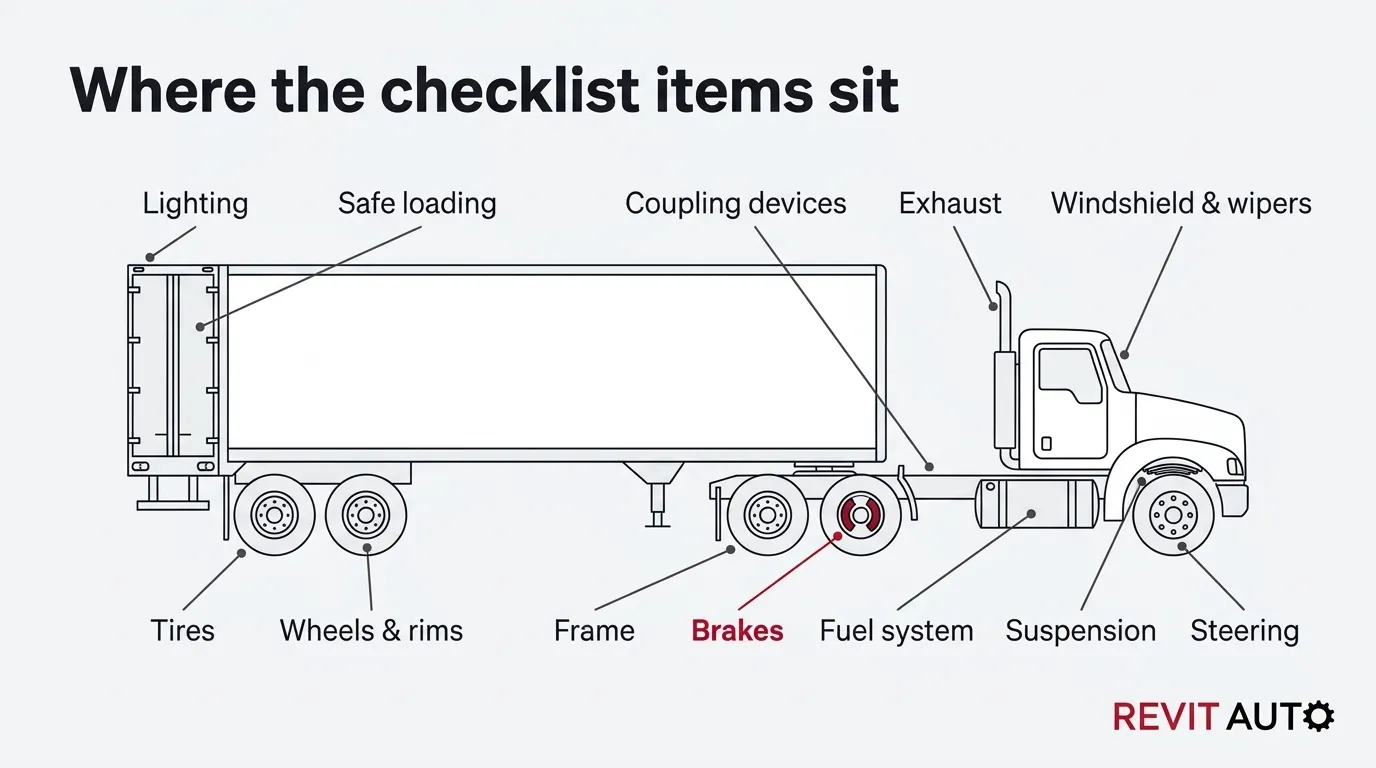
Appendix A has 15 numbered categories. I’ve grouped them by system so you can work through one at a time.
The very first thing I do when I look at a truck is go to the back and check the license plate and registration. Then I check the VIN, the oil-change sticker and the mileage, so the paperwork matches the truck.
Brake system
Brakes were again the top out-of-service category in the 2026 International Roadcheck (CVSA, 2026), so start here.
- Service brakes on every axle, the parking brake, drums, rotors, linings and pads
- Brake hoses and tubing, with no audible air leaks
- Brake adjustment within the limit for the chamber type, and automatic slack adjusters that actually adjust
- The tractor protection valve, the low-pressure warning and the air compressor
- Hydraulic, vacuum or electric brakes where fitted, and antilock brakes where required
Pushrod stroke is how far the brake chamber’s pushrod travels when the brakes are applied. Too much travel means the brake is out of adjustment.
Steering mechanism
- Steering wheel free play (lash) within limits
- Steering column, gear box, pitman arm, tie rods and drag links
- Power steering working, with no leaks
Lighting devices
Every lamp and reflector required by Part 393 has to work.
An inoperable required lamp was the most common single violation code in our roadside data, so check every one.
Tires, wheels and rims
- Tread depth, measured in a major groove, on every tire
- Sidewalls, bulges, exposed cords and leaks
- Wheels, rims, lock rings and fasteners, with no cracks or loose or missing nuts
Suspension, frame and coupling devices
- Springs, spring hangers, U-bolts and torque arms
- Frame rails and cross members, with no cracks, sagging or loose mounts
- The fifth wheel and kingpin, or the pintle hook, drawbar and safety chains on full trailers and dollies
Fuel, exhaust, loading, glass and guards
- Fuel system: no leaks, and tanks and caps secured.
- Exhaust system: no leaks forward of or directly below the cab or sleeper, and nothing placed where it could burn wiring, fuel lines or other combustible parts.
- Safe loading: nothing (load, dunnage or the spare tire) that could fall onto the road, and a front-end structure (headerboard) where one is required.
- Windshield glazing and wipers: no damage in the driver’s view, and wipers that work.
- Rear impact guard, plus seats on motorcoaches.
Mirrors, the horn and emergency equipment aren’t on the Appendix A list. Drivers check them before every trip, and officers still cite them at roadside.
The pass/fail specs that catch fleets
These are the Appendix A limits:
| Item | Fails if |
|---|---|
| Steer-axle tires | Less than 4/32 inch of tread in a major groove |
| All other tires | Less than 2/32 inch of tread in a major groove |
| Air drum brake lining | Less than 1/4 inch thick at the shoe center |
| Air disc brake pad (any axle) | Less than 1/8 inch thick |
| Hydraulic or electric drum brake lining | 1/16 inch or less at the shoe center |
| Brake adjustment | Pushrod stroke over the readjustment limit (for example, 2 inches on a standard Type 30 clamp chamber, 2½ inches on a long-stroke Type 30) |
| Steering free play, 20-inch wheel | More than 2½ inches on manual steering, or 5¼ inches on power steering (engine running) |
| Lamps and reflectors | Any required one doesn’t work |
Pushrod stroke is measured with the engine off and the air tanks at 80 to 90 psi, with the brakes fully applied.
Measure these with a tread gauge and a ruler, not by eye.
Free download: DOT inspection checklist
Every Appendix A category, with the pass/fail specs built in, on two printable pages.
What gets trucks cited at roadside
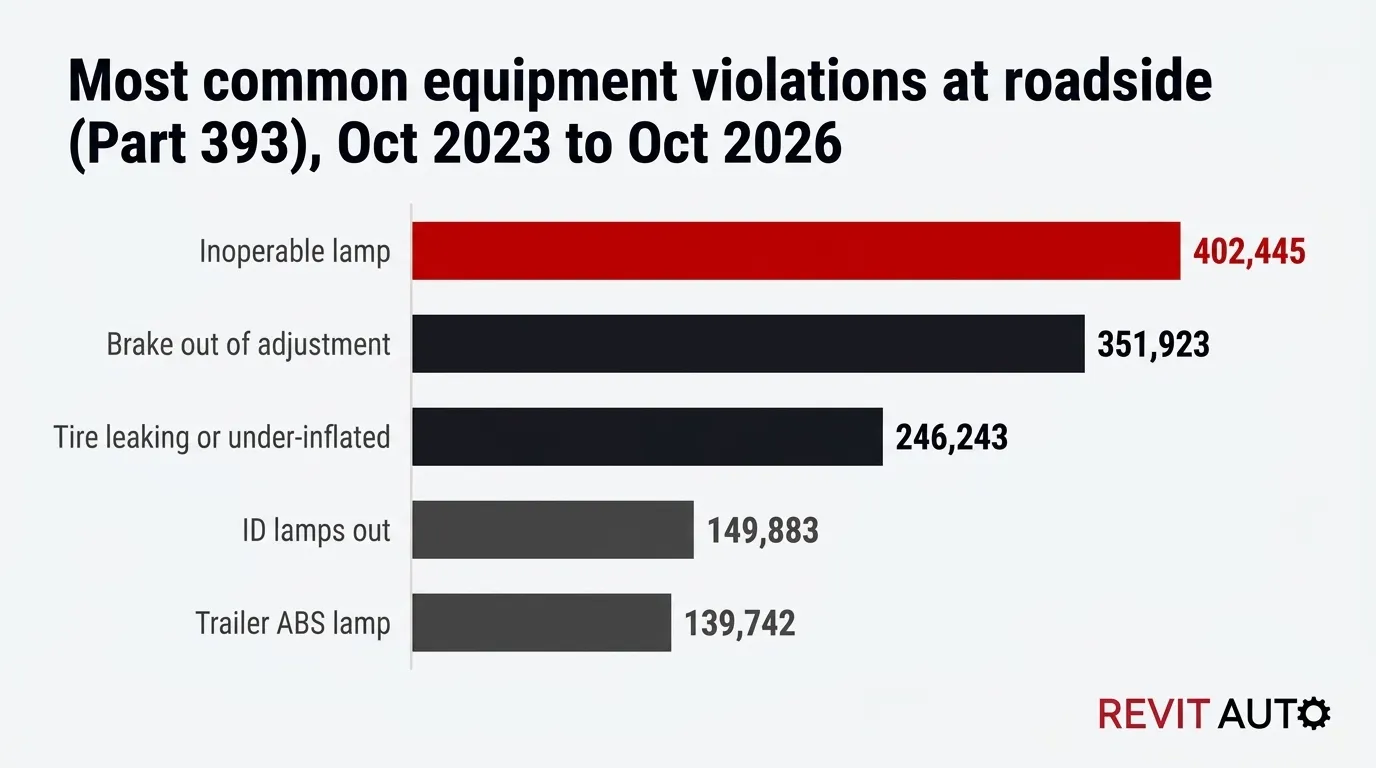
We pulled DOT’s own roadside inspection data and counted every vehicle violation under Parts 393 and 396, from October 2023 to October 2026 (DOT roadside data, 2023 to 2026).
The violation fleets got more than any lamp or brake was missing annual-inspection proof: 502,508 violations across two codes (396.17C and 396.17C-PI). Keeping the report or decal in the cab fixes that one for free.
Among equipment problems, lights and brake adjustment top the list, and a pre-inspection catches both.
An out-of-service violation means the truck can’t move until it’s fixed. Tire problems do that fast: of 246,243 violations for a leaking tire or one under 50% inflation, 240,961 were out-of-service violations.
In the 2026 International Roadcheck, a 72-hour inspection blitz across North America in May, inspectors put 10,350 of the vehicles they checked out of service, about 19% (CVSA, 2026). Brakes were the top reason again.
| Figure | What it means |
|---|---|
| 15 | Numbered categories in Appendix A |
| 502,508 | Roadside violations for missing annual-inspection proof, Oct 2023 to Oct 2026 |
| 402,445 | Violations for an inoperable required lamp over the same period |
| 351,923 | Violations for brakes out of adjustment over the same period |
| 4/32″ | Minimum steer-axle tread depth in a major groove |
| 1/4″ | Minimum air drum brake lining at the shoe center |
| 14 months | How long to keep the annual inspection report (396.21) |
Sources: Appendix A to Part 396, 49 CFR 396.21, and the DOT Vehicle Inspections and Violations dataset.
Common mistakes before inspection day
- Eyeballing instead of measuring. Tread and lining pass or fail by a fraction of an inch.
- Inspecting the tractor and forgetting the trailer. Each unit needs its own inspection and its own proof.
- Skipping the “small” categories. A burned-out marker lamp fails the inspection just like a bad brake.
- Fixing one brake and stopping there. A worn lining often means its partner on the same axle is close behind.
- Leaving it to inspection day. By then, a failed item means a second trip. Find it a week early and it’s just a repair.
How to use this checklist
Run it as a pre-inspection about a week before each vehicle is due:
- Walk every category with the specs in hand. Measure the tread, linings and pushrod stroke instead of guessing.
- Write down every defect, the same way your drivers do on a DVIR.
- Fix what fails before the inspection. Mobile truck repair can handle most of it where the truck is parked.
- Book the official inspection once everything passes. We do onsite DOT inspections at your yard.
If you rely on memory to catch this stuff, you’ll miss a truck eventually. A written checklist and a date on the calendar for every unit is the system that works.
Free tool: Maryland DOT compliance calendar
Track every truck’s and trailer’s due date, by month and by mileage, in one place.
What fleet managers say
“Revit Auto is the go-to maintenance provider. They have always communicated issues and notes immediately and follow up in a timely manner. They are always responsive and do a great job with repairs.”
Darin Strickland · ★★★★★ Read the review on Google
Revit Auto is rated 5.0 from 120 reviews on Google, as of September 2026.
Pass your next inspection the first time
Fleets that pass every year measure against the real specs, fix what fails, and then inspect.
Grab our free DOT inspection checklist with the specs built in. Or have us run onsite DOT inspections across Maryland, DC and Northern Virginia, and we can fix many failed items on the same visit.
Free Maryland fleet compliance resources
| Resource | What it helps you do |
|---|---|
| DOT inspection checklist (download) | Pre-check every truck against the Appendix A specs |
| Maryland DOT compliance calendar (tool) | Track due dates by month and mileage |
| Maryland DOT inspection requirements (guide) | Know who needs the annual inspection and when |
| DVIR guide (guide) | Set up daily driver inspection reports |
| Maryland PM Program guide (guide) | Understand Maryland’s state inspection program |
Frequently asked questions
What does a DOT inspection checklist include?
The 15 categories in Appendix A to Part 396: brakes, coupling devices, exhaust, fuel, lighting, safe loading, steering, suspension, frame, tires, wheels and rims, windshield glazing, wipers, motorcoach seats and the rear impact guard.
What's the most common reason trucks get cited?
In DOT roadside data from October 2023 to October 2026, missing annual-inspection proof led with 502,508 violations. Among equipment problems, an inoperable required lamp (402,445) and brakes out of adjustment (351,923) led. In the 2026 International Roadcheck, brakes were the top out-of-service reason.
Can I use this checklist on my own trucks?
Yes. Running it as a pre-inspection is how fleets catch problems early. A motor carrier can also do its own annual inspection, as long as the inspector is qualified under 396.19.
What tread depth passes a DOT inspection?
At least 4/32 inch in a major groove on steer-axle tires, and 2/32 inch on every other axle. Measure it, because a tire can look fine and still be under.
How long do I keep the annual inspection report?
14 months, under 49 CFR 396.21, along with the inspector’s qualification records. Keep a copy of the report or a decal on the vehicle too.
Do trailers need their own checklist?
Yes. Each vehicle in a combination, including the tractor, every trailer and any converter dolly, needs its own inspection and its own proof.
What happens if a truck fails?
It can’t be used until the defect is fixed and it passes. If an officer finds an out-of-service defect at roadside, the truck stays parked until it’s repaired.
Explore more compliance guides
This guide explains federal rules for general information. It isn’t legal advice. Confirm current requirements with FMCSA before acting on them.
Sources
- Periodic (annual) inspection rule, 49 CFR 396.17 (Cornell LII)
- Minimum periodic inspection standards, Appendix A to Part 396 (Cornell LII)
- Inspector qualifications, 49 CFR 396.19 (Cornell LII)
- Inspection record retention, 49 CFR 396.21 (Cornell LII)
- Parts and accessories necessary for safe operation, 49 CFR Part 393 (Cornell LII)
- DOT Vehicle Inspections and Violations dataset (Parts 393 and 396, queried November 1, 2026)
- CVSA 2026 International Roadcheck results (Commercial Vehicle Safety Alliance, 2026)