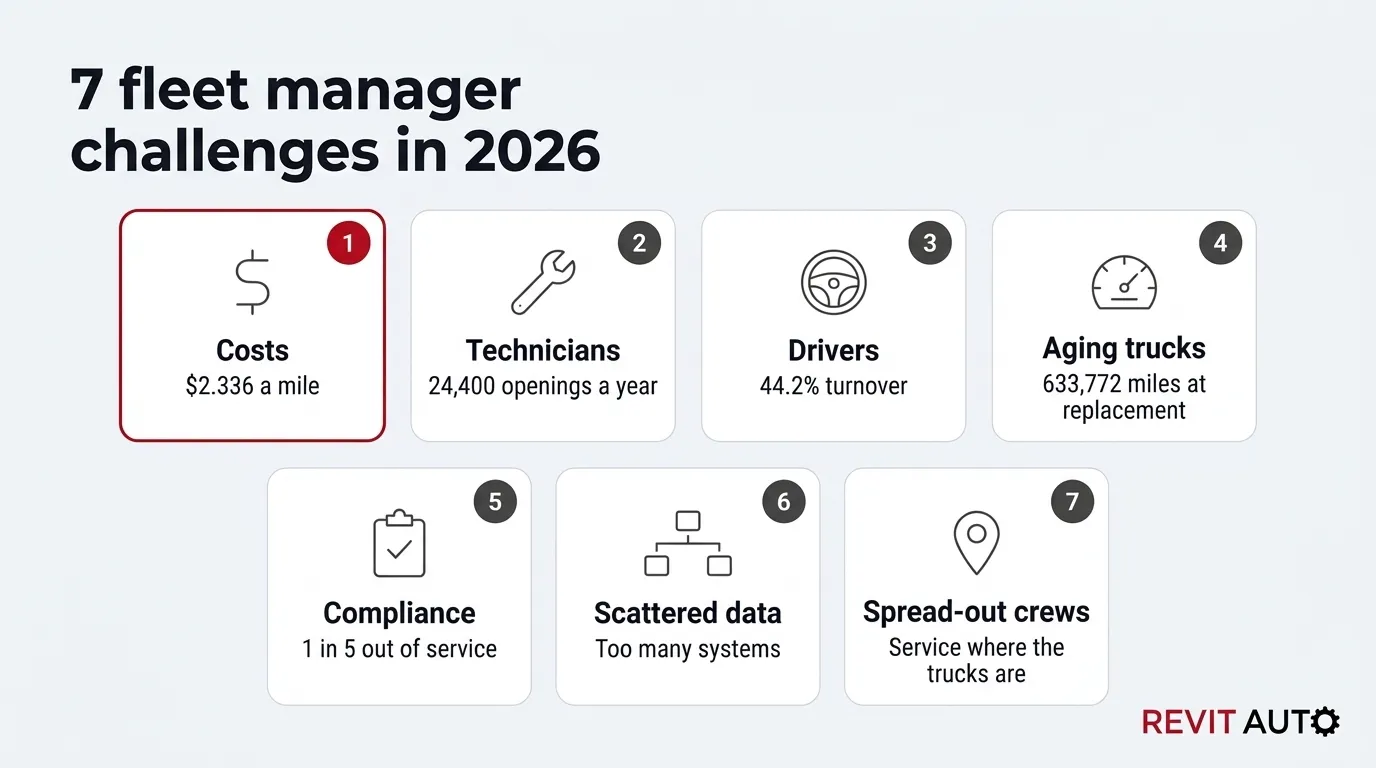
The biggest fleet manager challenges in 2026 are rising costs, short-handed shops, driver turnover, aging trucks, roadside compliance, scattered data and crews spread across a wide area. Most of them get worse the longer a vehicle sits off the road.
Key takeaways
- Running a truck cost a record $2.336 a mile in 2025, and repair and maintenance rose 8.6%, according to ATRI.
- BLS projects about 24,400 diesel technician openings a year through 2035, so shop waits aren’t going away.
- Trucks now hit an average of 633,772 miles before they’re replaced.
- About 1 in 5 trucks inspected in CVSA’s 2026 Roadcheck was put out of service, and brakes were the top reason.
- Cutting the time a vehicle spends waiting for service helps with almost every challenge on this list.
Search “fleet management challenges” and most of the results come from software companies selling tracking and dashboards. The industry numbers point at cost, people, old trucks and paperwork.
Enterprise fleets feel them hardest. Vehicles sit at several sites, budgets are split between departments, and crews rarely come back to one yard. The same is true for a 20-truck contractor working jobs across Maryland, DC and Northern Virginia.
Fleet manager challenges at a glance
| Challenge | Key figure | First fix |
|---|---|---|
| Operating costs | $2.336 a mile in 2025, a record | Track cost per vehicle, not just fleet totals |
| Technician shortage | About 24,400 diesel tech openings a year | Book PM on a fixed schedule |
| Driver turnover | 44.2% in 2025 | Fix driver-reported defects fast |
| Aging vehicles | 633,772 miles at replacement | Shorter PM intervals for older trucks |
| Roadside compliance | About 19% of trucks out of service in Roadcheck 2026 | Fix brakes and tires during routine service |
| Scattered data | Data integration named a top barrier | Pick the few numbers you need first |
| Spread-out crews | No public benchmark | Bring service to where the trucks are |
1. Operating costs keep climbing
ATRI put the average cost of running a truck at a record $2.336 a mile in 2025, up 3.4% from 2024 (Transport Topics). Repair and maintenance rose 8.6% to 21.5 cents a mile (FreightWaves).
Driver benefits rose 6.6%, tires about 6.4% and insurance about 3.9%. Over a longer stretch, liability insurance premiums rose 18.6% from 2021 to 2024, even as truck crash rates fell 2.6% (ATRI).
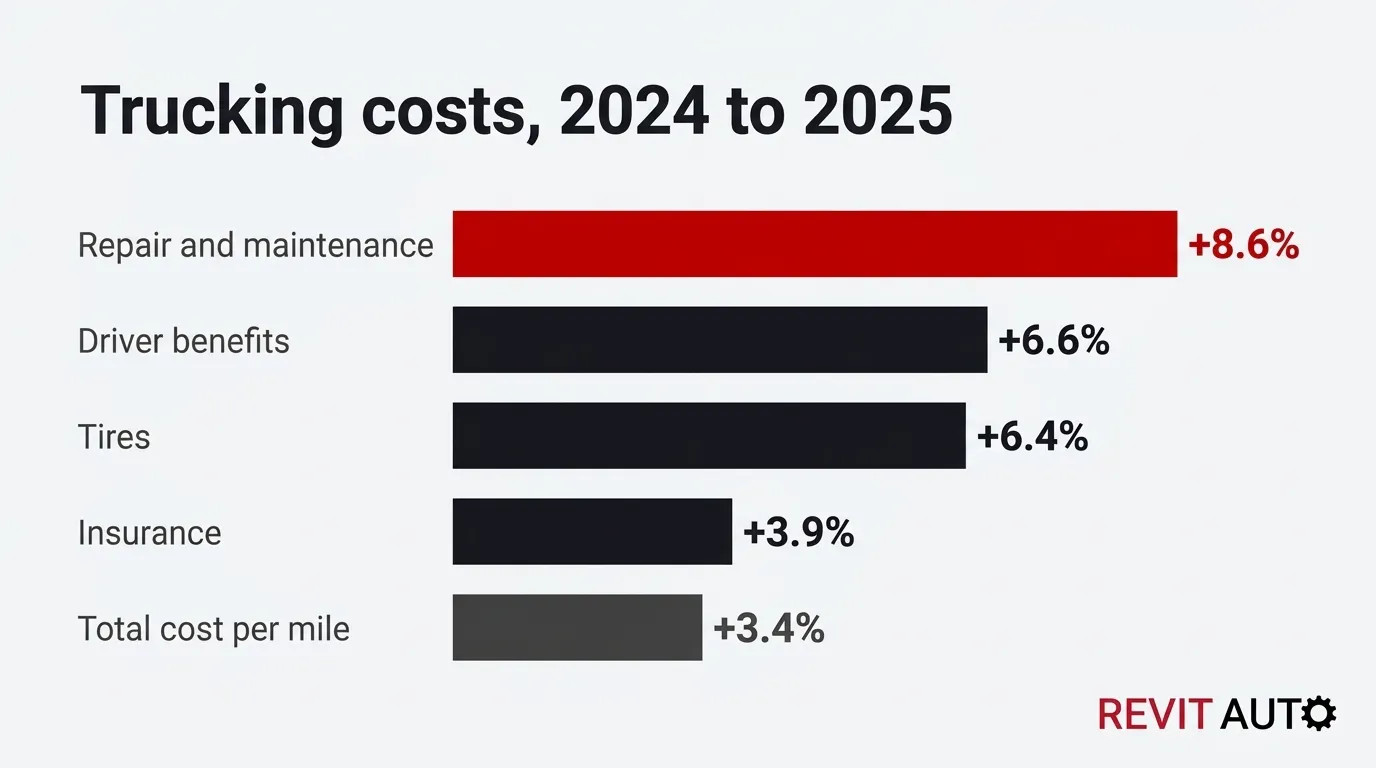
ATRI’s numbers come from for-hire trucking carriers. Use them as a benchmark, not as your fleet’s exact numbers.
Cost per mile is your total operating cost divided by the miles driven. It’s the simplest way to compare trucks of different ages and jobs.
What helps:
- Track cost per mile by truck, so you can see which ones drain the budget.
- Check insurance renewals against your actual claims and safety record.
- Put a dollar figure on downtime with our free downtime cost calculator.
- Use the vehicle cost calculator to decide when repairing an old truck stops making sense.
2. Not enough technicians
The Bureau of Labor Statistics projects about 24,400 openings for diesel technicians every year through 2035, while total jobs grow only 4% (BLS). Many of those openings replace techs who retire or leave the trade.
Fleet leasing company Element has forecast repair downtime rising 20% to 25% over current timelines (Automotive Fleet).
For a fleet manager, the shortage shows up as wait time. A two-hour repair can sit at a busy shop for days, and a driver loses half a shift shuttling the truck there and back.
What helps:
- Book preventive maintenance on a fixed schedule, so you aren’t fighting for emergency bay time.
- Bring the service to the truck. On-site fleet maintenance at your yard cuts out the drive, the wait and the pickup.
3. Finding and keeping good drivers
ATRI measured driver turnover at 44.2% in 2025, down from 48% the year before (FreightWaves). That still means replacing a big share of drivers every year.
Drivers notice how a fleet is run. Trucks that break down or come back with the same problem make the job harder, and good drivers have options.
What helps:
- Fix driver-reported defects fast. A DVIR only works if drivers see something happen when they write one up.
- Keep trucks reliable with planned maintenance, so drivers aren’t the ones stranded on the shoulder.
- Ask drivers which trucks they avoid. They usually know which one is about to fail.
4. Trucks staying in service longer
ATRI found the average mileage at replacement rose by nearly 50,000 miles, to 633,772 (Transport Topics). Fleet managers told Automotive Fleet about delivery delays on new trucks and replacement targets set “on a reduced budget” (Automotive Fleet).
When a new truck is expensive or late, the old one stays on the road. Older trucks need more maintenance, and they tend to fail in the same places.
On a quarterly inspection of a 2013 Freightliner box truck, I found dry-rot cracking in the suspension bushings and transmission cooler lines rusting to the point of flaking. Neither one was urgent, so we photographed them and flagged them to watch over the next few oil changes.
What helps:
- Move older trucks onto shorter PM intervals for brakes, batteries, cooling and air systems.
- Know the most common truck breakdowns and check for them on purpose.
- Track repair cost per truck, so the replacement call is based on numbers.
5. Compliance and roadside inspections
In CVSA’s 2026 International Roadcheck, inspectors put 10,350 of the vehicles they checked out of service, from 54,575 inspections (CVSA). That’s about 1 in 5. Brake systems were again the top reason.
Out of service means the truck can’t legally move until the problem is fixed, wherever it was stopped. In Maryland, about 1 in 4 trucks given a full Level I inspection in the last 12 months was put out of service, by our count of FMCSA data.
What helps:
- Build the annual inspection into your maintenance calendar instead of scrambling for it. Our annual DOT inspection checklist lists what’s checked.
- Fix brake and tire problems during routine service.
- If pulling trucks off the road is the problem, we do mobile DOT inspections in Maryland at your yard.
6. Data in too many places
In a 2026 Automotive Fleet survey of 190 fleet professionals, nearly 90% said they were moderately or highly confident in their cost tracking (Automotive Fleet). Yet many still relied on “spreadsheets, disconnected systems, and quarterly reconciliation,” and the survey named data integration as one of the biggest barriers.
Maintenance records live in one system, fuel cards in another, GPS in a third and inspection reports on paper. Nobody can answer “what did truck 14 cost us last quarter?” without an afternoon of spreadsheets.
On our side, every inspection goes into a digital report with photos, and I can pull a truck’s maintenance records on site from my phone.
What helps:
- Decide which numbers you need, like cost per vehicle, downtime days and PM completion, before buying another tool.
- Get maintenance history and vehicle health in one place. That’s what Revit Auto built Downtime Terminator to do.
- Keep a written fleet maintenance checklist so every truck gets the same inspection.
7. Managing crews across a wide area
When trucks and crews are spread across job sites from Baltimore to Northern Virginia, you can’t walk the lot every morning.
Picture a crew truck on a two-week job in Gaithersburg. It never comes back to the yard, so its oil change slips, then its brake check, until a warning light forces the issue.
What helps:
- Schedule service around where the trucks are, not where the shop is. Our service area covers Maryland, DC and Northern Virginia.
- Use telematics alerts for things that can’t wait, like engine fault codes and low battery voltage.
- Give each site lead a simple weekly check of tires, lights, fluids and warning lights.
- Prep for the season early. Our winter fleet maintenance guide covers what to check before the cold.
The common thread: time off the road
Costs, tech shortages, driver frustration, old trucks, inspections and spread-out crews all get worse the longer a truck waits for service. That’s why cutting downtime is usually a better first move than buying another dashboard.
A solid fleet maintenance program is the base the rest sits on.
What fleet managers say
Here’s how one fleet customer describes service at the job site:
“I can’t recommend Revit Auto enough. Not only do they serve our fleet at Value Dry Waterproofing, where they go to a job site that we are working at and fix our trucks, while our Crews are able to continue to work, “NO downtime”. They are Reliable, Fast, and Efficient.”
Carolyn Gooden · ★★★★★ Read the review on Google
Revit Auto is rated 5.0 from 120 reviews on Google, as of November 2026.
Start with the challenge costing you the most
If these sound familiar, start with the one costing you the most days off the road. We do preventive maintenance, repairs and DOT inspections at your location across Maryland, DC and Northern Virginia.
Frequently asked questions
What is the biggest challenge fleet managers face in 2026?
Cost, in several forms. ATRI put the average cost of running a truck at a record $2.336 a mile in 2025, with repair and maintenance up 8.6%.
Why are shop waits getting longer?
There aren’t enough diesel technicians. BLS projects about 24,400 openings a year through 2035, many of them replacing techs who leave the trade.
How do aging trucks affect fleet management?
Older trucks need more maintenance and tend to fail in the same places, like brakes, batteries and cooling systems. Shorter PM intervals and per-truck cost tracking keep them running and show when to replace them.
Why is fleet data so hard to manage?
Maintenance, fuel, GPS and inspection records usually live in separate systems. Decide which few numbers you need, then bring them together.
How do you manage a fleet spread across a wide area?
Schedule service around where the trucks are, use telematics alerts for urgent faults, and use on-site service so trucks don’t have to drive back to a shop.
How can fleet managers reduce downtime?
Move from reactive repairs to scheduled PM, fix driver-reported defects quickly, and cut the time trucks spend getting to and waiting at a shop.
How does Revit Auto help?
We do preventive maintenance, repairs and DOT inspections at your location across Maryland, DC and Northern Virginia, so your trucks spend less time off the road.
Sources
- ATRI Operational Costs of Trucking, 2026 update (Transport Topics)
- Trucking costs outpaced consumer inflation in 2025 (FreightWaves)
- ATRI research on rising insurance costs (ATRI)
- Diesel Service Technicians and Mechanics, Occupational Outlook Handbook (BLS)
- What’s driving operating costs in 2025 (Automotive Fleet)
- CVSA 2026 International Roadcheck results (CVSA)
- Fleet managers think they understand their costs (Automotive Fleet)
- 11 fleet managers describe challenges for 2026 (Automotive Fleet)
- FMCSA vehicle inspection file, Maryland, Nov 2025 to Oct 2026 (U.S. DOT open data, our analysis)