Winter fleet maintenance means fixing the systems cold weather attacks before the cold arrives: batteries, diesel fuel, air brakes and tires. In DC and Baltimore, the first freeze typically comes around November 1, so if it’s already November, start with batteries and fuel this week.
Key takeaways
- Cold mostly exposes weak batteries, wet air systems and soft tires that were already there.
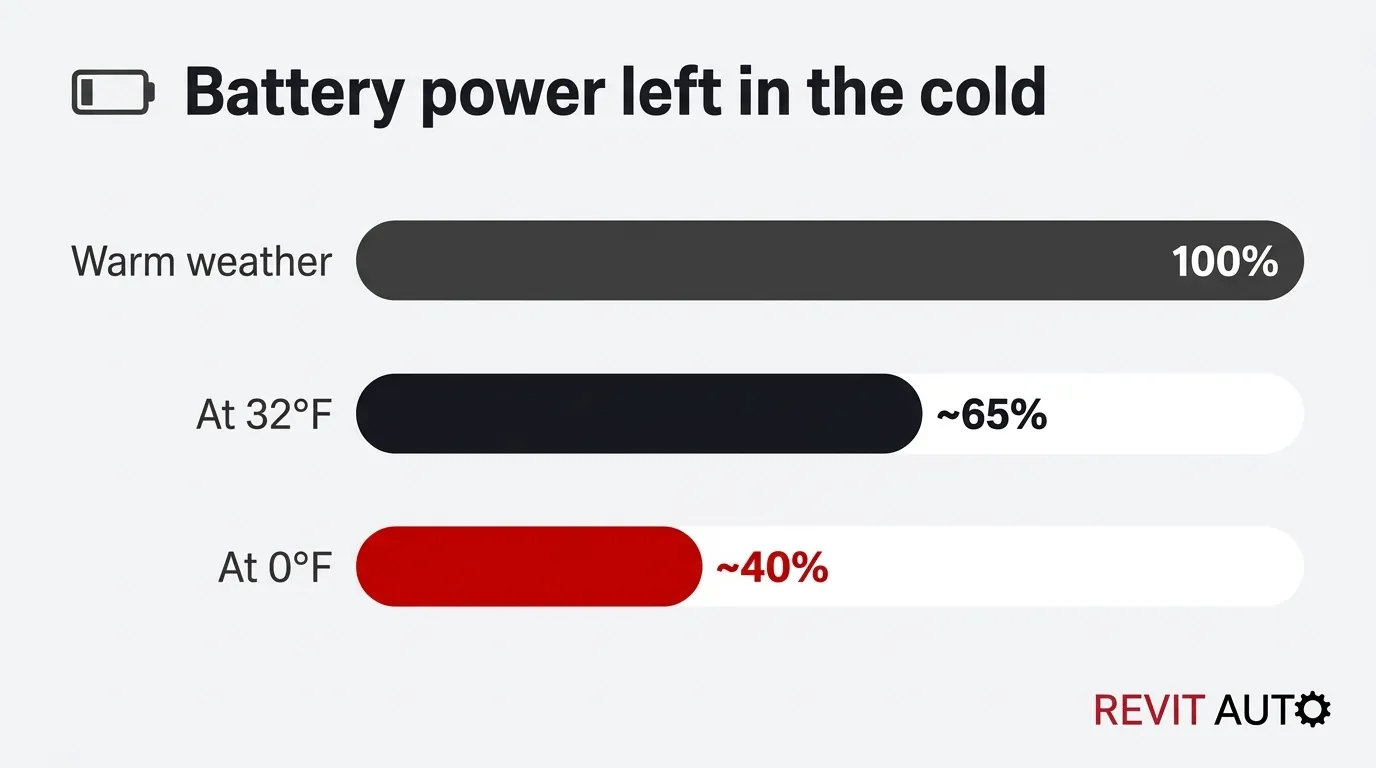
- A battery loses about 35% of its cranking power at 32°F and about 60% at 0°F, according to AAA.
- Most #2 diesel starts clouding with wax near 14°F, so switch to winter-blend fuel once nights approach 30°F.
- Tire pressure drops about 1 PSI for every 10°F, so check it weekly all winter, not once in October.
- In Maryland roadside data, December had the lowest vehicle out-of-service rate of any month in each of the last 3 years.
- Past the first freeze already? Start with batteries and fuel this week.
The first hard cold snap always finds somebody. Picture a box truck that started fine all October, then won’t turn over one cold morning.
Before I crank a weak truck on a cold morning, I hook up a jump box. A dying battery can drop voltage low enough to wipe stored data in the engine computer (ECU).
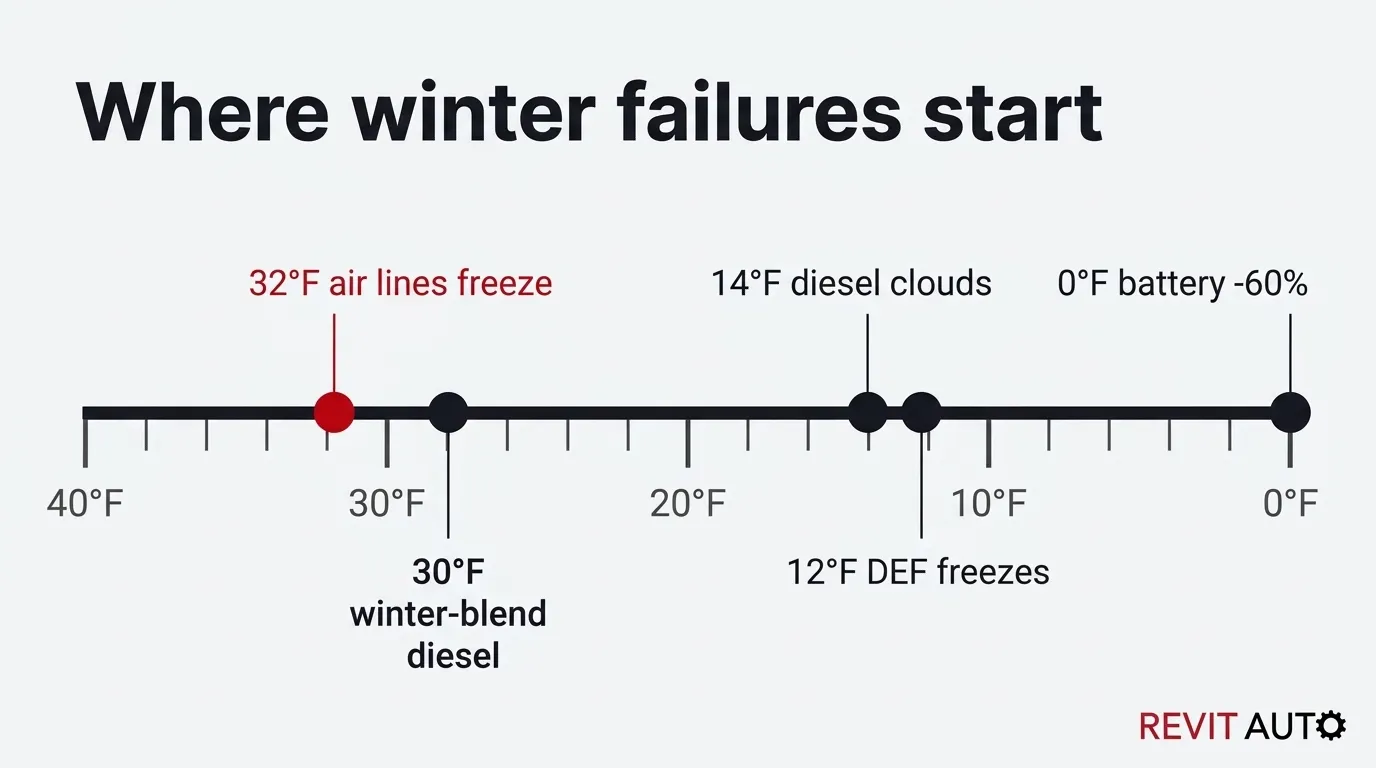
Each winter failure shows up at a known temperature, so you can plan for it.
When does cold weather start causing fleet failures?
Earlier than most fleets expect. Several systems hit trouble well above 0°F.
| Temperature | What happens |
|---|---|
| 32°F | Moisture in air brake lines and tanks can freeze. Batteries have already lost about 35% of their cranking power |
| ~30°F nights | Time to be on winter-blend diesel |
| ~14°F | Typical cloud point of #2 diesel: wax crystals form and filters start to plug |
| ~12°F | Diesel exhaust fluid (DEF) freezes. The truck is built to thaw it |
| 0°F | Batteries have lost about 60% of their cranking power |
| Every 10°F drop | Tire pressure falls about 1 PSI |
The winter fleet maintenance checklist, by system
On a winter PM, I check every fluid before the engine ever starts, the same as on any truck I diagnose. Then come the systems below.
Batteries and charging
A battery that tests weak in October won’t get better in January.
AAA Mid-Atlantic’s cold-weather figures put the loss at about 35% of cranking power at 32°F and 60% at 0°F. AAA was still quoting the same numbers in later winters.
What to check on every unit:
- Load-test every battery before the first no-start, not after it.
- Clean and tighten terminals. Corrosion adds resistance when you can least afford it.
- Replace anything that tests marginal. A new battery costs less than a tow and a lost route.
- Check alternator output. A weak alternator can drain a new battery fast on short winter runs.
- Check block heaters and cords on trucks that sit outside, and make sure drivers plug them in.
Diesel fuel and filters
The cloud point is the temperature where paraffin wax in diesel starts to form crystals. Fuel supplier Cenex puts it at about 14°F for #2 diesel.
Those crystals plug filters, and the fuel keeps thickening as it gets colder. Cenex’s advice is to be on a winter blend once nights dip toward 30°F.
- Confirm when your supplier switches to winter blend, and run down any summer fuel first.
- Add an anti-gel treatment before the cold. Check whether your product prevents clouding or rescues fuel that already clouded.
- Change fuel filters before winter. A partly clogged filter plugs first when wax forms.
- Drain water separators often. Water freezes at 32°F, long before the fuel clouds.
- Top off tanks at the end of the day to limit condensation.
Air brakes
Water left in the air system freezes at 32°F and can lock up valves and lines.
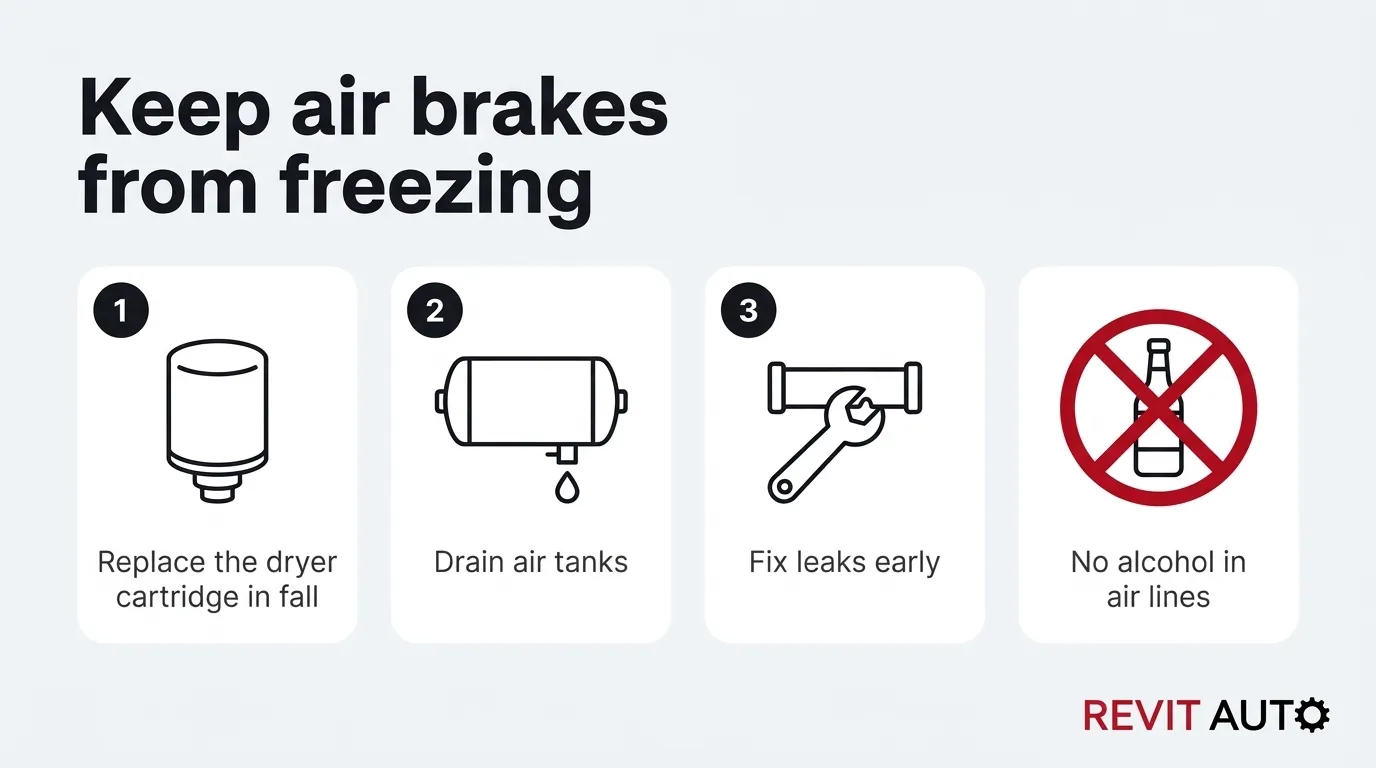
- Replace the air dryer cartridge in the fall. That’s the timing air brake maker Bendix recommends to keep moisture out.
- Drain air tanks regularly, or confirm the automatic drain valves work.
- Fix air leaks now. A slow leak in September can outrun the compressor in January.
- Don’t pour alcohol into air lines. Bendix doesn’t recommend it in air brake systems under any conditions, because it can damage seals.
DEF system
Diesel exhaust fluid (DEF) is the urea solution a truck sprays into its exhaust to cut nitrogen oxide emissions.
DEF freezes around 12°F and expands about 7%, but freezing doesn’t hurt its quality.
Cummins’ service documentation says the tank and lines are heated and designed to freeze and thaw.
Trouble starts when a heater, line or sensor already has a fault.
- Clear any DEF heater or sensor codes before cold weather.
- Store spare DEF indoors, and don’t fill a tank to the brim right before a hard freeze.
Coolant, oil and visibility
- Test the coolant mix for the coldest night you expect, not an average one.
- Use the cold-weather oil viscosity your engine maker recommends.
- Fill washers with winter-rated fluid and replace streaky wipers.
- Check defrost and cab heat. A driver who can’t clear the windshield is a safety risk.
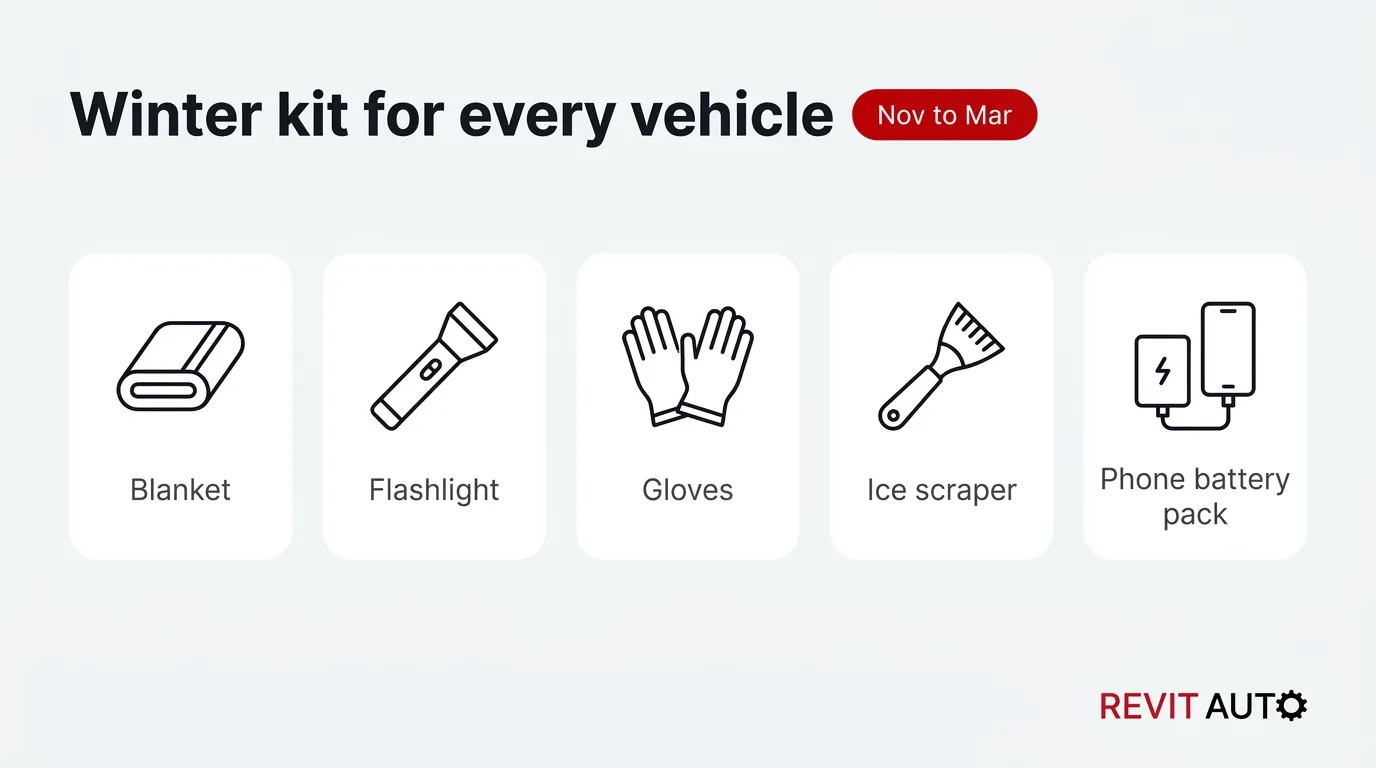
- Stock an emergency kit in every vehicle.
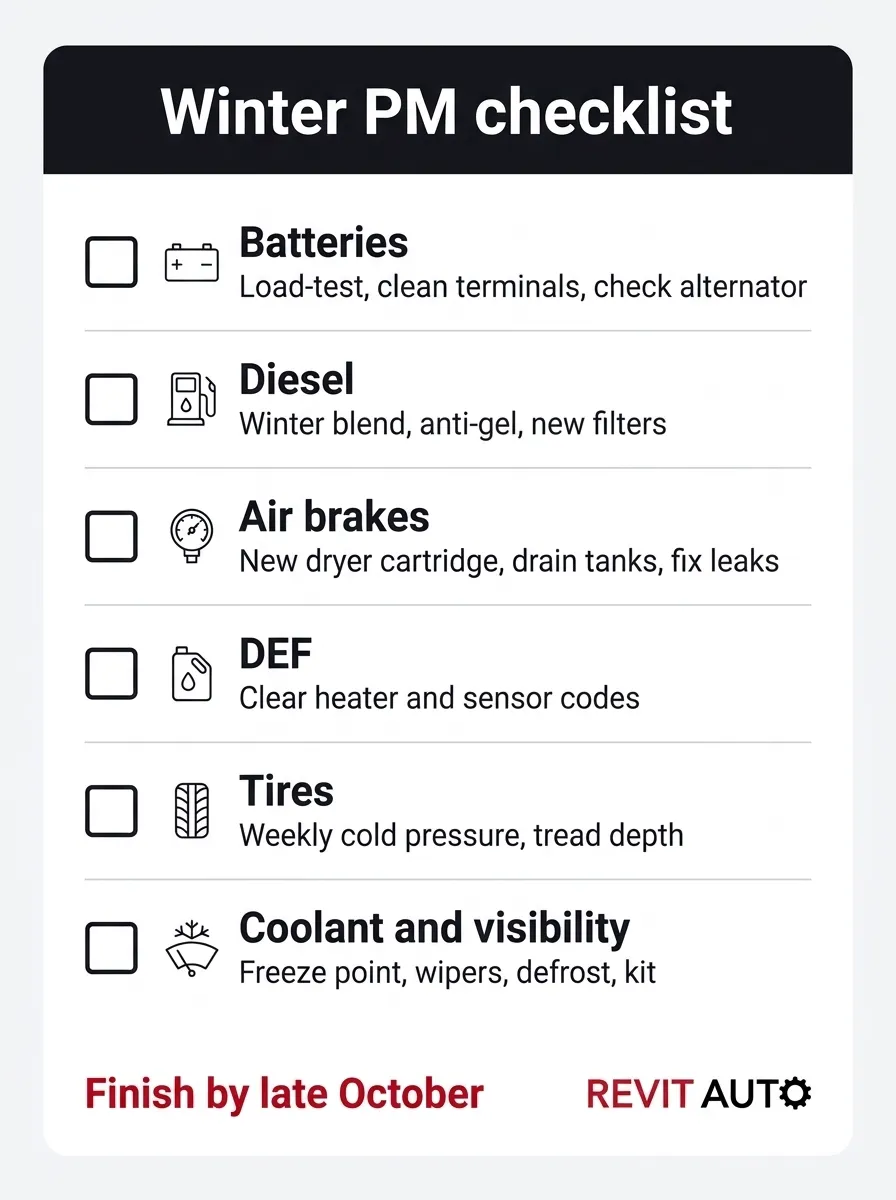
Free download: Winter fleet prep checklist
Every winter check in this guide on one printable page, by system and by vehicle.
How much does tire pressure drop in cold weather?
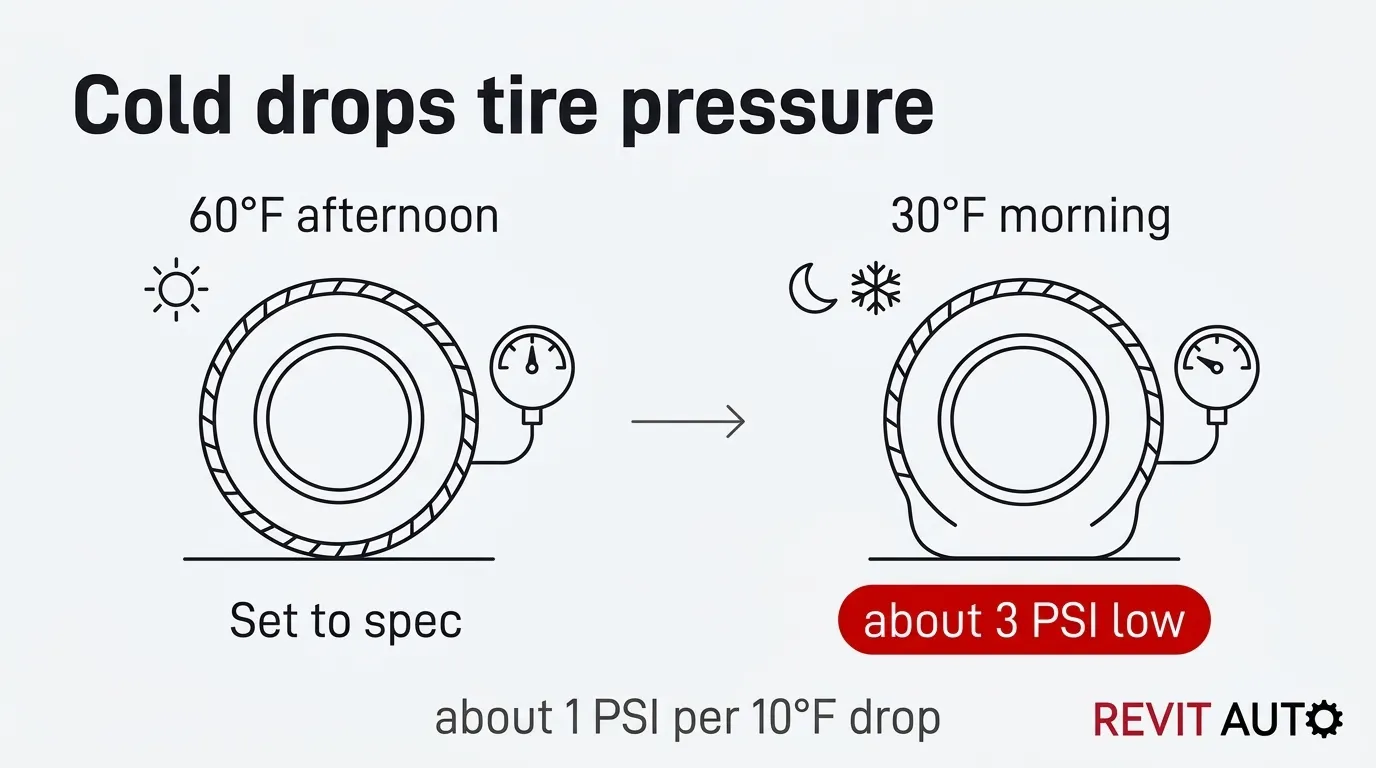
Goodyear’s tire specialists put it at about 1 PSI for every 10°F drop.
So a truck tire set correctly on a 60°F afternoon can be about 3 PSI low by a 30°F morning, with no leak at all.
The same drop can turn on the TPMS warning light (tire pressure monitoring system) on vans and pickups during the first cold mornings.
An underinflated truck tire runs hot, wears unevenly and can’t safely carry its rated load. Vans and pickups lose less in absolute terms, but the same weekly check applies.
Check tread while you’re at it.
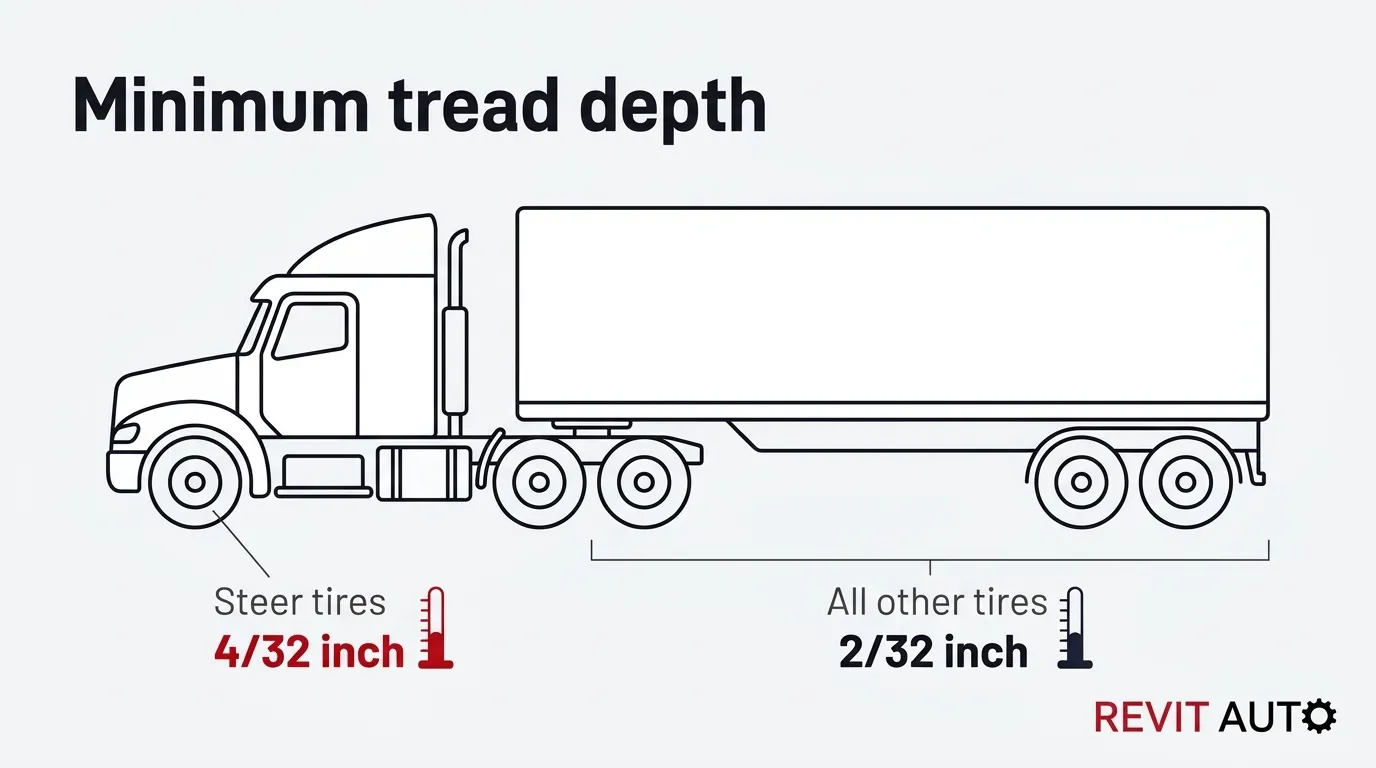
Federal rules set the minimum at 4/32″ on the front tires of trucks, tractors and buses and 2/32″ everywhere else (federal tread depth rule). A tire that’s legal in October can be marginal by February.
What to tell your drivers:
- Check pressures cold, before the first run, at least weekly from November through March.
- Set pressure to the vehicle’s spec, from the door sticker on vans and pickups or the tire maker’s load table on trucks.
- Put a cap on every valve stem. Road salt and grime get into an open valve and stop it from sealing.
- Measure steer-tire tread every month, not just at the annual inspection.
- Add tire checks to every driver vehicle inspection report (DVIR), so drivers flag a low tire before it fails.
Why DMV winters catch fleets out
Maryland, DC and Northern Virginia swing between mild and freezing all winter.
A mild week in the 50s can be followed by a night in the teens, then a thaw, then ice. That swing is harder on equipment than steady cold.
- Freeze and thaw adds moisture. Bendix notes that swings of more than 30°F can cause a temporary moisture buildup in air systems.
- Tire pressure moves with every swing, so a one-time October adjustment doesn’t hold.
- Mild stretches create false confidence. A weak battery survives December, then fails the first 10°F morning in January.
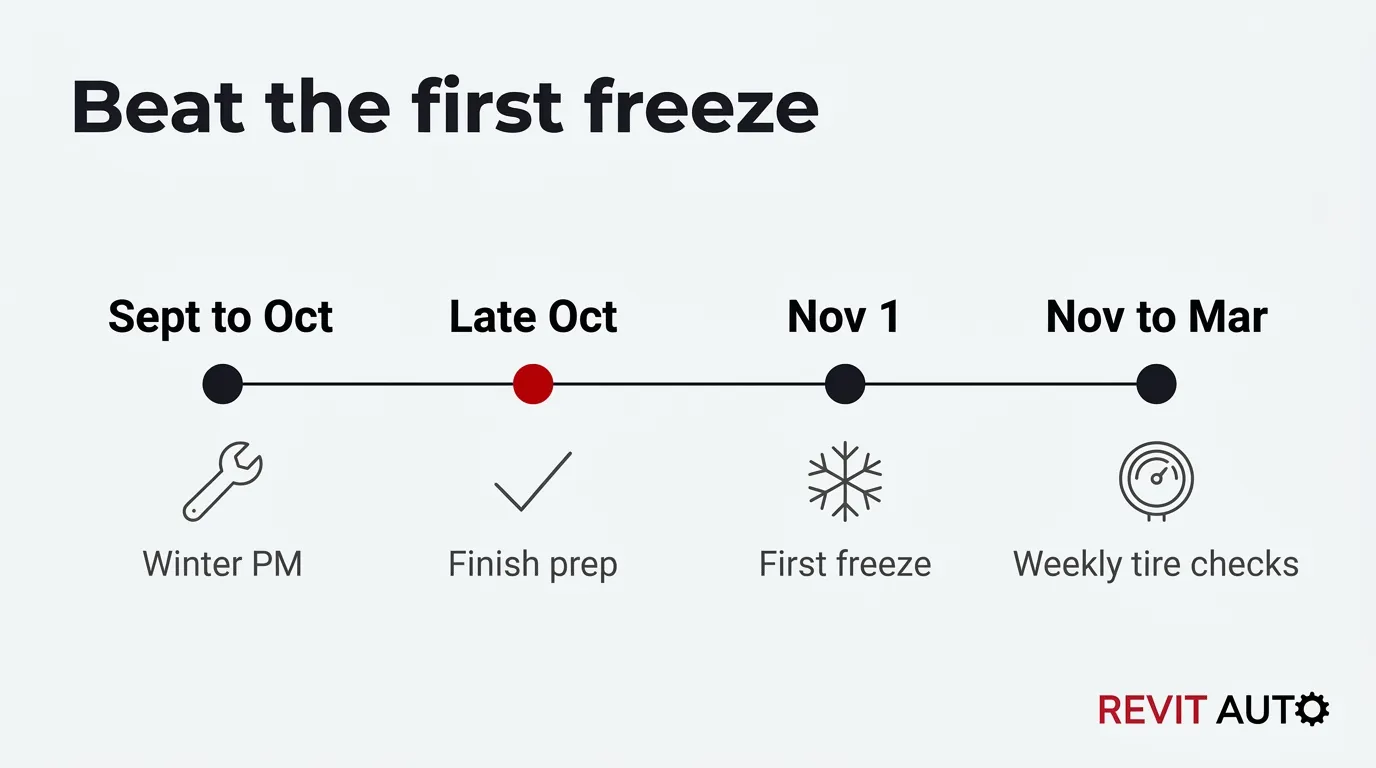
The National Weather Service’s climate normals put the first freeze for DC and Baltimore on or about November 1. Areas away from the I-95 urban core can freeze earlier.
So late October is the deadline across our Maryland, DC and Northern Virginia service areas. If it’s already November and nothing’s done, start with batteries and fuel this week, because those are the systems that stop a truck from starting when they fail.
What the roadside numbers miss
You might expect more trucks to fail roadside inspections in winter. In Maryland roadside data, the opposite shows up in December.
| Year (Nov to Oct) | Out of service, all inspections | Out of service, December |
|---|---|---|
| 2023-24 | 16.1% of 75,109 | 13.2% |
| 2024-25 | 16.5% of 80,751 | 11.4% |
| 2025-26 | 19.6% of 72,402 | 13.8% |
December had the lowest vehicle out-of-service rate of any month in each of the 3 years. Full Level I inspections alone show the same December low.
That doesn’t mean trucks hold up better in the cold. One likely reason is that a gelled filter or dead battery stops the truck in your lot, before an inspector sees it.
The inspection mix also changes by season. CVSA’s annual Brake Safety Week, for example, adds brake-focused inspections outside winter.
Method: we analyzed all 228,262 roadside inspections Maryland reported to FMCSA’s Vehicle Inspection File, November 2023 to October 2026. We counted the share with at least one vehicle out-of-service order, by month.
This includes all inspection levels and out-of-state trucks inspected in Maryland.
Build winter prep into your maintenance program
Winter prep works best as a scheduled service.
Put a “winter PM” on the calendar for every unit in October, alongside your regular fleet maintenance program. Use a written fleet maintenance checklist so nothing gets skipped on the 40th truck.
Batteries, fuel and tires show up in the most common truck breakdowns all year, and winter finds the weak ones first.
If a unit does go down, know what to do in a roadside emergency before you need it.
Free tool: Downtime Cost Calculator
See what one no-start morning costs your fleet in lost hours and routes, using your own numbers.
What customers say
One tractor owner wrote this after a February job:
“I used Revit Auto to replace a starter motor in my International tractor and do some work on some of my trailers. Aaron and Ari braved an extremely cold and windy February day and were outstanding. Their work was perfect and I would definitely call them back out for future repairs!”
David Stuckenschneider · ★★★★★ Read the review on Google
Revit Auto is rated 5.0 from 120 reviews on Google, as of November 2026.
Winterize your fleet before the freeze finds it
The fleets that run all winter are the ones prepped before the first hard freeze.
We do on-site preventive maintenance at your yard across Maryland, DC and Northern Virginia. A winter PM visit can cover battery testing, fuel system service, air brakes and tires.
If something’s already failing, our mobile truck repair team comes to the vehicle.
Free fleet winter resources
| Resource | What it helps you do |
|---|---|
| Winter fleet prep checklist (download) | Run every winter check on one page |
| Downtime Cost Calculator (tool) | See what a breakdown costs your fleet |
| Downtime Terminator app (app, made by Revit Auto) | Schedule winter PM and track every vehicle’s service |
| Fleet maintenance checklist (guide) | Build a year-round inspection routine |
| All fleet resources and tools (hub) | Calculators, checklists and templates in one place |
Frequently asked questions
When should I winterize my fleet in Maryland?
By late October. The National Weather Service puts the first freeze for DC and Baltimore near November 1.
Areas away from the I-95 urban core can freeze earlier. If you’re past that date, start with batteries and fuel right away.
At what temperature does diesel gel?
Trouble starts at the cloud point, about 14°F for most #2 diesel, according to Cenex. Wax crystals form there and begin plugging filters.
Switch to winter-blend fuel once nights approach 30°F, and add an anti-gel treatment before the cold arrives.
How much power does a battery lose in the cold?
According to AAA, about 35% of its cranking power at 32°F and about 60% at 0°F. That’s why marginal batteries fail on the first hard freeze.
How much does tire pressure drop in winter?
Tires lose about 1 PSI for every 10°F drop, per Goodyear. Check pressures cold, before the first run, every week through winter.
Why does my tire pressure light come on when it's cold?
Cold air takes up less space, so pressure falls overnight even without a leak. Check the tires cold and fill them to the spec on the door sticker.
Will frozen DEF damage my truck?
Freezing doesn’t harm DEF itself. It freezes around 12°F, and the system is designed to thaw it after startup.
Problems come from heaters, lines or sensors that already had faults, so clear any DEF codes before winter.
How do I keep air brakes from freezing?
Keep moisture out. Replace the air dryer cartridge in the fall, drain tanks regularly, and fix leaks early.
Bendix recommends against using alcohol in air brake systems.
Can Revit Auto winterize our fleet on-site?
Yes. We do winter preventive maintenance at your yard across Maryland, DC and Northern Virginia.
That covers batteries, fuel, air brakes, tires and fluids, so vehicles don’t need to go to a shop.
Explore more fleet maintenance guides
This guide gives general maintenance guidance. Always follow your vehicle and equipment makers’ service instructions, and confirm current tread rules with FMCSA.
Sources
- AAA Mid-Atlantic battery figures for cold weather (via WTOP, January 2017)
- AAA battery figures, later winter (via NBC Chicago)
- Cold-weather diesel problems and cloud point (Cenex)
- Winter-proofing DEF: freezing point and expansion (Mansfield Energy, November 2024)
- SCR system freeze and thaw design (Cummins service bulletin via NHTSA)
- Preparing air dryers and wheel ends for winter (Bendix Tech Tips via Movin’ On)
- Truck tire pressure in winter (Goodyear via Movin’ On)
- Federal minimum tread depth rule (Cornell Law)
- First-freeze timing for DC and Baltimore, NWS 1991-2020 normals (via WOAY)
- Vehicle Inspection File (FMCSA via data.transportation.gov, queried November 2026)