Maryland DOT inspection requirements say every commercial truck, trailer, or passenger vehicle used for business and rated 10,001 lb or more must pass a DOT inspection at least once every 12 months, with proof kept on the vehicle.
Maryland-registered trucks can meet this through the state’s Preventive Maintenance Program, which can also make a truck due sooner by mileage.
Key takeaways
- Any truck or trailer used for business and rated 10,001 lb or more needs a DOT inspection at least once every 12 months.
- Maryland’s own program can make a truck due sooner, at 25,000 miles for most vehicles.
- A tractor and every trailer it pulls each need their own separate inspection.
- Missing inspection proof gets you a citation and a hit to your safety score, but almost never an automatic out-of-service order.
- A passing Maryland program inspection counts as your federal annual inspection.
Most annual inspection problems aren’t about unsafe trucks.
A date slips, a trailer gets missed, or the paperwork isn’t in the cab when an officer asks. The rules are simple, but they’re strict.
Here’s what applies to your Maryland fleet.
Who needs an annual DOT inspection in Maryland?
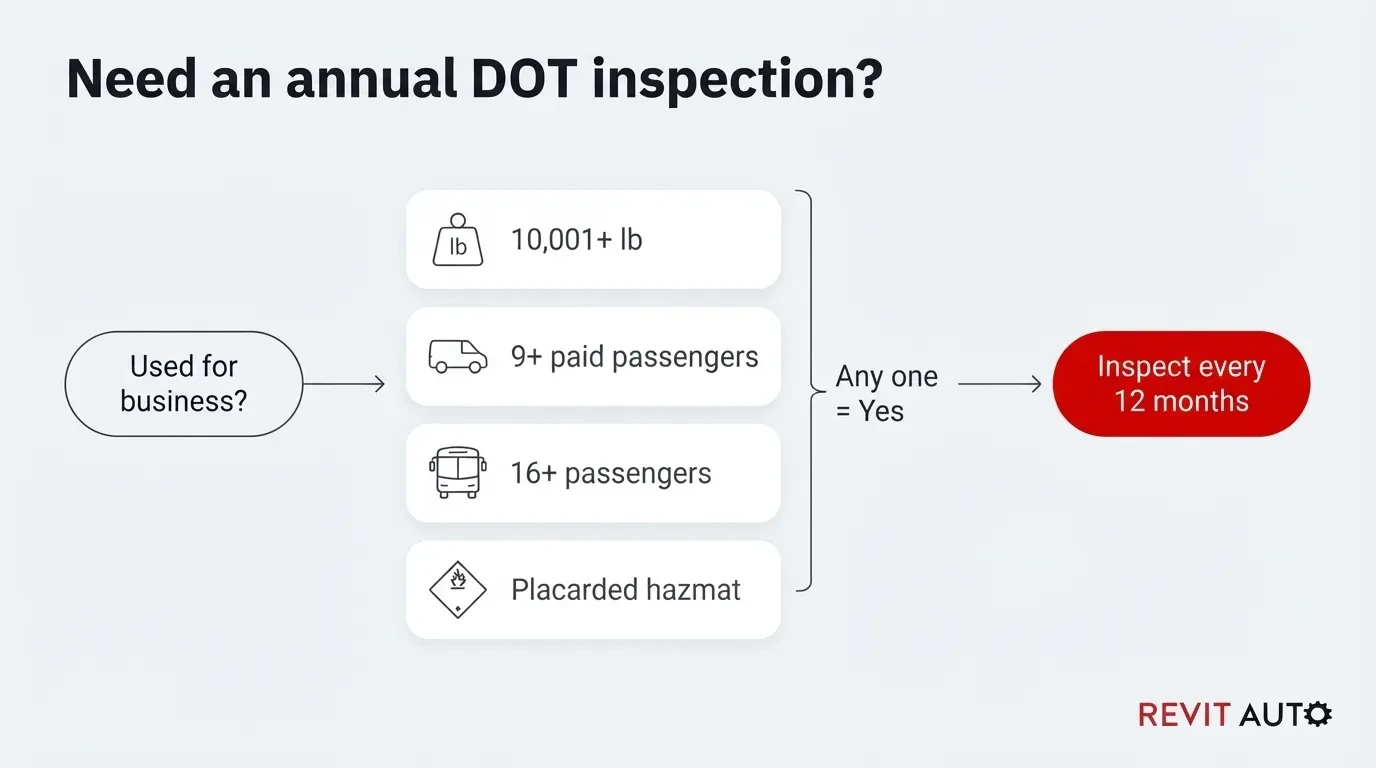
Your vehicle needs an annual DOT inspection if it’s used for business and it:
- Weighs 10,001 lb or more: by weight rating or actual weight, whichever is higher
- Carries 9 or more people for pay, including the driver
- Carries 16 or more people, paid or not, including the driver
- Hauls hazmat in amounts that need placards
That’s the federal definition of a commercial motor vehicle.
That 10,001-lb line surprises a lot of fleets. Many box trucks, service bodies, and pickups pulling trailers cross it.
Staying inside Maryland doesn't get you out of it
It doesn’t matter if your trucks never cross the state line.
Maryland applies the same federal safety rules to in-state carriers, including trailers and converter dollies.
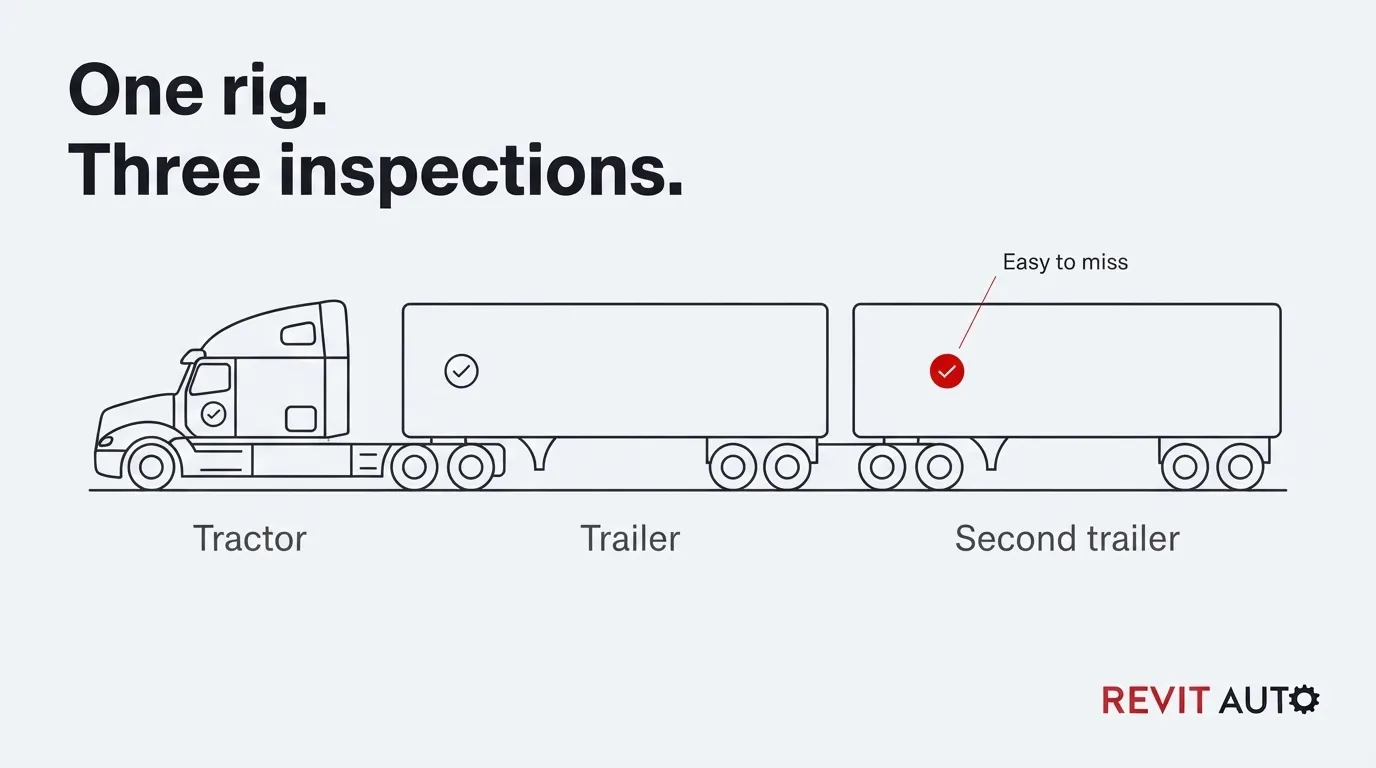
Every trailer needs its own inspection
The federal rule treats each vehicle in a combination as its own commercial vehicle.
So a tractor and semitrailer need two inspections. Add a second trailer and it’s three.
One forgotten trailer is all it takes to get cited at roadside.
Maryland's state inspection is a different thing
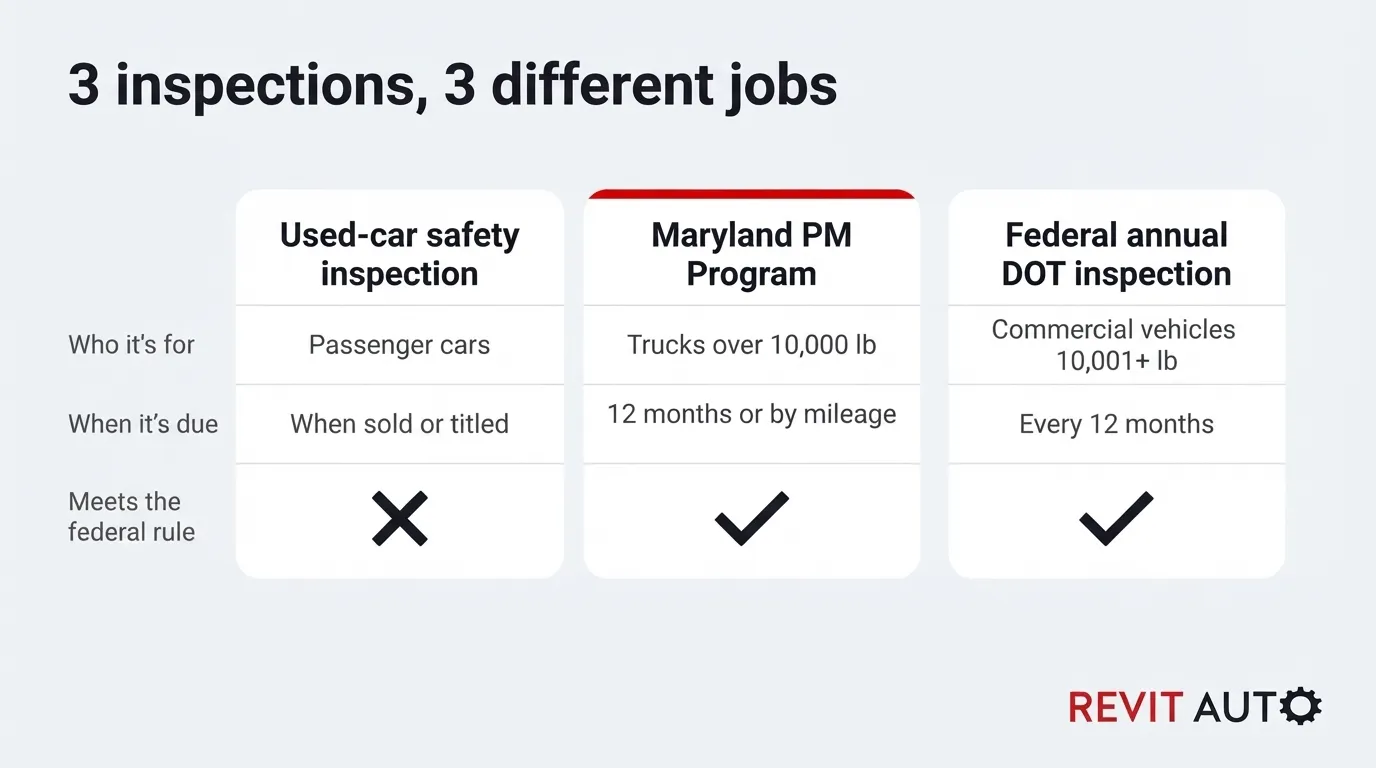
People mix these up all the time, so let’s clear it up.
The used-car safety inspection
Maryland has no yearly inspection for passenger cars.
A used car gets a one-time Maryland safety inspection before it’s titled, usually after a sale. It has nothing to do with the annual commercial inspection.
Maryland's commercial program
For commercial vehicles, Maryland runs a Preventive Maintenance Program.
It covers trucks over 10,000 lb registered weight, truck tractors, freight trailers, and larger buses.
Here’s the good news. The federal safety agency, FMCSA, listed Maryland’s program as equal to the federal one in 2008.
So one passing Maryland program inspection can count as your federal annual inspection. It’s good for 12 months, counted from the end of the month it was done.
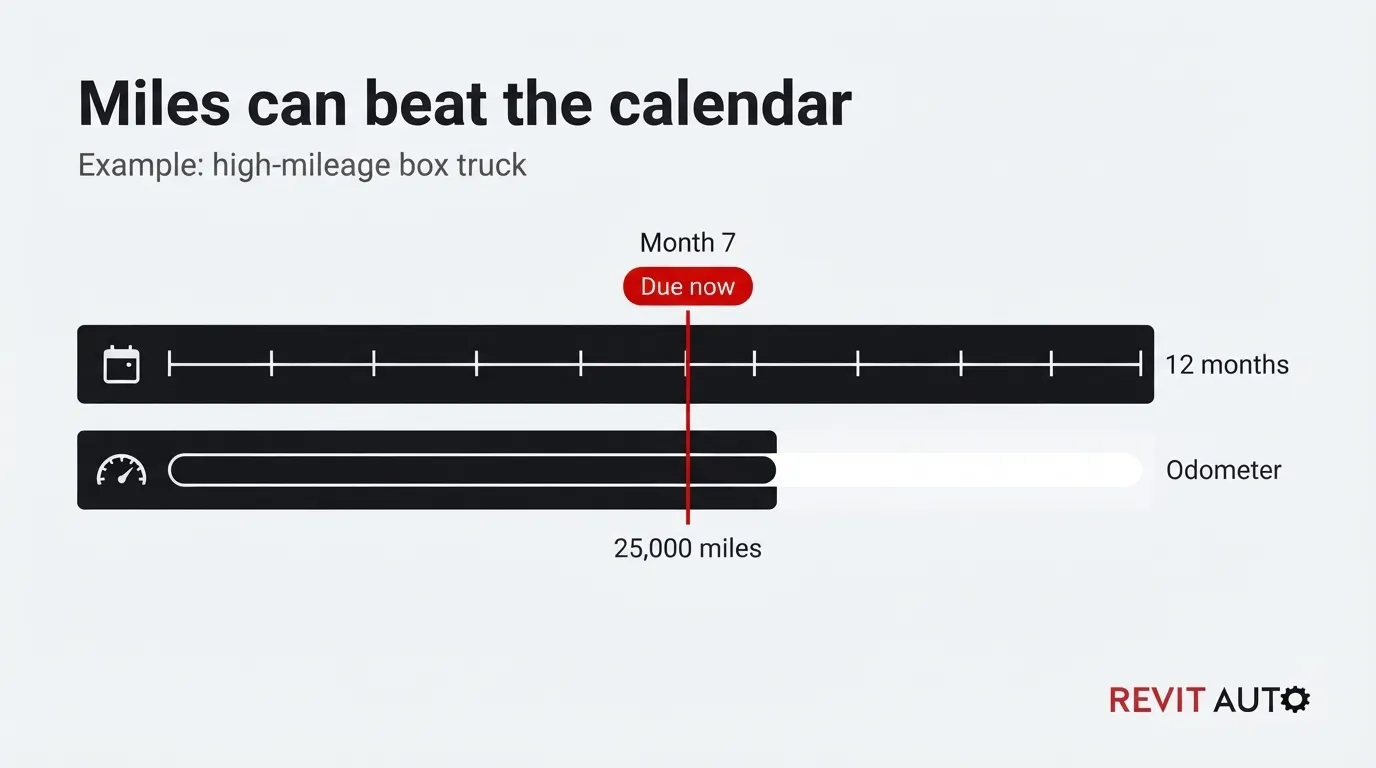
Watch the odometer, not just the calendar
Maryland’s program has its own clock, set by Maryland’s inspection-interval law.
Each vehicle is due at whichever comes first:
| Vehicle | Miles | Or time |
|---|---|---|
| Most covered vehicles | 25,000 | 12 months |
| Truck tractors, 5 years old or newer | 35,000 | 12 months |
| Zero-emission and fuel-cell trucks, 5 years old or newer | 50,000 | 12 months |
| Vehicles 18 years old or more | 12,500 | 6 months |
A high-mileage truck can come due months before its 12-month date.
The state’s older regulation still lists only the 25,000-mile rule. The newer law is the one that counts.
Trucks registered in other states still need an inspection that meets the federal rule.
What the inspection checks
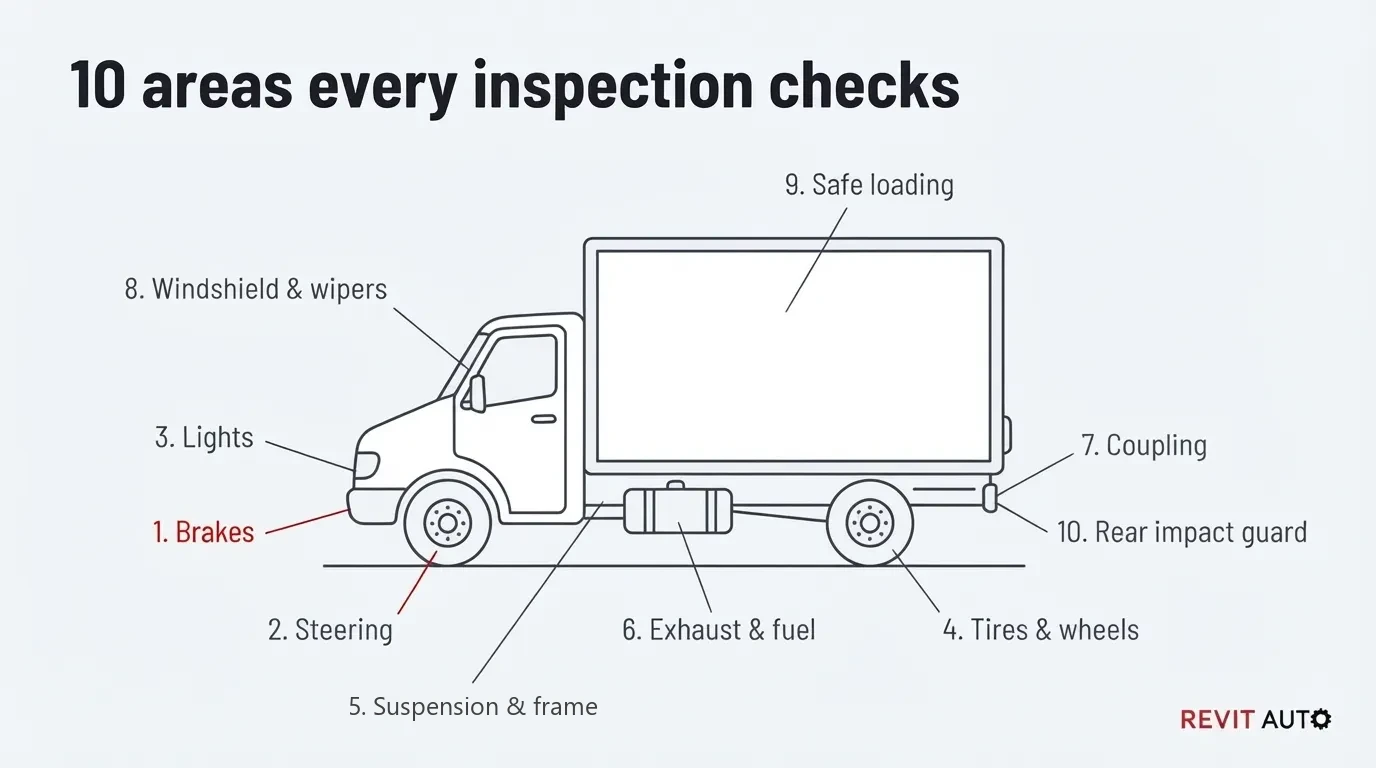
The inspector works through the federal minimum inspection standards.
If any listed defect is found, the vehicle doesn’t pass.
The systems checked are:
- Brakes
- Coupling devices
- Exhaust and fuel systems
- Lights and reflectors
- Safe loading
- Steering
- Suspension and frame
- Tires, wheels and rims
- Windshield and wipers
- Rear impact guards, plus seating on motorcoaches
These standards used to be called “Appendix G.” Older checklists may still use that name.
Brakes fail the most
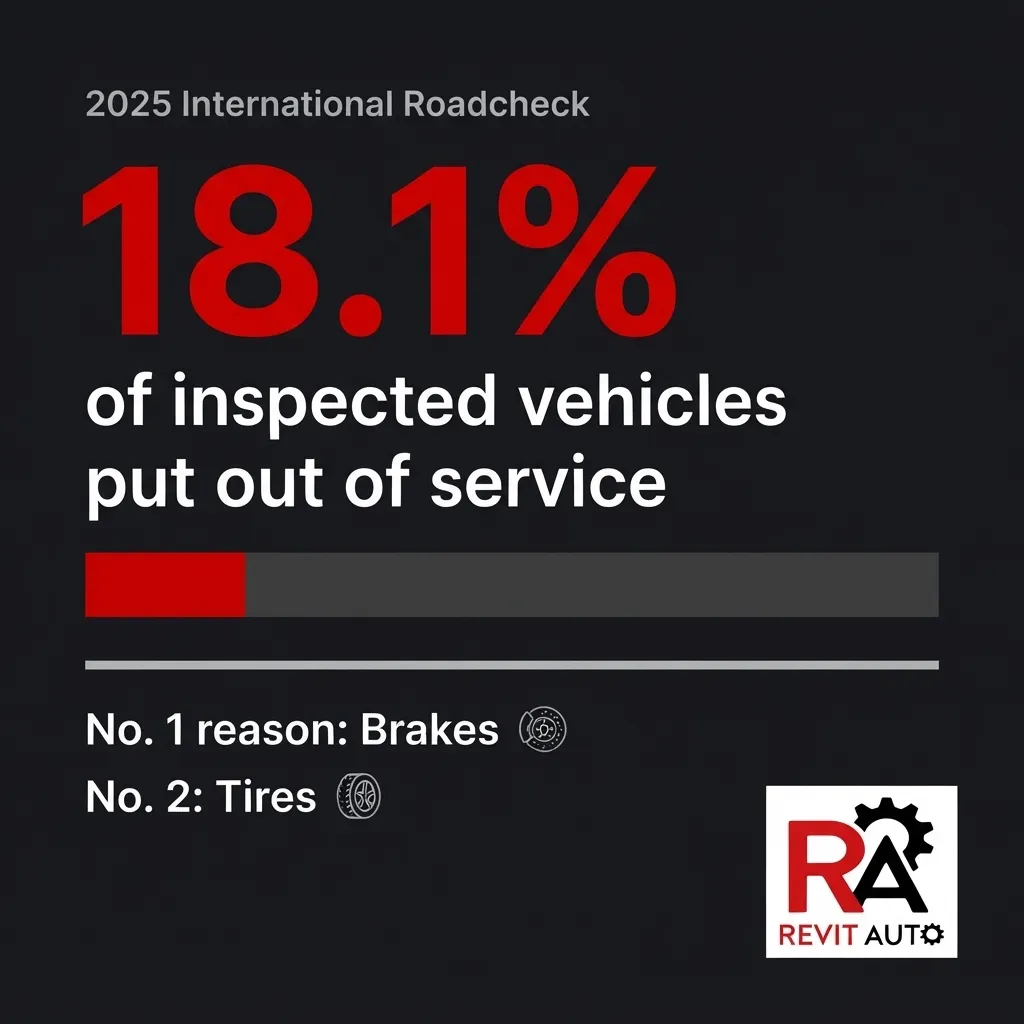
That’s from the 2025 International Roadcheck results, a yearly inspection blitz run by the Commercial Vehicle Safety Alliance.
If you only have time to check one thing before inspection day, check the brakes.
Free download: Annual DOT inspection checklist
Walk every truck through the same items the inspector will check, before they do.
Who can do the inspection?
It has to be a qualified inspector.
There’s no federal “DOT certification” for inspectors. Instead, the person must know the standards and the tools.
They also need one of these:
- A federal or state training program, or a state certificate
- At least one year of combined training and experience
The carrier must keep proof of the inspector’s qualifications. Keep it while they inspect for you, and for one year after.
What proof to keep, and for how long
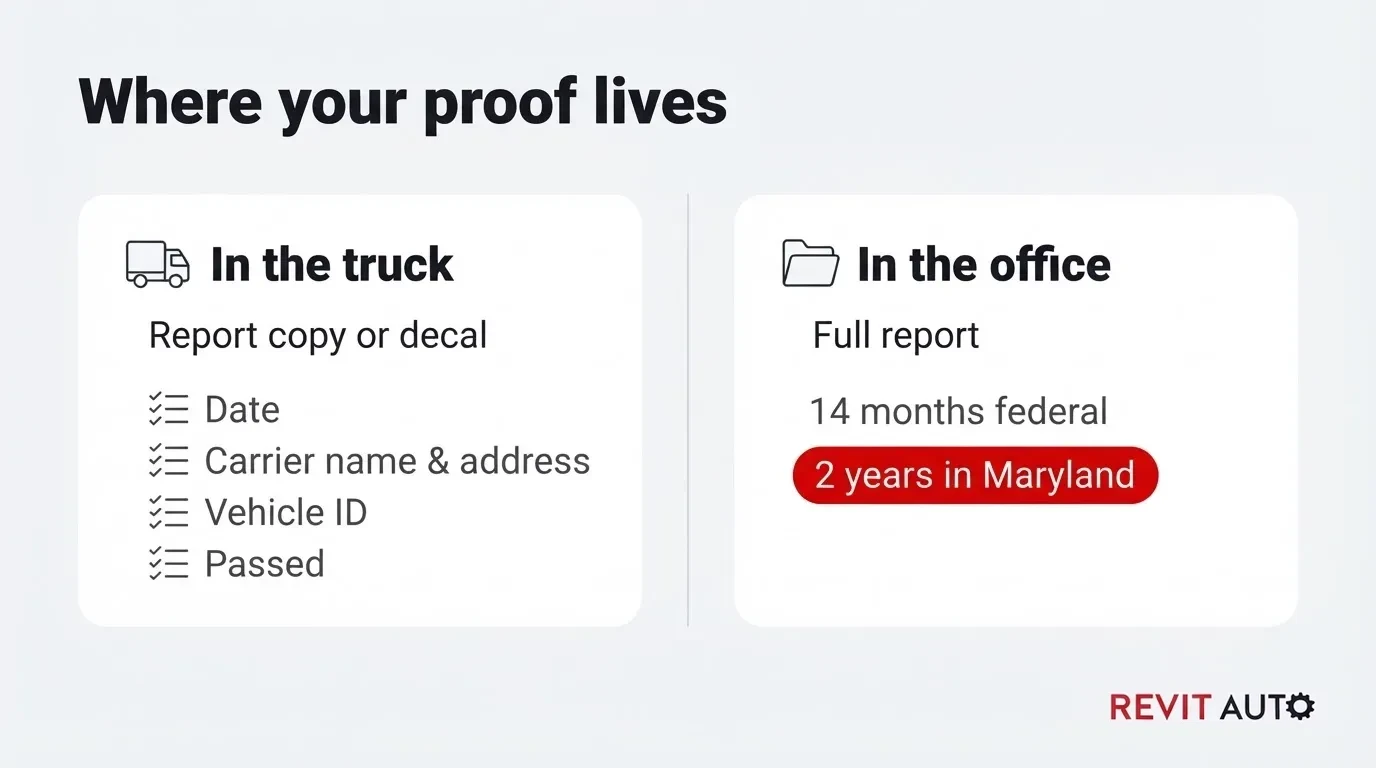
You need proof in two places.
- On the vehicle: a copy of the report, or a decal. The decal must show the date, the carrier’s name and address, the vehicle ID, and that it passed.
- On file: the full report, kept for 14 months under federal rules, where the vehicle is housed or maintained.
Maryland’s program asks for more. It requires two years of records where the vehicle is garaged or maintained.
Simple rule for Maryland fleets: keep every inspection report for two years.
What happens if an inspection is missing or expired?
A lot of guides say a missing inspection means an automatic out-of-service order. That’s not true.
An out-of-service order means the truck can’t move until the problem is fixed. Missing inspection proof almost never triggers one on its own.
The DOT’s roadside inspection data shows it clearly. From October 2023 to October 2026, officers wrote about 504,000 citations for missing inspection proof.
Only 97 of them were out-of-service violations.
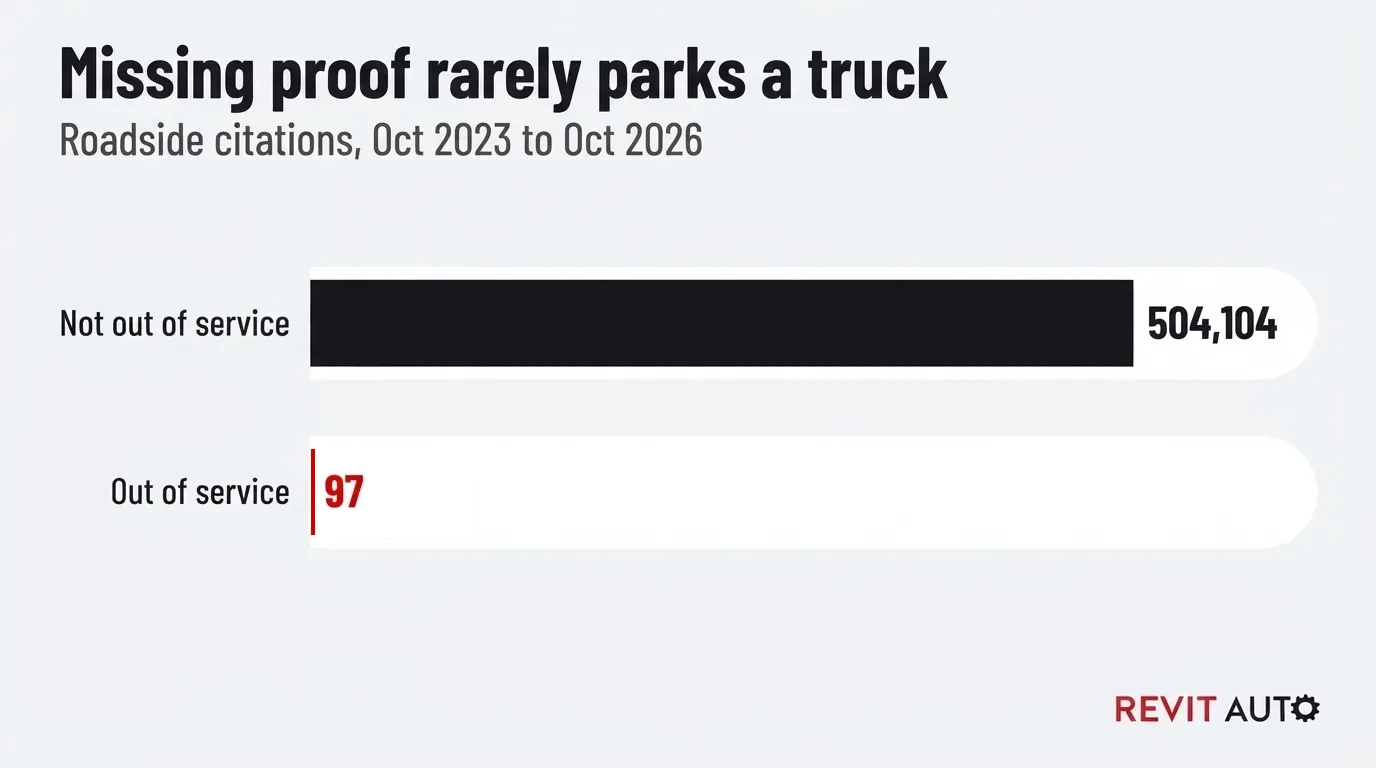
In fiscal year 2025 alone, there were about 170,000 of these citations.
It still costs you
Missing proof isn’t harmless. Here’s what can follow:
- A hit to your safety score. The violation counts against your Vehicle Maintenance score in FMCSA’s CSA program, which decides which carriers get investigated.
- A closer look at the truck. Officers often check further, and real defects found then can put the truck out of service.
- No grace period. Once 12 months pass, the vehicle can’t legally run until it passes a new inspection.
The fines
Federal fines can follow too. Under the current federal penalty schedule:
| Violation type | Maximum fine |
|---|---|
| Safety rule violation (non-recordkeeping) | Up to $19,246 each |
| Recordkeeping violation | Up to $1,584 per day, max $15,846 |
Which one applies depends on how the officer writes it up.
The fine is rarely the biggest cost. A parked truck, a missed job, and a worse safety record usually cost more.
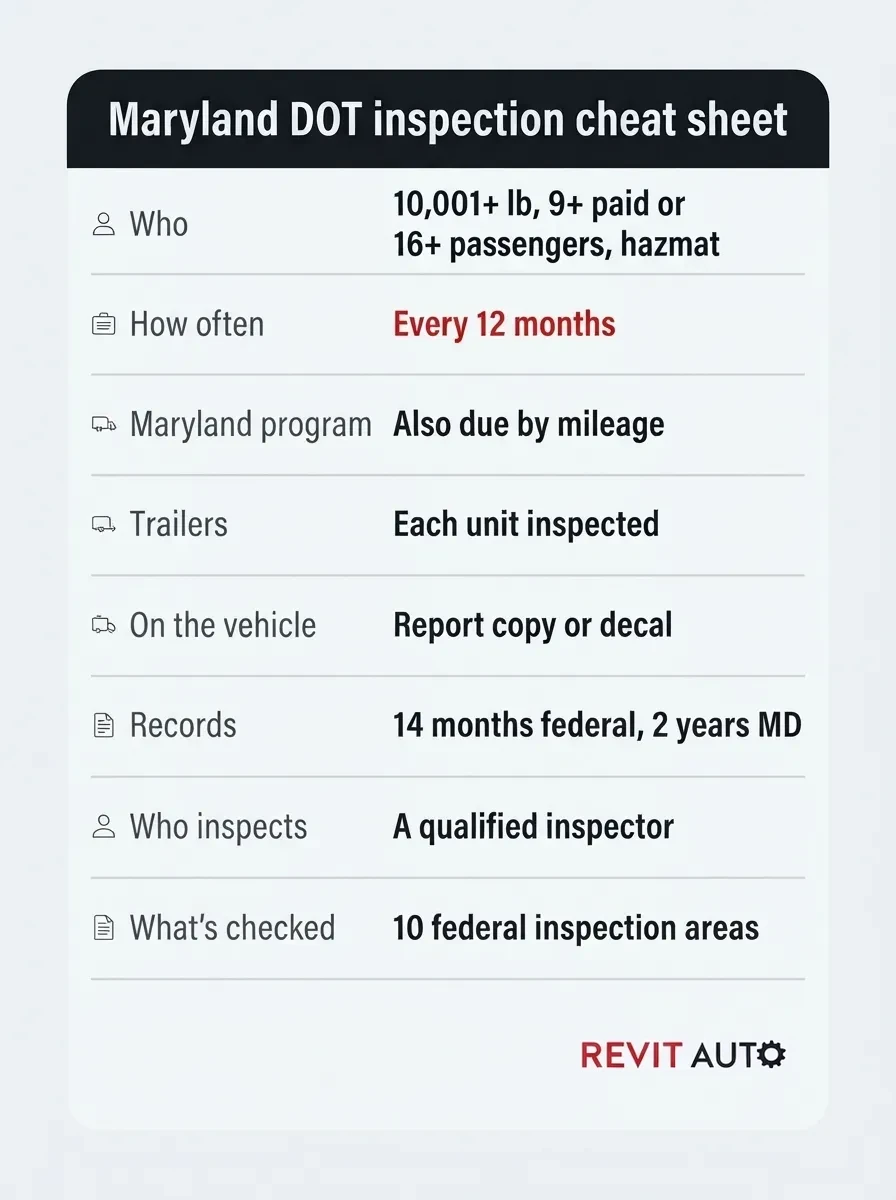
Annual inspection rules at a glance
Onsite inspection or a trip to the shop?
Most Maryland fleets choose one of two ways. They drive each truck to a shop, or they bring the inspector to the yard.
| What matters | Onsite at your yard | Driving to a shop |
|---|---|---|
| Location | Where the trucks are parked | You drive each truck in |
| Driver time | Drivers stay on their routes | One driver per trip, often hours |
| Several trucks | Done in one visit | One at a time, several trips |
| Failed items | Often fixed the same visit | May need a second appointment |
With several trucks due, the driving often costs more than the inspection.
That’s why many fleets book onsite DOT inspections at their yard.
Common mistakes that get Maryland fleets cited
- One due date for the whole fleet. Every truck and every trailer has its own clock.
- Watching the calendar, not the odometer. A high-mileage truck can hit 25,000 miles long before 12 months.
- Leaving proof in the office. The report or decal has to be on the vehicle.
- Sending out a truck with a known defect. A problem a driver already reported looks worse at roadside.
- Splitting inspection and repair. A failed item that isn’t fixed becomes the next violation. Regular on-site preventive maintenance catches most of these early.
How to prepare for a DOT inspection
- Train drivers on daily pre-trip checks. Defects get found before an officer finds them.
- Track each vehicle’s due date separately. Set a reminder a month before.
- Keep proof where it belongs. Report or decal in the truck, past reports on file.
- Fix defects before dispatch. Mobile truck repair can fix many of them where the truck is parked.
- Book inspection and repair together. A failed item shouldn’t mean a second trip.
Free tool: Maryland DOT compliance calendar
Track every truck’s and trailer’s due date, by month and by mileage, in one place.
What fleet managers say
“Revit’s service is a gem to the community and will make your commercial vehicle operation flourish. The value they provide goes far beyond other auto vendors. They will work with you to custom tailor what you need to be successful.”
Daniel Allison, Fleet Manager, 40-vehicle fleet including box trucks · ★★★★★ Google review
Revit Auto is rated 5.0 from 120 reviews on Google.
Example: six trucks due in the same two weeks
Picture a Montgomery County contractor with six trucks, all due in the same two-week window.
Sending them to a shop means six trips and a driver off the road each time. That’s days of staggered downtime.
An onsite visit works differently. A qualified inspector comes to the yard and works through all six trucks where they’re parked.
Minor brake or lighting defects get fixed the same day. The trucks go back out with fresh reports, and nobody loses a day driving to a shop.
Stay compliant without the shop runaround
Maryland’s DOT inspection requirements aren’t hard to meet with a simple system.
Track each vehicle, keep proof in every cab, and bring the inspection to your trucks.
Revit Auto performs mobile DOT inspections in Maryland at your yard. We also handle maintenance and repairs across Maryland, DC and Northern Virginia.
Free Maryland fleet compliance resources
| Resource | What it helps you do |
|---|---|
| Annual DOT inspection checklist (download) | Pre-check every truck against the inspector’s list |
| Maryland DOT compliance calendar (tool) | Track due dates by month and mileage |
| DVIR guide (guide) | Set up daily driver inspection reports |
| Maryland PM Program guide (guide) | Understand Maryland’s state inspection program |
| Hours of Service and ELD rules (guide) | Stay legal on driver hours |
Frequently asked questions
How often does a commercial vehicle need a DOT inspection in Maryland?
At least once every 12 months, under the federal annual inspection rule.
Under Maryland’s program, most vehicles are also due at 25,000 miles if that comes first. Vehicles 18 years or older are due every 6 months or 12,500 miles.
Is a Maryland state inspection the same as a federal DOT inspection?
Not always. The used-car safety inspection is a different thing.
But a passing inspection under Maryland’s Preventive Maintenance Program does count as the federal annual inspection.
What happens if my DOT inspection has expired?
You can’t legally use the vehicle until it passes a new inspection.
At roadside, expect a citation that hurts your CSA score, and maybe a fine. It’s rarely an out-of-service order by itself.
Do trailers need their own DOT inspection?
Yes. The tractor and every trailer each need their own annual inspection and their own proof.
Who is allowed to perform the inspection?
A qualified inspector who knows the standards and tools. They need training, a state certificate, or at least a year of experience.
There’s no federal “DOT certification.” The carrier must keep proof of the inspector’s qualifications.
How long do I need to keep the inspection report?
At least 14 months under federal rules. Maryland’s program requires two years, so keep them for two years.
Can Revit Auto do the inspection at our location?
Yes. We do annual DOT inspections at your yard across Maryland, DC and Northern Virginia.
We can usually fix failed items during the same visit.
Explore more compliance guides
This guide explains federal and Maryland rules for general information. It isn’t legal advice. Confirm current requirements with FMCSA or MDOT MVA before acting on them.
Sources
- Definition of a commercial motor vehicle, 49 CFR 390.5 (Cornell LII)
- Federal annual (periodic) inspection rule, 49 CFR 396.17 (Cornell LII)
- Inspector qualifications, 49 CFR 396.19 (Cornell LII)
- Inspection record retention, 49 CFR 396.21 (Cornell LII)
- Minimum periodic inspection standards, Appendix A to Part 396 (Cornell LII)
- Federal civil penalty schedule, Appendix B to Part 386 (Cornell LII)
- FMCSA list of states with equivalent inspection programs, 73 FR 63040 (Federal Register, October 2008)
- Maryland adoption of federal safety rules for in-state carriers, COMAR 11.21.01.03
- Maryland Preventive Maintenance Program coverage, COMAR 11.22.01.02
- Maryland PM Program inspection interval regulation, COMAR 11.22.01.03
- Maryland PM Program record rules, COMAR 11.22.01.04
- Maryland inspection intervals by mileage and age, Md. Transportation Code § 23-302
- Maryland used-vehicle safety inspection, Md. Transportation Code § 23-107
- DOT Vehicle Inspections and Violations dataset (codes 396.17C and 396.17C-PI, queried October 6, 2026)
- CVSA 2025 International Roadcheck results (via AMTA, October 2025)